




The Efficient ESAT Preparation Guide

UEIE Founder
Senior Oxbridge preparation mentor and Olympiad gold medal coach with nearly 20 years of international curriculum teaching experience. 55 students coached have received Oxbridge offers, with hundreds more gaining admission to G5 and Ivy League universities.
UEIE Founder
The Efficient ESAT Preparation Guide

Acknowledgements
Profound gratitude is extended to Joy, our esteemed chemistry specialist, and Sara, our distinguished biology specialist, for their invaluable contributions to the chemistry and biology sections of this ESAT preparation guide.
With the University of Oxford fully introducing the ESAT (Engineering and Science Admissions Test) for engineering, physics, and other degrees in the 2027 application cycle, it has officially converged with the University of Cambridge and Imperial College London regarding STEM admissions tests. The candidate pool is set to expand significantly, and the admission threshold for top-tier universities will inevitably rise.
In the Comprehensive ESAT Guide, I provided an in-depth analysis of the exam’s requirements, format, and scoring mechanisms. This guide, however, distils my years of practical experience coaching students for similar admissions tests and related competitions. It aims to provide you with a systematic and highly efficient ESAT preparation strategy, allowing you to comfortably cross this admissions threshold with utmost academic rigour.
I. Know Yourself and Your Enemy: Admission Data, Score Distribution, and Target Positioning
Before embarking on your ESAT preparation journey, setting goals based purely on intuition is a major pitfall. We must use objective data to pinpoint your true standing in this highly competitive arena.
1. Clarify Your Choice of Subject Modules
You need to confirm not only whether your target degree requires the ESAT, but also the specific combination of modules needed. Below are recommendations for high-frequency module combinations when applying to multiple G5 universities simultaneously (e.g., “Cambridge + Imperial + UCL”) (Note: You cannot apply to both Oxford and Cambridge in the same cycle):
| Major Category | University Combination for Application | Recommended Module Selection |
|---|---|---|
Engineering (excluding Chemical Engineering, | Cambridge + Imperial College + UCL | 1st ESAT sitting in October: |
| Cambridge + Imperial College | ||
| Oxford + Imperial College + UCL | ||
| Oxford + Imperial College | ||
| Imperial College + UCL | 1st ESAT sitting in October or 2nd ESAT sitting in January: | |
| Chemical Engineering | Cambridge + Imperial College | 1st ESAT sitting in October: |
| Oxford + Imperial College | Module Conflict, Unable to Select: Oxford requires candidates to take Maths 1 + Maths 2 + Physics, whereas Imperial College requires Maths 1 + Maths 2 + Chemistry. However, each candidate is permitted to select only three modules within a single test sitting; furthermore, candidates who sit for the first ESAT in October are ineligible to sit for the second ESAT the following January. | |
| Mechanical Engineering | Cambridge + Imperial College + UCL | 1st ESAT sitting in October: 2nd TARA sitting in January |
| Oxford + Imperial College + UCL | ||
| Imperial College + UCL | ||
| Physics | Cambridge + Imperial College | 1st ESAT sitting in October: |
| Oxford + Imperial College | ||
Biology & Life Sciences | Cambridge + Imperial College | 1st ESAT sitting in October: |
| Oxford + Imperial College |
2. Analyse Admission Data and the True "Safety Line"
Synthesising historical data, the offer rates for Engineering and Physics (Natural Sciences) degrees at Oxford and Cambridge typically fluctuate between 10%-25%. This means that if you want to hold the initiative in your application, your admissions test score must be firmly rooted within the top 25% globally.
The text below details the admission numbers and distributions for Oxbridge engineering and sciences.
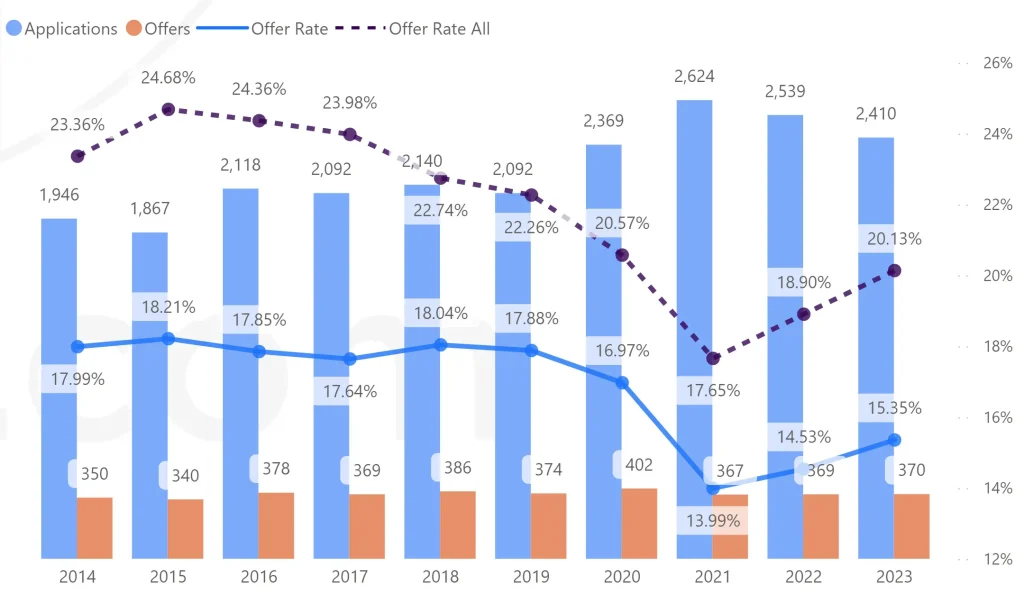
Engineering Admissions Data at Cambridge during 2014–2023 Application Cycles
(Plotted by UEIE based on official data)
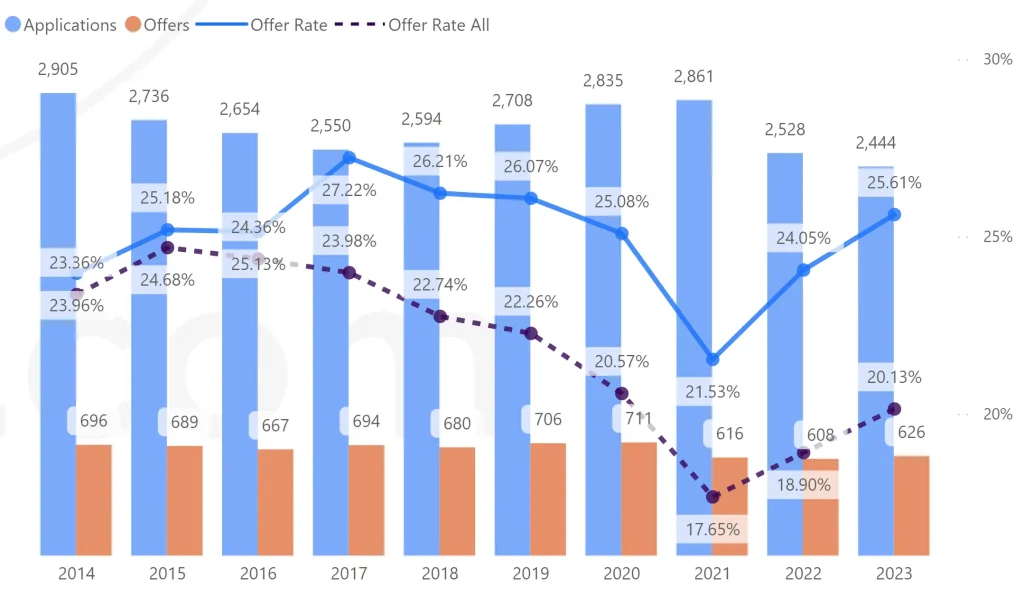
Natural Sciences Admissions Data at Cambridge during 2014–2023 Application Cycles
(Plotted by UEIE based on official data)
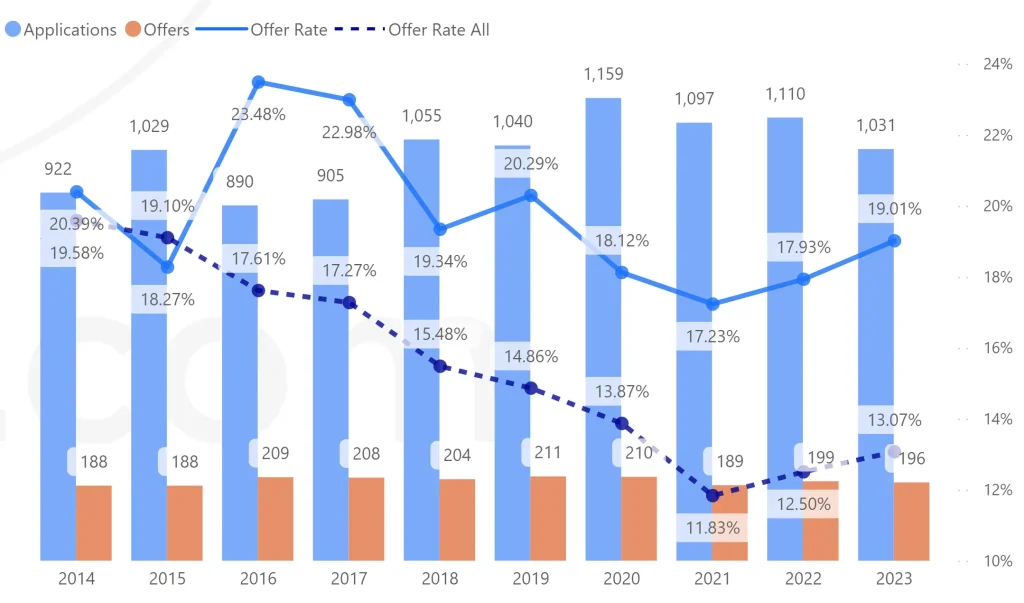
Engineering Science Admissions Data at Oxford during 2014–2023 Application Cycles
(Plotted by UEIE based on official data)
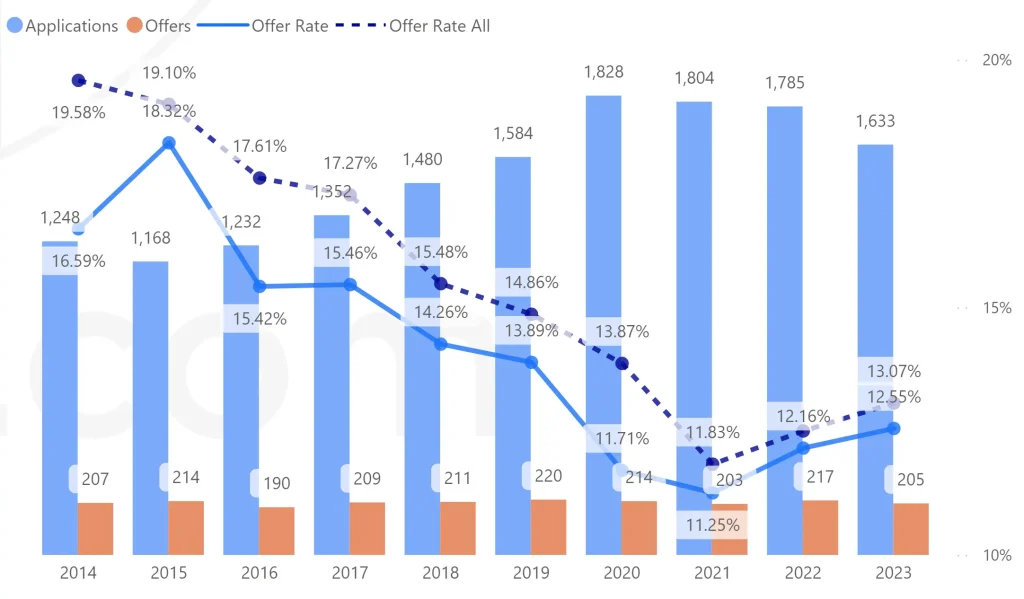
Physics Admissions Data at Oxford during 2014–2023 Application Cycles
(Plotted by UEIE based on official data)
According to the official October 2025 score distribution data released by UAT-UK: the top 10% of global candidates achieved a score of 7.0, while the median was anchored at 4.5. Based on the distribution charts, the score range for the top 25% lies approximately between 5.6-6.0.

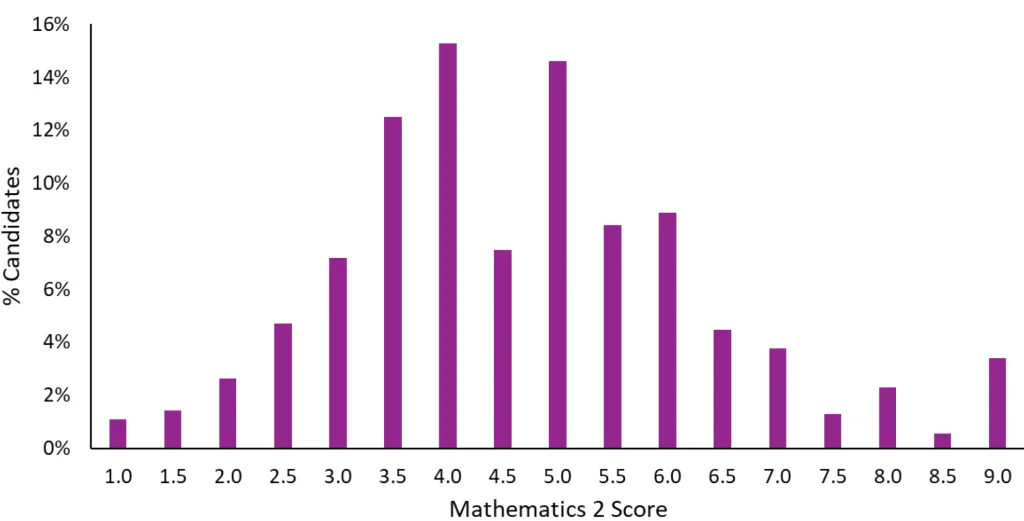
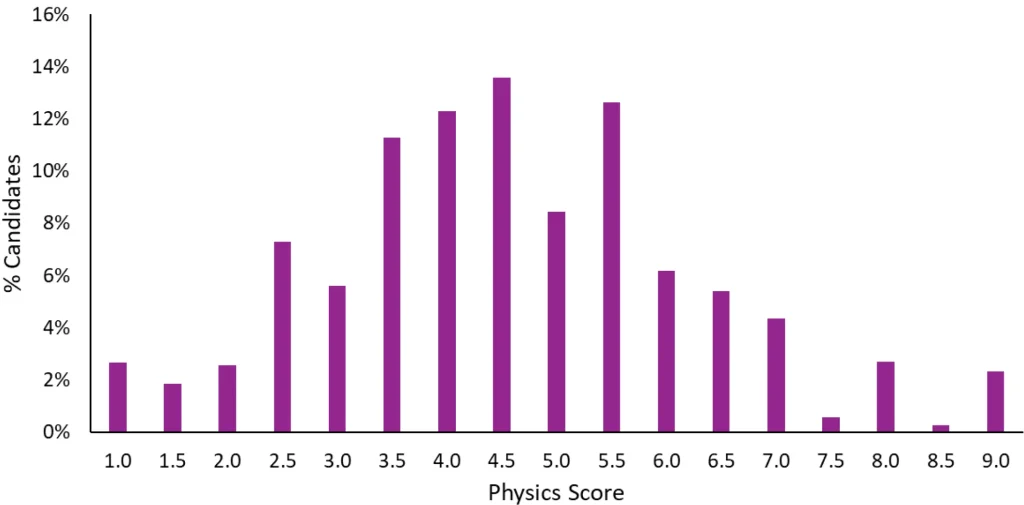


Global Score Distribution for the Five ESAT Modules — October 2025
(Screenshot from the Official UAT-UK Report)
However, this is merely a “passing line” from a global average perspective; for highly competitive Chinese candidates, this score is far from safe.
Comparison of ESAT Module Scores: Chinese vs. UK Candidates (2024/25 Application Cycle)
| Module | Chinese Candidates (Top 10%) | Chinese Candidates (Top 25%) | UK Candidates (Top 10%) | UK Candidates (Top 25%) |
|---|---|---|---|---|
| Maths 1 | 8.5 | 7.1 | 5.6 | 4.8 |
| Maths 2 | 8.2 | 6.8 | 5.7 | 5.0 |
| Physics | 8.0 | 6.8 | 6.0 | 5.0 |
| Chemistry | 8.2 | 6.8 | 6.2 | 5.2 |
| Biology | 7.6 | 6.4 | 7.0 | 5.4 |
* Source: UAT-UK Official Report
As clearly illustrated in the table above, there is a staggering, asymmetric gap between the scores of candidates from the two countries. Taking Mathematics 1—the foundational bedrock of all disciplines—as an example, the discrepancy between the top 25% in China and the UK is an astonishing 2.3 points. The top 10% threshold for Chinese candidates has been driven up to 8.5. Consequently, the “safety line” for Chinese candidates must be significantly adjusted upwards; striving for zero margin of error in the Mathematics 1 module is the absolute foundation for standing your ground.
3. Diagnostic Exam and Target Anchoring
Why perform an assessment?
Because the ESAT is a computer-based test, taking a diagnostic exam (mock test) before officially starting your preparation is particularly crucial. This will help you:
- Experience the real exam environment
Familiarise yourself with the online testing platform’s interface and question presentation, alongside the intense time pressure of completing 27 multiple-choice questions within 40 minutes per module. This may expose weaknesses in your mental arithmetic without a calculator. - Assess your current standing in each subject
Form a baseline judgment of your knowledge mastery, problem-solving speed, and accuracy in the compulsory Mathematics 1 and your two elective modules, identifying the primary gaps between your current level and the exam requirements.
How to choose assessment tools?
Past ESAT papers have never been publicly released. Currently, the official UAT-UK body has only published specimen papers and practice questions, but the difficulty of these specimen papers is significantly lower, making it impossible to accurately assess your true level. To address this, our UEIE research and development team has developed a set of Free ESAT Diagnostic Exam, complete with an online computer-based testing system that replicates 99% of the official interface.
Aligned with the latest ESAT syllabus, this diagnostic exam is designed to evaluate the core knowledge and abilities required for the ESAT more effectively. According to authentic feedback from past students, the difficulty of this paper is slightly higher than that of the 2024 and 2025 past questions. However, this does not prevent us from deriving an objective and reasonable score conversion curve based on global candidate data, thereby helping applicants better determine their position among worldwide peers.
Click the link below to learn more about the diagnostic exam and complete them online:
Free ESAT Diagnostic Exam
Of course, you can also use past ENGAA/NSAA papers for ESAT preparation. However, while these past papers can verify your mastery of the relevant knowledge, they cannot fully simulate the online testing format, interface, and computer-based timing rules of the ESAT. Furthermore, you must pay close attention to syllabus alignment.
What is the self-assessment process?
- Strictly time each module independently for 40 minutes, and complete your chosen combination of modules consecutively.
- Complete the test on a computer with a strict ban on calculators, using only pen and paper for rough working.
- Check your answers against the solutions or system scoring to objectively evaluate your performance in each module (ideally converting it into a reported score between 1.0-9.0).
- Critically analyse the reasons behind your mistakes: Are they due to missing knowledge points? Clear misconceptions? Calculation errors? Misinterpretations in reading comprehension? Poor time allocation? Or a lack of test-taking techniques?
- Record the weak areas in each subject to serve as the primary focus for your subsequent ESAT preparation.
4. Setting a Scientific Target for ESAT Preparation
Equipped with an awareness of your target requirements and your own starting point, the next step is to set a score anchor that suits you. You can refer to the competitiveness ladder model below to establish a reasonable ESAT preparation target based on your diagnostic exam score.
| Report Score | Global Ranking | Tier | Admission Prediction |
|---|---|---|---|
| 8.5 | Top ~3% | Grandmaster | Extremely high probability of Oxbridge admission, allowing you to secure for admission based on academic results alone. |
| 8.0 | Top ~5% | Master | Above average probability of Oxbridge admission, with distinct advantages. |
| 7.5 | Top ~7% | Diamond | Relatively low probability of Oxbridge admission, but high chances for Imperial College London. |
| 7.0 | Top ~10% | Platinum | Still stand a chance of Oxbridge admission, for those who are exceptionally lucky or deliver a truly outstanding performance in the interview. |
| 5.5 | Top ~25% | Gold | Basic G5 competitiveness, most likely to get interview offer for Oxbridge admission. |
| 4.5 | Top ~50% | Silver | Moderate competitiveness, at a relative disadvantage among applicants to top-tier universities. |
*The analysis presented above reflects the experienced academic perspectives of Mr. Xie Tao and does not constitute an official guarantee of university admission.
It is worth noting that your score anchor should be challenging enough to unlock your potential, yet realistic enough to avoid unnecessary anxiety.
II. Required Knowledge Base for ESAT Preparation
Having clarified your goals, the second step is to take stock of your academic arsenal. Accurately grasping the requirements of the ESAT syllabus and seamlessly integrating them with your existing curriculum is the key to efficient test preparation.
1. Scope of the Examination Syllabus
- Knowledge Foundation
The ESAT syllabus is broad, drawing primarily from the core knowledge of UK A-Level (or equivalent qualification) Mathematics, Physics, Chemistry, and Biology. It assumes candidates already possess a solid GCSE (or equivalent level) foundation in the respective subjects. - Exclusion of Further Content
The syllabus does not include A-Level Further Mathematics or any Physics, Chemistry, or Biology content that extends beyond the standard A-Level scope.
2. Overview of Core Content across Subject Modules
The following outlines the primary areas of knowledge covered by each module:
- Mathematics 1
Basic arithmetic and number theory concepts, units, ratios and proportions, algebra (including equations, inequalities, polynomials), planar and coordinate geometry, basic statistics and probability. (Roughly corresponds to GCSE and parts of A-Level Mathematics content) - Mathematics 2
Advanced algebra and functions (including polynomials, modulus functions, mappings), sequences and series, coordinate geometry (including parametric equations, foundational conic sections), trigonometry (including compound angles, double angles, trigonometric equations/inequalities), exponential and logarithmic functions, calculus (differentiation, integration for area/volume), and the application of calculus to curve sketching. (Roughly corresponds to AS-Level Mathematics and parts of A2 Pure Mathematics content) - Physics
Electricity (circuits, electric fields), foundational magnetism, kinematics, Newton’s laws, energy and momentum, circular motion, moments, foundational thermal physics, properties of matter, waves (including basic optics), atomic physics and radioactivity. (Roughly corresponds to AS-Level and parts of A2 Physics core content) - Chemistry
Atomic structure and periodicity, stoichiometry and equations, redox reactions, chemical bonding and structure, states of matter and particle theory, main group chemistry, separation techniques, acids, bases and salts, reaction rates, foundational chemical thermodynamics, foundational electrochemistry, core organic chemistry, metals and their reactivity, air and water, and foundational chemical analysis. (Roughly corresponds to AS-Level and parts of A2 Chemistry core content) - Biology
Cell structure and function, biological molecules, enzymes, cellular transport, cell division and inheritance, DNA and gene technology, variation and evolution, animal physiology (respiration, circulation, digestion, nervous and endocrine systems, etc.), plant physiology, and ecosystems. (Roughly corresponds to AS-Level and parts of A2 Biology core content)
3. Knowledge Integration and Recommendations for Different Curricula
Natural knowledge gaps exist across different educational curricula. It is imperative to conduct a thorough, line-by-line comparison against the ESAT syllabus before your preparation:
ESAT Module
A-Level
AP
IB
Chinese High School Curriculum
Mathematics 2
Strictly circumscribed by the A-Level Mathematics syllabus.
Calculus AB/BC addresses calculus; supplementary revision of non-calculus elements from Pre-Calculus, such as algebra, functions, trigonometry, and coordinate geometry, is requisite.
DP Mathematics SL (Analysis and Approaches / Applications and Interpretation) generally encompasses the requisite topics; HL knowledge is not deemed essential.
High school mathematics (New Textbook: Compulsory + Selective Compulsory) covers most knowledge; foundational calculus must be covered via electives or self-study.
Physics
Typically necessitates prospective study of certain A2 components (e.g., thermal physics, wave phenomena, modern physics). Specific topics previously encountered at GCSE/IGCSE level will be assessed according to A2 standards.
Physics C (Mechanics + Electricity & Magnetism) or a synthesis of Physics 1 and 2 affords extensive coverage, yet meticulous cross-referencing with the syllabus is imperative; supplementation may be required (e.g., waves, thermal physics, modern physics, elementary astronomy).
DP Physics HL Core provides substantial coverage; proactive study of pertinent HL physics topics stipulated by the syllabus is advisable (Optional topics are not required); particular attention should be devoted to enhancing calculus-based physics calculation proficiency.
The physics elective combination (e.g., the physics track in the “3+1+2” system) covers most mechanics and electricity knowledge. Waves, thermal physics, modern physics, and calculus-based calculations are relatively weak and require targeted reinforcement.
Chemistry
Subsequent to AS completion, further A2 content requires supplementation, notably in domains such as the structure of matter, chemical principles (kinetics, equilibrium, energetics), and core organic chemistry.
AP Chemistry generally furnishes sound coverage of ESAT topics; nonetheless, a granular, item-by-item verification against the syllabus details is strongly recommended.
DP Chemistry SL addresses a broad spectrum of topics, but relevant HL topics concerning structure, principles, organic chemistry, etc., necessitate supplementation in alignment with the syllabus. Diligence regarding the pace of study is crucial.
Completing high school chemistry (New Textbook: Compulsory + Selective Compulsory) covers most test points, but parts of organic chemistry and experimental analysis need to be supplemented. Concurrently, reinforce relevant English technical terms.
Biology
AS-level knowledge accounts for most content, but due attention must be paid to the breadth and depth stipulated by the syllabus. Particular emphasis should be placed on fortifying experimental analysis skills and the application of mathematical principles within a biological context.
AP Biology provides comprehensive coverage, but dedicated focus should be directed towards the cultivation of experimental analysis skills and mathematical application capabilities, as the emphasis herein may subtly diverge from that of the ESAT.
DP Biology HL offers extensive coverage; a strengthening of physiological knowledge is required, alongside an enhancement of experimental analysis capabilities and mathematical reasoning in the context of biological problem-solving. Prudent management of the study pace is essential.
After completing high school biology (New Textbook: Compulsory + Selective Compulsory), you primarily need to strengthen scientific inquiry (experimental analysis) capabilities and adapt to reading comprehension and technical vocabulary in an English environment.
4. An Objective View on Competition Experience
If you have experience preparing for top-tier Olympiads such as the BPhO or UKChO, this will undoubtedly provide tremendous support regarding logical rigour, stress resilience, and problem-solving flexibility. However, please remember that the ESAT is not an Olympiad. Do not get bogged down in excessively complex derivations that go beyond the syllabus. During your preparation, you must rein your mindset back into the foundational ESAT syllabus, translating the acuity cultivated through competitions into an optimal multiple-choice strategy geared towards an average pace of “one and a half minutes per question”.
III. ESAT Preparation Strategies and Timeline Planning: Core Capability Remodelling and Advancement Pathways
Mastering the examination syllabus is merely securing your entry ticket. In the real exam hall, what ultimately decides victory or defeat is rarely whether you know how to do a question, but whether you can do it correctly and swiftly under extreme pressure. This demands that we shift our focus during ESAT preparation away from pure knowledge acquisition and towards remodelling core test-taking capabilities.
1 Strategies for Enhancing Core ESAT Capabilities
To survive the extreme intensity of averaging less than 1.5 minutes per question, you must achieve the following:
- Deeply understand core concepts and apply knowledge flexibly
You cannot settle for superficial memorisation of formulae and definitions. Instead, you must thoroughly understand the physical, chemical, or biological principles—or the mathematical logic—behind each knowledge point, alongside its operational boundaries. Furthermore, you should be able to connect seemingly isolated concepts and apply them flexibly within the novel contexts presented in questions, swiftly constructing correct problem-solving models or approaches. This forms the foundation for quickly identifying what a question is testing and eliminating distractor options. - Wean yourself off calculator dependency and rebuild your mental arithmetic instincts
Calculators are strictly prohibited throughout the entire ESAT. Students accustomed to relying on tools within the A-Level or AP systems must deliberately train their mental and written calculation skills. Thoroughly transforming common formulae, algebraic manipulations, equation solving, and order-of-magnitude estimations into second nature is the only way to avoid running out of cognitive processing capacity in the exam room. - Extreme decision-making under 90 seconds and the “philosophy of skipping questions”
You must handle 27 multiple-choice questions within 40 minutes. Under such oppressive pressure, stubbornly fixating on a single question is a fatal error. You must possess sharp, rapid decision-making skills: quickly extract core information from the stem, and decisively employ techniques like dimensional analysis, substituting special values, or analysing extreme cases to narrow down the options. The moment you get stuck, immediately mark the question and skip it—preserving your total number of correct answers is the core principle of achieving a top score.
2. Core Factors Influencing the ESAT Preparation Cycle
The duration of your ESAT preparation primarily depends on:
- Target Score
Aiming for top score bands in each module demands more refined polishing. - Starting Level
Your current mastery of relevant subjects, calculation speed and accuracy, and adaptation to the online multiple-choice format. - Number of Preparation Subjects
The total number of ESAT modules needed for your preparation (typically three). - Weekly Effective Study Time
How many hours you can consistently dedicate to focused, highly efficient ESAT preparation. - Learning Efficiency
The rate at which you absorb knowledge and master new skills.
3. The June-to-October Golden Preparation Timeline for ESAT
The timeline outlined below is suitable for the majority of candidates, though you may adjust it to establish a pragmatic ESAT preparation timeframe tailored to your personal circumstances.
Jun–Jul
Clear | √ Familiarise with the Syllabus; Organise Knowledge
Systematically and comprehensively organise all knowledge points on the syllabus by category and topic. You must not only remember formulae but also understand their derivation, basic principles, and common question patterns, while beginning to accumulate problem-solving techniques. |
|---|---|
Jul–Aug
Increase Speed | √ Intensive Practice; Internalise Knowledge
This is the watershed! Relying solely on lessons will not achieve internalisation. This must be coupled with high-quality practice, and the difficulty of the questions must be moderate: slogging through overly difficult problems wastes time and damages confidence, while simple questions fail to identify gaps. Furthermore, to cope with CBT pressure, all practice must be completed under timed conditions. |
Sep–Oct
Pursue Precision | √ Full Mock Exams; Develop Instincts
In a highly simulated computer-based environment, become familiar with the countdown rhythm and optimise time management and question-skipping strategies. Through high-quality mock training, develop an instinctive response to various “trap” questions, ultimately improving accuracy under extreme time pressure. |
4. Common ESAT Preparation Pitfalls and Strategies
In the course of coaching students for the ESAT preparation, I have observed several widespread pitfalls that severely undermine preparation efficiency and final outcomes. Proactively identifying and avoiding them will allow you to achieve twice the result with half the effort.
Pitfall 1: Starting Too Late, Lacking or Having Inadequate Planning
- Manifestation & Consequences
Underestimating the workload of multi-subject ESAT preparation (typically three modules) and the demands placed on various skills (especially speed), leading to delayed preparation right before the exam; or having unclear planning, failing to allocate time reasonably across different ESAT modules and preparation stages. - Strategy
Fully recognise the complexity and long-term nature of ESAT preparation and kick off early. Devise a detailed, staged preparation plan tailored to the specific characteristics of each module, and execute it rigorously.
Pitfall 2: Overlooking Online Characteristics, Detaching Practice from Reality
- Manifestation & Consequences
Relying primarily on paper-based materials for ESAT preparation, lacking sufficient practice on online platforms. Candidates remain unfamiliar with reading, answering, flagging, and navigating in an online environment, and fail to target their calculation speed and techniques without a calculator. This leads to clumsy operation, trailing behind the clock, and frequent calculation blunders in the actual exam hall. - Strategy
The mid-to-late stages of ESAT preparation must pivot heavily towards online practice and simulations. Frequently utilise official practice tools alongside high-quality online mock exams (such as UEIE mock exams); treat non-calculator operations as a dedicated skill to be trained deliberately and continuously.
Pitfall 3: Underestimating Multiple-Choice Questions, Lacking Strategies and Techniques
- Manifestation & Consequences
Dismissing multiple-choice questions as simple, thereby disregarding strategic methods and techniques; lacking an awareness of time management, with a pacing far slower than the required average of 1.5 minutes per question; and lacking proficiency in analysing options, eliminating distractors, or making strategic guesses. - Strategy
Treat multiple-choice exam techniques as an essential component of your studies. Conduct extensive timed multiple-choice drills to cultivate a sense of pace and precision. Repeatedly rehearse time allocation and answering strategies during mock exams.
Pitfall 4: Chaotic Use of Resources, Lagging Information
- Manifestation & Consequences
Blindly grinding through questions, particularly using old ENGAA/NSAA papers without discrimination, while overlooking differences in syllabus matching and formatting; failing to follow the latest announcements and official resource releases on the UAT-UK website; hoarding vast amounts of materials without utilising them deeply. - Strategy
Anchor your core focus around the official syllabus and official practice resources; use past papers critically; select high-quality supplementary resources (such as the UEIE Self-Study Kit, Isaac Physics, etc.); and regularly check the official website to secure the latest updates.
Pitfall 5: Unbalanced Mindset, Stress Overload
- Manifestation & Consequences
Experiencing excessive anxiety over multi-subject ESAT preparation and high-speed pacing requirements; falling into self-doubt or even giving up when mock results are underwhelming or when encountering a bottleneck; suffering from extreme pre-exam nerves that impair performance. - Strategy
Set realistic goals and accept challenges and setbacks; focus on the process and incremental progress; learn to relax and recalibrate, balancing work and rest; build self-confidence, and trust the value of your hard work.
IV. Efficient Utilisation of ESAT Preparation Resources
Having mapped out the timeline and pitfall-avoidance strategies, the final piece of the puzzle in implementing your ESAT preparation is leveraging high-quality resources to fill the vacuum left by the absence of official past papers. Faced with an admissions test that offers an exceptionally low margin for error, blindly grinding through questions will only yield half the result for twice the effort. What you need is a scientific ESAT preparation scheme that directly targets the pain points of computer-based testing.
1. Official Cornerstone Resources
You can access the most essential foundational ESAT preparation materials on the official UAT-UK website:
- The latest version of the ESAT examination syllabus.
- Official specimen papers and practice materials.
- Examination guides and FAQs.
- Past papers of the ESAT’s predecessors, the ENGAA and NSAA exams (2016–2023).
2. UEIE's Exclusive "Learn-Practise-Test" All-In-One Matrix
Meticulously crafted by our research and development team, the UEIE ESAT On-Demand Prep Suite undergoes rigorous annual revisions based on the latest exam trends, perfectly encompassing the core closed-loop of scientific preparation:
Say goodbye to fragmented learning. Let top tutors guide you through a systematic review of core tested points. The courses strictly maintain academic rigour, deeply breaking down anti-routine, highly efficient problem-solving techniques.
A question bank scientifically stratified by topic and difficulty. Through a vast volume of high-quality, targeted, and timed drills, it helps you completely wean off calculators and build muscle memory for extreme mental arithmetic and rapid decision-making.
Developed with immense effort, these online mock tests replicate 99% of the official computer-based testing environment. They restore the genuine exam interface and the high-pressure countdown experience, ensuring you firmly occupy a top tier in actual combat.
3. Advanced Learning and Systematic Planning
Beyond the on-demand suite, if you require supervision from master tutors and personalised module diagnostics, UEIE also offers systematic group classes on a rolling basis throughout the year. For students getting ready for the ESAT preparation, we have mapped out a structured teaching and reinforcement closed loop to ensure that under high-intensity academic training, candidates’ foundational knowledge base remains rock-solid.
ESAT Preparation Programme (October 2026 Sitting)
Conclusion
The ESAT is an exceptionally objective touchstone. It filters away superficial packaging, identifying only those scientific minds that can maintain mathematical and logical fluency under extreme pressure. Having clarified your score positioning and mastered the timeline and study methodologies, the single most critical step forward is immediate action.
May this ESAT preparation guide help you pinpoint your coordinates within this brand-new standardised testing system, serving as a steadfast signpost as you scale the peaks of Oxford, Cambridge, and the G5.
Follow Us on Wechat