
Tag: TMUA

  • TMUA vs MAT Synergy: An Efficient Strategy for Joint Preparation

    TMUA vs MAT Synergy: An Efficient Strategy for Joint Preparation

    I. TMUA vs Oxford MAT: Why Are They So Often Mentioned Together?

    Prospective students and parents targeting mathematics, computer science, economics, or other sought-after degree programmes at Oxbridge or other G5 universities will likely be familiar with the TMUA and the Oxford MAT (hereafter MAT) – two key mathematics admissions tests. Astute parents and students may have already spotted a crucial distinction: TMUA vs MAT — one examination (TMUA) is composed entirely of multiple-choice questions, while the other (MAT) features both multiple-choice and extended-response questions. These are fundamentally different examinations, so why are they often mentioned in the same breath, or even recommended for concurrent preparation? Could this approach dilute one’s focus?

    This is an exceedingly common and pertinent query. This article aims to demystify the situation by directly comparing the TMUA and MAT, thereby revealing their ‘intrinsic connection’. I will explain why, for many students, preparing for these two examinations in tandem is, in fact, a more astute and efficient strategy – one capable of producing a synergistic effect greater than the sum of its parts (a ‘1+1>2’ outcome) – and will outline a clear and practical path to achieve this.

    II. TMUA vs MAT: A Table for Understanding Core Similarities and Differences

    First, let us consolidate the key information for the TMUA and MAT into a table, enabling you to discern their most crucial similarities and differences at a glance:

    Dimension TMUA Oxford MAT
    Managing Body UAT-UK University of Oxford
    Exam Delivery Partner Pearson VUE Pearson VUE
    Response Format Online, computer-based Online, computer-based
    Question Types & Quantity 40 multiple-choice questions 25 multiple-choice questions + 2 extended-response questions
    Examination Duration 2.5 hours 2.5 hours
    Knowledge Base Primarily based on A Level Mathematics + some GCSE Mathematics Primarily based on A Level Mathematics
    Further Mathematics Not required Not required
    Examination Style Emphasis on speed and precision Emphasis on thinking and logic
    Assessed Abilities Rapid and accurate application of knowledge; logical reasoning agility. Rigorous logical thinking; creative problem-solving.
    Permitted Aids Calculators, formula sheets, and dictionaries are all prohibited. Calculators, formula sheets, and dictionaries are all prohibited.
    Scoring Method Standardised score: 1.0-9.0 (converted from raw score) Raw score: 0-100
    Typical Universities / Majors
    • Cambridge (Computer Science, Economics) and compulsory for some Imperial/LSE/UCL programmes.
    • Accepted or alternative for some Warwick/Durham programmes.
    • Compulsory for Oxford Mathematics/Computer Science related programmes.
    Keywords Speed, accuracy, logical reasoning, broad application Logic, problem-solving, mental flexibility, Oxford

    Brief Summary

    Upon reviewing the table, you will observe that the TMUA and MAT do indeed exhibit distinct differences in question format (one being purely multiple-choice, the other a hybrid) and style (one prioritising speed, the other depth). However, their commonalities are also remarkably prominent: both are computer-based examinations, neither necessitates Further Mathematics, both are founded upon A Level core mathematics knowledge, and both place considerable emphasis on logical aptitude. These shared characteristics precisely form the basis upon which we can implement an effective joint preparation strategy.

    III. ‘Combination’ and ‘Separation’: The Rationale and Key Aspects of TMUA MAT Joint Preparation

    Having understood the core similarities and differences, you can now appreciate why the TMUA and MAT are suitable for ‘combined’ preparation, and yet necessitate ‘separate’ training in certain aspects.

    1. Why ‘Combine’? – Unveiling the Intrinsic Connection

    The feasibility and efficacy of joint preparation primarily stem from their close ‘intrinsic connection’.

    A Highly Overlapping Knowledge System is Core

    This is the most crucial point! Both the TMUA and MAT predominantly assess A Level Mathematics knowledge (mainly Pure Mathematics with a small amount of Statistics). Both are built upon core secondary school mathematics knowledge and neither requires the additional burden of studying Further Mathematics. This implies that when revising fundamental modules such as functions, algebra, calculus, and coordinate geometry, a single study pass can satisfy the majority of the knowledge requirements for both examinations, thereby avoiding substantial duplication of effort. This is the most significant efficiency gain!

    Underlying Skills are Transferable

    Whether it is the TMUA’s demand for rapid and accurate logical judgement or the MAT’s requirement for rigorous and in-depth logical analysis, a sound foundation in logical thinking is essential. Similarly, solid fundamental calculation skills, the ability to accurately express oneself using mathematical language, and basic problem deconstruction capabilities are vital for both examinations. Training these underlying skills can yield a ‘dual benefit from a single effort’.

    Consistent Examination Environment

    Both are computer-based examinations conducted at Pearson VUE test centres. Familiarity with the computer-based testing environment, on-screen reading, and online answering procedures is entirely transferable, reducing adaptation costs.

    In simple terms, if we liken examination preparation to constructing a house, the foundational materials and load-bearing columns (core knowledge, underlying skills, examination environment) for the TMUA and Oxford MAT are largely identical. Tutors can construct them simultaneously, saving both time and effort.

    2. Why ‘Separate’? – Unique Skills Require Dedicated Practice

    Naturally, identical foundations do not equate to identical houses. The TMUA and MAT have different emphases regarding skill requirements; therefore, students must undertake specialised training separately.

    TMUA is like a ‘Sprint’

    It demands that students unleash their maximum problem-solving speed and accuracy within an extremely limited timeframe. Consequently, extensive timed multiple-choice question practice is imperative. Students must become proficient in various multiple-choice techniques (such as rapid elimination, substitution of special values, etc.) and develop time management into an ingrained habit. Merely possessing knowledge without the requisite techniques and speed will not suffice to achieve a high score in the TMUA.

    MAT is like ‘Puzzle Solving and Questing’

    It places greater emphasis on a student’s depth of thought and creativity when confronted with unfamiliar problems. Therefore, dedicated practice is needed in deconstructing novel problems, conducting in-depth logical analysis, and learning how to articulate problem-solving processes clearly via the keyboard (to address the extended-response questions). Practising only multiple-choice techniques will not adequately prepare one for the unique intellectual challenges posed by the MAT.

    3. TMUA vs MAT: Brief Summary

    The foundational elements of TMUA and MAT preparation can be tackled together, akin to building overall physical fitness; however, specific skills must be honed separately – a sprinter and a puzzle master will undoubtedly have different specialised training regimens.

    IV. The Efficient Path: The ‘1+1>2’ Approach to Joint Preparation

    Understanding the rationale behind ‘combination’ and ‘separation’ allows us to devise an efficient joint preparation path that truly achieves a ‘1+1>2’ effect.

    1. Wherein Lie the Advantages of ‘1+1>2’?

    The benefits of jointly preparing for the TMUA and MAT are tangible:

    • Time-saving: This is the paramount advantage. Foundational knowledge need only be revised once, averting the repetitive investment of substantial time.
    • Efficient: The enhancement of core abilities (such as logic and calculation) simultaneously benefits both examinations, creating a synergistic learning effect.
    • Effort-saving: Familiarisation with the computer-based testing platform and procedures is only required once.
    • Pragmatic: For students planning to apply simultaneously to Oxford and other top universities requiring the TMUA, this is the most natural and highly efficient strategy.

    2. How to Achieve Efficient TMUA MAT Joint Preparation?

    The key to efficient joint preparation lies in ‘strategy’:

    Fundamental Path: Communalities First, Differences Later

    • Step One (Laying the Foundation): Concentrate efforts on revising and consolidating the common A Level/AS core mathematics knowledge, ensuring conceptual clarity, formulaic proficiency, and computational accuracy. Concurrently, cultivate fundamental logical thinking skills.
    • Step Two (Building the Framework, Dividing the Rooms): Once the foundation is solid, begin introducing targeted practice. On one hand, commence MAT-style in-depth thinking and problem-solving training; on the other, start TMUA-style timed practice to cultivate an initial sense of speed and multiple-choice question response capability.
    • Step Three (Fine-Tuning): Enter the intensive phase, increasing the intensity of specialised training. Engage in extensive timed TMUA multiple-choice question practice, rigorously focusing on speed and accuracy. Simultaneously, concentrate on tackling past MAT papers and challenging problems to refine depth of thought and skills for answering short-answer questions.

    Recommended Preparation Time

    Generally, a systematic preparation period of 5-10 months is considered reasonable (the specific duration will vary depending on the student’s foundational knowledge). The crucial aspect is to commence early and ensure consistent, sustained effort.

    Official Resources are Fundamental

    Official materials (such as sample questions from the TMUA and MAT official websites, syllabuses, past papers, etc.) are fundamental and must be utilised effectively.

    Considering the unique aspects of joint preparation, opting for specially designed joint preparation courses and materials tailored to the characteristics of both the TMUA and MAT will prove to be significantly more effective. For example, the TMUA+MAT On-Demand Prep Suite and the TMUA+MAT Live Classes offered by UEIE.

    Key Recommended Resources

    The greatest value of such resources lies in their optimised design, which already incorporates the ‘combination’ and ‘separation’ learning paths and training content based on the similarities and differences between the two examinations. They can clearly guide students on what to learn first, what to practise subsequently, and how to practise most efficiently, thereby averting the potential waste of time and energy that might arise from students’ own trial-and-error efforts. For those pursuing highly efficient preparation, this is an exceedingly judicious choice.

    3. Reassurance for Parents

    Some parents may harbour concerns: Will preparing for both simultaneously result in neither being mastered thoroughly? On the contrary, a scientific approach to joint preparation is a more intelligent learning strategy. It does not merely amalgamate the content of the two examinations; rather, by integrating the common foundational components, it conserves precious time and energy, enabling the child to address the unique difficulties and skill requirements of each examination with greater composure and focus. This is a structured, efficiency-oriented method, the objective of which is to maximise the outcome of the preparation.

    V. Conclusion: Bid Farewell to Indecision, Progress Efficiently

    In summary, whilst the TMUA and MAT differ in their assessment styles and specific question types, their close ‘intrinsic connection’ in terms of knowledge base and core competency requirements makes joint preparation not only entirely feasible but, for many ambitious students, an intelligent path capable of genuinely enhancing efficiency and achieving a ‘1+1>2’ effect.

    The key to success lies in employing appropriate methodology: fully leveraging their commonalities to efficiently establish a solid foundation, whilst also clearly recognising their differences and undertaking precise, specialised skills training.

    It is hoped that the analysis herein will help to dispel any doubts and instil confidence in your forthcoming preparation planning. It is advisable to consider adopting structured, systematic joint preparation schemes and high-quality resources to ensure a smoother and more efficient preparation journey.

    Want to learn more? Please see:

  • STEP vs TMUA vs MAT: A Strategic Comparison to Choose Your Maths Test

    STEP vs TMUA vs MAT: A Strategic Comparison to Choose Your Maths Test

    If you intend to apply for mathematics, computer science, or economics-related courses at top G5 universities in the UK, such as Oxbridge or Imperial College, you may need to face one of three examinations: STEP, TMUA, or MAT. The requirements for these examinations vary, often leaving applicants perplexed: STEP vs TMUA vs MAT — Which one should I prepare for? What are the differences between them? Which is most suitable for me?

    Choosing the right examination and planning your preparation schedule appropriately can help you avoid detours and improve efficiency. This article will provide you with a clear and comprehensive comparative guide, analysing the core differences between STEP, TMUA, and MAT in terms of assessment focus, examination format, knowledge requirements, difficulty level, style, and specific university requirements. After reading this article, you will be better able to determine which examination best matches your target institutions and personal circumstances, thereby enabling you to make the most informed choice.

    I. STEP vs TMUA vs MAT: Overview of the Three Examinations

    To begin with, and before delving into a detailed comparison, the table below provides a quick outline of the core information for each of the three examinations – STEP, TMUA, and MAT – to help you form a basic impression.

    DimensionCambridge STEPTMUAOxford MAT
    Managing BodyUniversity of CambridgeUAT-UKUniversity of Oxford
    Exam Delivery ProviderOCR Examination BoardPearson VUEPearson VUE
    Answering FormatPen-and-paperOnline computer-basedOnline computer-based
    Question TypesExtended answer questionsMultiple-choice questionsMultiple-choice + Extended answer questions
    Key CharacteristicsLong, challenging questions; requires Further Mathematics knowledge; emphasises proof process.High time pressure; requires A-Level Mathematics; assesses speed, precision, logical judgment.Based on A-Level Mathematics, does not require Further Mathematics; emphasises flexibility of thought.
    Typical Universities / Courses Requiring Exam
    • Mandatory for Mathematics at Cambridge
    • Accepted or recommended by Imperial/Warwick etc.
    • Mandatory for Computer Science, Economics at Cambridge & certain courses at Imperial/LSE/UCL
    • Accepted/alternative at Warwick/Durham etc.
    • Mandatory for Mathematics/Computer Science related courses at Oxford.
    KeywordsDepth, Rigour, Proof, CambridgeSpeed, Accuracy, Logical Reasoning, Wide ApplicabilityLogic, Problem Solving, Flexibility of Thought, Oxford

    II. STEP vs TMUA vs MAT Comprehensive Comparison: Analysis of Key Dimensions

    Having gained a basic impression of the three examinations, this section will provide a more comprehensive and detailed analysis, comparing the differences between STEP, TMUA, and MAT across multiple key dimensions.

    1. Assessment Objectives and Focus

    • Cambridge STEP: The core objective is to test profound mathematical thinking and rigorous proof-writing ability. Specifically, it requires students not only to solve problems but also to clearly and completely justify every step of their solution process, akin to conducting a small mathematical investigation. Therefore, it is suited for demonstrating a solid mathematical foundation and logical reasoning capability.
    • TMUA: The core objective is to test the fluent application of mathematical knowledge and the agility of mathematical reasoning. It demands that students, under strict time constraints, quickly and accurately recall foundational knowledge (primarily AS Level) and make logical judgments. It is suited for demonstrating a solid foundation and efficient cognitive responsiveness.
    • Oxford MAT: The core objective is to test a deep understanding of mathematical concepts and creativity in solving novel problems. It requires students to flexibly apply foundational knowledge (primarily A Level) and find breakthroughs via logical analysis in situations without fixed ‘routines’. It is suited for demonstrating flexibility of thought and mathematical intuition.

    2. Applicable Universities and Course Requirements

    University admissions policies may change annually. The table below is for reference only, based on information current as of 2025. Applicants for 2026 entry and beyond must consult the official websites of their target universities and courses for the latest, definitive information.

    DimensionCambridge STEPTMUAOxford MAT
    Main Mandatory Requirements (Uni/Course)
    • University of Cambridge: Mathematics
    • University of Cambridge: Computer Science, Economics
    • Imperial College: Mathematics Dept., Economics, Finance & Data Science, some Computer Science Dept. courses etc.
    • LSE: Economics, Econometrics, Mathematics & Economics etc.
    • UCL: Economics
    • University of Warwick: Mathematics, Statistics, Computer Science, Economics etc.
    • Durham University: Some courses
    • University of Oxford: Mathematics, Computer Science related courses
    Recommended / Accepted Alternative / Other
    • University of Warwick: Can be substituted with TMUA/AEA
    • Imperial College: Can supplement TMUA in special circumstances
    • UCL: Can be used to lower A Level requirements, or substituted with AEA
    • University of Bath etc.: May accept/recommend
    • University of Oxford: Participation officially encouraged
    • Warwick: Mathematics, Statistics accept STEP/AEA as alternatives
    • Imperial, Warwick etc.: no longer require or accept MAT
    Summary PositioningCore requirement for Cambridge Mathematics, accepted by some other institutions.Widest applicability, covering Maths, Comp Sci, Economics at many top institutions.Core requirement for University of Oxford.

    3. Examination Format and Structure

    Dimension Cambridge STEP TMUA Oxford MAT
    Examination Mode Pen-and-paper Paperless computer-based Paperless computer-based
    Question Types Extended answer questions Multiple-choice questions Multiple-choice + Extended answer questions
    Paper Construction Globally uniform paper Question bank based (papers may differ slightly by region/session) Globally uniform paper
    Number of Questions STEP 2 & STEP 3: 12 questions per paper, answer any 6. Papers 1 & 2: 20 questions each, total 40 multiple-choice, answer all. Total 25 multiple-choice + 2 extended answer (keyboard input), answer all.
    Examination Duration 3 hours / per paper 2.5 hours (75 mins each for Paper 1 & 2) 2.5 hours
    Permitted Aids Calculators, formula sheets, dictionaries NOT allowed. Calculators, formula sheets, dictionaries NOT allowed. Calculators, formula sheets, dictionaries NOT allowed.

    4. Marking Scheme and Result Presentation

    DimensionCambridge STEPTMUAOxford MAT
    Scoring MethodOnly the best 6 questions scored (20 marks each), total 120.All 40 multiple-choice questions scored (1 mark each), raw total 40.All questions scored (MCQ weighted by difficulty, total 70; Extended answers 15 marks each with partial credit), total 100.
    Result FormatGrades: S, 1, 2, 3, U (S highest)Standardised score: 1.0 – 9.0 (one decimal place)Raw score: 0 – 100
    Score ThresholdsVariable, adjusted annually based on paper difficulty and candidate performance.No ‘pass mark’; score significance depends on application context.No fixed ‘offer threshold’; Oxford uses holistic assessment, score significance interpreted against historical data.
    Competitiveness ReferenceCambridge typically requires Grade 1 or S; other institutions may require Grade 2 or above.Generally, 6.5+ considered competitive; 7.0+ strong; 8.0+ highly competitive.Oxford offer-holders often average around 70; recent trend suggests rising scores, mainland Chinese students may need higher for interview.

    5. Comparison of Knowledge, Difficulty, and Style

    DimensionCambridge STEPTMUAOxford MAT
    Knowledge RequirementSTEP 2: A Level Maths + AS Further Maths
    STEP 3: A Level Maths + A Level Further Maths
    Primarily based on A Level Maths + some GCSE MathsPrimarily based on A Level Maths
    Further MathematicsRequiredNot requiredNot required
    Question StyleDepth & Rigour: Assesses deep understanding and complex application of knowledge, emphasising rigorous, multi-step proof processes. Structured, progressive questions, akin to mini mathematical research.Speed & Application: Assesses fluent mastery and rapid, accurate application of foundational knowledge, plus agility in logical reasoning. Short, fast-paced questions focused on reaction speed and calculation/judgment precision.Flexibility & Creativity: Assesses profound understanding of basic concepts and flexible application in novel contexts, emphasising logical analysis and creative problem-solving. Cleverly designed questions, sometimes like mathematical puzzles, prioritising insightful approaches.
    Source of DifficultyDepth and breadth of knowledge (esp. Further Maths); high standard for proof rigour; question length and computational complexity; requires problem-solving stamina.Extreme time pressure (avg. 3.5 mins/question); demands exceptional speed and accuracy in calculation/judgment; requires swift judgement in logical reasoning questions.Novelty/’non-routine’ nature of questions; demands depth and rigour in logical thinking; requires creative application of basic knowledge to unfamiliar scenarios.
    Difficulty Rating★★★★★★★★★★★☆
    Comparison with A-LevelFar exceeds A-Level, particularly in depth of thought, proof requirements, and breadth of knowledge (incl. Further Maths).Significantly exceeds A-Level, mainly in demands for speed, precision, and logical application.Far exceeds A-Level, especially in depth of logical reasoning, creativity in problem-solving, and flexibility of thought.

    Summary Points

    • Knowledge Threshold: STEP has mandatory Further Mathematics requirements, the highest amongst the three. The knowledge base for TMUA and MAT is relatively closer to standard A Level.
    • Core Challenge: STEP’s difficulty lies in depth and proof; TMUA’s in speed and efficiency; MAT’s in thinking and novelty.
    • Difficulty Consensus: All three examinations are considerably more challenging than A Level examinations, requiring a higher level of mathematical proficiency and ability.

    III. How to Choose: Selecting the Most Suitable Examination for You

    Having understood the detailed differences between the three examinations, the question now is: which examination(s) do you need to prepare for? The following steps will guide you in making an initial determination:

    1. Step 1: Identify Mandatory Requirements

    This is the decisive starting point for choosing an examination, overriding all other factors.

    Clarify Targets: Clearly identify all the universities and specific courses you plan to apply for.

    Verify Official Websites: Visit the official admissions pages for each of these university courses one by one. First, find and confirm the latest, most accurate entrance examination requirements for your intended year of entry (e.g., 2026). Crucially, pay attention to keywords such as ‘Required,’ ‘Recommended,’ ‘Accepted Alternative,’ etc..

    Determine Mandatory Exams: Based on the official information, determine which examinations you must take.

    • Applying to Oxford Mathematics/Computer Science etc. → MAT is mandatory.
    • Applying to Cambridge Mathematics → STEP is mandatory.
    • Applying to Cambridge Computer Science/Economics → TMUA is mandatory.
    • Applying to Imperial/LSE/UCL/Warwick etc. for Mathematics, Computer Science, Economics → Check specific requirements; TMUA is often mandatory, but note if alternatives are accepted.

    Completing this step clarifies the examination hurdles you must overcome. Consequently, for some students, the result might be needing to prepare for only one examination; in contrast, for others, it might mean facing the challenge of two or even three examinations simultaneously.

    2. Step 2: When Options Exist, Match with Personal Attributes

    You only need to consider this second step under the following circumstances:

    • University Offers Multiple Options: Your desired university/course accepts more than one examination result (e.g., Warwick accepts TMUA/STEP/AEA).
    • Saving Preparation Time and Effort: You are required to take multiple examinations and need to judge which one better aligns with your natural strengths to allocate preparation effort more reasonably.
    • Considering Optional Exams for Enhancement: You are considering taking a non-mandatory examination (e.g., Oxford encourages STEP) to strengthen your application competitiveness.

    In such cases, consider the following personal factors to determine which examination allows you to best leverage your strengths:

    Academic Background and Strengths

    • Is Further Mathematics your comfort zone, and do you enjoy rigorous proofs? → STEP might be a good fit.
    • Is your foundational mathematics exceptionally solid, are you fast and accurate in calculations, and is your logic clear? → TMUA’s requirements might highly match your abilities.
    • Can you demonstrate profound understanding without relying on Further Mathematics, are you flexible in thinking, and adept at clever solutions? → MAT’s style might suit you better.

    Learning and Examination Preferences

    • Prefer immersive problem-solving on a few challenging questions? → STEP’s format (choose 6 from 12).
    • Prefer fast-paced responses to a variety of questions (multiple-choice)? → TMUA’s format.
    • Prefer logical puzzles and showcasing thought processes (multiple-choice + extended answers)? → MAT’s format.

    Available Preparation Time

    • Ample time, able to commit long-term (9-12 months+)? → Better equipped to handle STEP’s depth requirements.
    • Relatively limited preparation time, needing efficient improvement? → Preparation for TMUA or MAT (especially a TMUA+MAT combination) might offer higher time efficiency.

    3. Summary

    The primary basis for choosing an entrance examination is the undeniable mandatory requirement set by the target university. Beyond that, personal academic strengths, learning preferences, and time planning are important considerations for making a choice (when options exist) or optimising your preparation strategy.

    IV. Addressing Multiple Challenges: Common Examination Combinations and Preparation Strategies

    If you plan to apply simultaneously to several top universities (e.g., Oxbridge, Imperial, LSE) for mathematics, computer science, or economics courses, you will likely need to prepare for multiple entrance examinations. Below are suggestions for preparation timelines and strategies for common combinations of these three examinations.

    1. STEP + TMUA Combination

    Applicable Universities and Courses: Simultaneously applying to Cambridge University and other G5 universities for mathematics-related courses.

    Suggested Preparation Period: 12 months or more. Sufficient time is needed to separately hone the depth required for STEP and the speed for TMUA.

    Core Preparation Strategy:

    • Specialised Training: Independent, high-intensity specialised practice sessions must be arranged to address STEP’s depth of proof and Further Mathematics, alongside TMUA’s timed multiple-choice answering, speed, and precision.
    • Style Switching: Focus on adaptability training to switch between two vastly different problem-solving styles and thinking modes.

    2. TMUA + MAT Combination

    Applicable Universities and Courses: Simultaneously applying to Oxford University and other G5 universities for mathematics or computer science related courses.

    Suggested Preparation Period: Preparation time varies depending on mathematical foundation, generally 5-10 months is recommended.

    Core Preparation Strategy:

    • Integrated Foundation: Leverage the high degree of knowledge overlap to consolidate foundational review and core competency training.
    • Differentiated Training: Specifically strengthen TMUA’s timed multiple-choice speed and techniques, alongside MAT’s logical depth and extended answer argumentation.
    • Resource Utilisation: Consider using resources specifically targeting this combination (e.g., the UEIE TMUA+MAT series) to maximise preparation efficiency.

    3. STEP + TMUA + MAT Combination

    Applicable Universities and Courses: Uncertain initially whether applying for Cambridge or Oxford mathematics, or wishing to enhance mathematical proficiency through STEP preparation, ultimately deciding to apply for Oxford and other G5 universities for mathematics or computer science related courses.

    Suggested Preparation Period: 18 months or more. An extreme challenge to time, ability, and perseverance.

    Core Preparation Strategy:

    • Realistic Assessment: Prudently evaluate your own abilities and goals, setting feasible expectations.
    • Intensive Planning: Develop an extremely detailed plan integrating the requirements of all three, potentially requiring trade-offs in some areas.
    • Seek Support: Strongly recommended to seek guidance from experienced professionals and efficiently utilise all available resources.
    • Focus on Core: Within extremely limited time, prioritise ensuring absolute solidity in core knowledge and common competencies before undertaking the most efficient training for specialised skills.

    V. Conclusion and Action Recommendations

    Through the comprehensive comparison in this article, it is hoped you now have a clearer understanding of the three entrance examinations: STEP, TMUA, and MAT. Let us summarise the core points:

    • Cambridge STEP: Characterised by its depth, rigour, and requirement for Further Mathematics, it focuses on assessing students’ ability to undertake complex mathematical proofs and deep thinking, serving as a hallmark threshold for courses like Cambridge Mathematics.
    • TMUA: With its high demands on speed, accuracy, and logical reasoning, it focuses on assessing students’ ability to fluently apply core mathematical knowledge under time pressure, having the broadest range of applications.
    • Oxford MAT: By examining flexibility of thought, logical depth, and creative application of foundational knowledge, it focuses on assessing students’ mathematical potential and ability to solve novel problems, serving as Oxford University’s distinctive selection tool.

    So, having clarified these differences, what should you do next?

    First Priority

    Verify Official Requirements! To reiterate, the final decision on which examination(s) to take rests with the universities and courses you are applying to. You need to log onto the official admissions websites of your target institutions to understand the latest, most accurate entrance requirements. Any non-official information (including this article) can only serve as a reference.

    Gain In-depth Understanding of Relevant Exams

    After determining the examination(s) you need to take, it is recommended you read my detailed guides and preparation guides for the relevant examinations to obtain more in-depth information:

    Focus on Specific Combinations

    If you find you need to take both TMUA and MAT, you can further read my analysis on preparation strategies for this combination:

    Understand the Registration Process

    Once you have decided on the examination(s), familiarise yourself with and prepare for the registration procedures in a timely manner:

    Plan and Prepare Early

    Regardless of which examination you choose, thorough preparation is key to success. Utilise the relevant preparation guides, formulate a detailed preparation plan early on, and put it into action. If needed, consider leveraging high-quality preparation resources, such as:

    Choosing the correct entrance examination is a significant step towards your dream university. I hope the comparative analysis in this article illuminates the path ahead, helping you make the decision best suited to you. Wishing you smooth preparation and successful applications!

  • October 2024 TMUA & ESAT Scores and Explanations

    October 2024 TMUA & ESAT Scores and Explanations

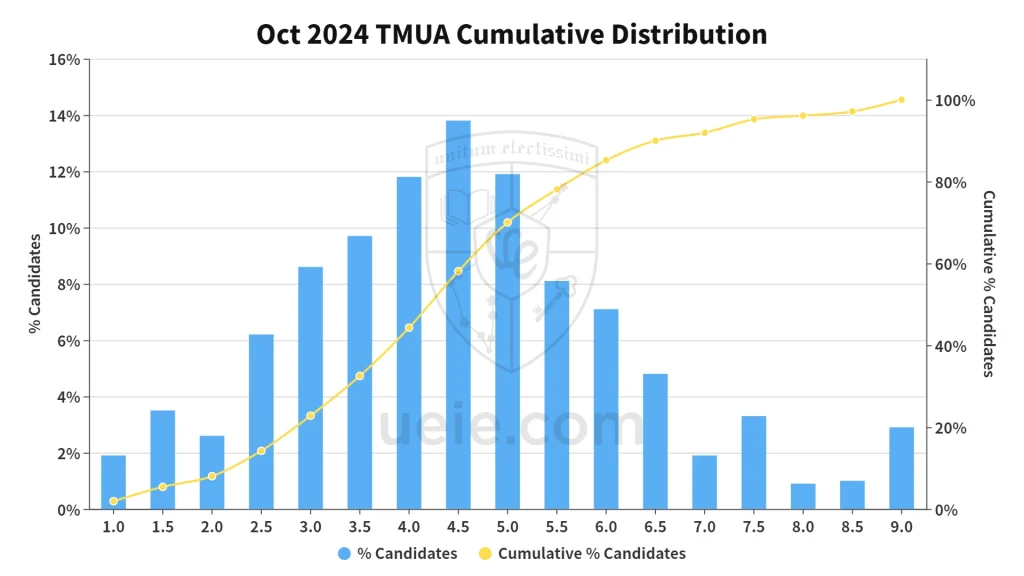
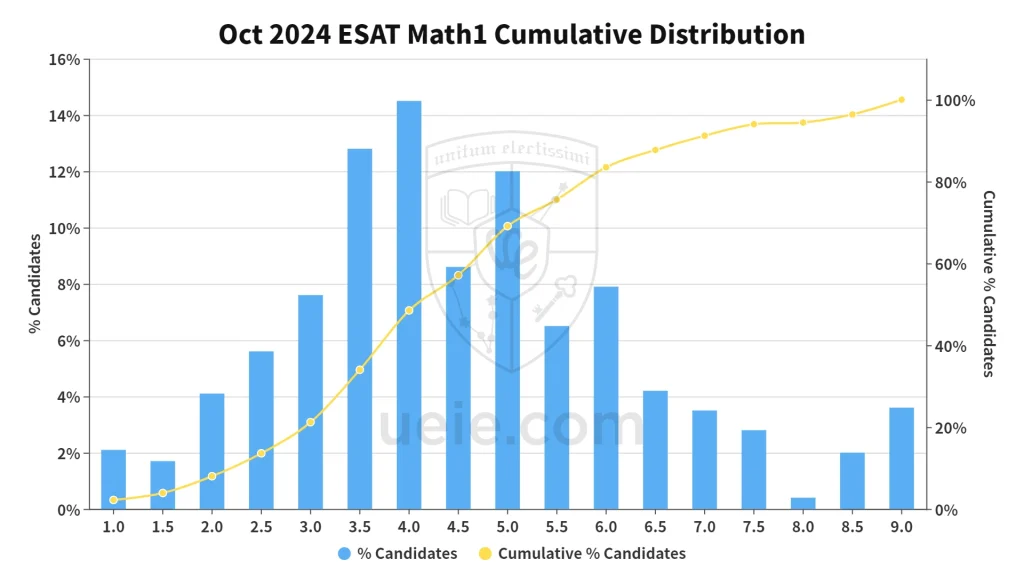
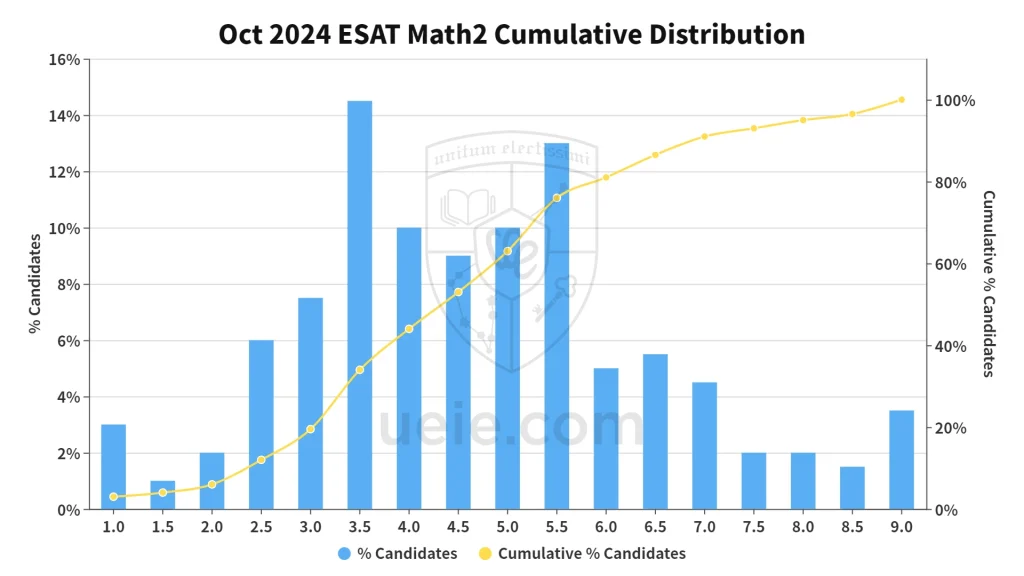
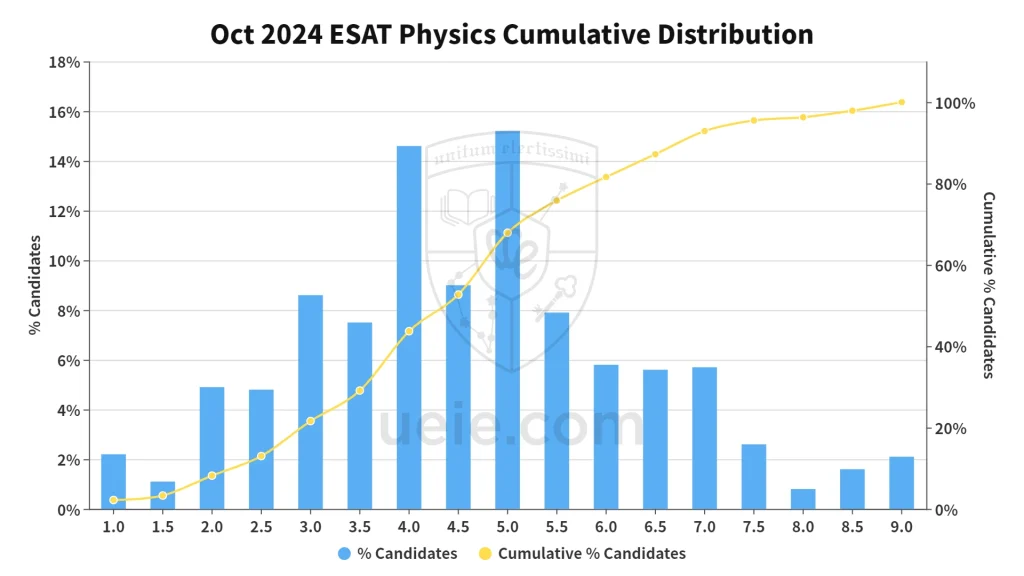
    The TMUA is a crucial benchmark for assessing a student’s mathematical ability. At the same time, the ESAT serves as a gateway to engineering and science-related courses at the University of Cambridge and Imperial College London. Both tests employ a 1.0 to 9.0 grading scale, similar to the IELTS, with higher TMUA and ESAT scores indicating a higher rank and stronger academic abilities in the relevant disciplines.

    I. Unveiling the secrets behind the 2024 TMUA and ESAT scores

    With this year’s adjusted scoring system, scores now provide a more intuitive reflection of a student’s rank, which is crucial for university admissions. So, where does your score stand? Let’s delve into a detailed analysis of the TMUA and ESAT score distribution.

    TMUA

    2024 TMUA Score

    Math 1 ESAT

    2024 ESAT Math 1 Score

    Math 2 ESAT

    2024 ESAT Math 2 Score

    Physics ESAT

    2024 ESAT Physics Score

    Chemistry ESAT

    2024 ESAT Chemistry Score

    Biology ESAT

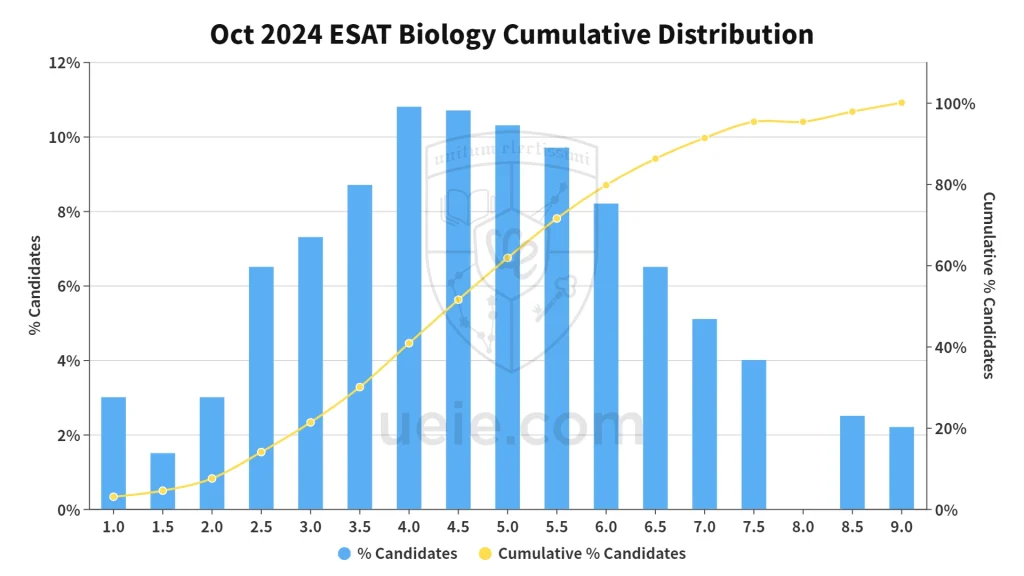
    2024 ESAT Biology Score

    II. Why are there so many applicants who scored 9?

    You may have noticed that the percentage of students scoring 9 is higher than those scoring 8 or 8.5! In some tests and subjects, the proportion of 9s even exceeds the combined proportion of 8.0 and 8.5 scores! There are several factors behind this phenomenon:

    • A concentration of top students: Each subject attracts a group of exceptionally talented students who possess strong learning abilities and test-taking skills.
    • Applicants for mathematics courses also sit the TMUA: Students applying for mathematics courses, who often have a strong aptitude for the subject, tend to score significantly higher on the TMUA compared to those applying for computer science or economics courses.
    • Chinese students’ strength in mathematics: It’s well-known that Chinese students excel in mathematics and science. Their advantage in these subjects often gives them an edge in TMUA and ESAT, contributing to the higher proportion of 9 scores.

    III. TMUA & ESAT scores: More than just correct answers

    The TMUA and ESAT scores are reported on a scale that runs from 1 (low) to 9 (high). Contrary to popular belief, the score is not a simple reflection of the correct answer rate. The exams use multiple test papers, and the difficulty level can vary across different regions and exam times. Under this mechanism, merely counting correct answers cannot accurately assess a candidate’s true ability. Instead, the official scores, derived from rigorous statistical analysis and adjustments, provide a more precise ranking of candidates relative to their peers. Therefore, TMUA and ESAT scores are better understood as a comprehensive assessment of a candidate’s overall ability.

    IV. Understanding your TMUA and ESAT score

    Regardless of your score, maintain a positive attitude and keep striving for your dreams. Please note that the following interpretations are based on general trends and individual opinions, and should be taken as a reference only:

    • 5.0 points: Congratulations! You’ve already outperformed half of the applicants.
    • 6.5 points: You have a high chance of receiving an interview invitation from Cambridge. It’s time to start preparing for your interview.
    • 7.5 points: Your chances of being admitted to Imperial College London and Cambridge are quite high.
    • 8.5 and 9.0 points: If your personal statement and interview (if any) are strong, you can expect offers from top universities like Cambridge, Imperial College London, and LSE.

    Of course, there are always exceptions. Factors such as luck, encountering an interviewer who is not a good fit, or performing poorly in an interview can influence the final outcome, even with a high TMUA or ESAT score. Remember, TMUA and ESAT scores are just one piece of the puzzle. Universities consider a variety of factors, including academic performance, personal statements, academic references, and interview performance, when making admissions decisions.

    V. Next steps for your application

    1. Don’t get overly focused on the correlation between your score and the number of correct answers.
    2. Set realistic academic expectations based on your score.
    3. Check the official websites of universities for the latest requirements and updates on exam scores.
    4. Maintain a positive attitude and continue striving for your goals.

    We hope the above information helps you better understand your TMUA and ESAT scores and aids in your future academic planning. Explore more preparation resources and posts:

  • How to Register for TMUA

    How to Register for TMUA

    For students aspiring to read mathematics, computer science, or economics-related degrees at leading UK universities, such as the University of Cambridge, the University of Oxford and Imperial College London, the Test of Mathematics for University Admission (TMUA) is a vital part of the application process. The TMUA result is a significant factor influencing offers of admission. However, many students and their parents are unacquainted with the particulars of TMUA registration, including the procedures, timelines, and appropriate test session. This article offers a thorough guide to the TMUA registration process, aiming to clarify common uncertainties.

    I. TMUA Organisation and Administration

    Since 2024, the TMUA has been centrally managed by UAT-UK (University Admissions Tests – UK), a not-for-profit organisation. UAT-UK focuses on university admissions tests in the United Kingdom and currently oversees three computer-based testing programmes: ESAT, TMUA and TARA. Pearson VUE delivers these tests. It is the certification and licensure arm of Pearson, an internationally recognized learning company. With a vast network of over 5,500 test centres across more than 180 countries and territories, Pearson VUE provides professional assessment services to academic and admissions bodies globally.

    II. Key Dates for the Upcoming TMUA Sittings

    The TMUA has two test sittings, scheduled for October 2026 and January 2027. The pertinent dates are outlined below:

    1. October 2026 TMUA Sitting

    1st June 2026 Account Creation Opens
    20th July 2026 TMUA Registration Opens
    28th September 2026 TMUA Registration Closes
    12th-16th October 2026 TMUA Test Dates*
    16th November 2026 TMUA Results Released

    * Only on 15-16th October 2026 for candidates sitting in China, Hong Kong and Macau.

    2. January 2027 TMUA Sitting

    Not applicable for Cambridge or Oxford applicants unless you are applying to a mature college with a January admissions deadline at Cambridge, or an Oxford Foundation Year programme also with a January deadline.

    5th October 2026 Account Creation Opens
    26th October 2026 TMUA Registration Opens
    21st December 2026 TMUA Registration Closes
    4th-8th January 2027 TMUA Test Dates*
    8th February 2027 TMUA Results Released

    * Only on 8th January 2027 for candidates sitting in China, Hong Kong and Macau.

    III. TMUA Registration Procedure

    1. Create a UAT-UK Account

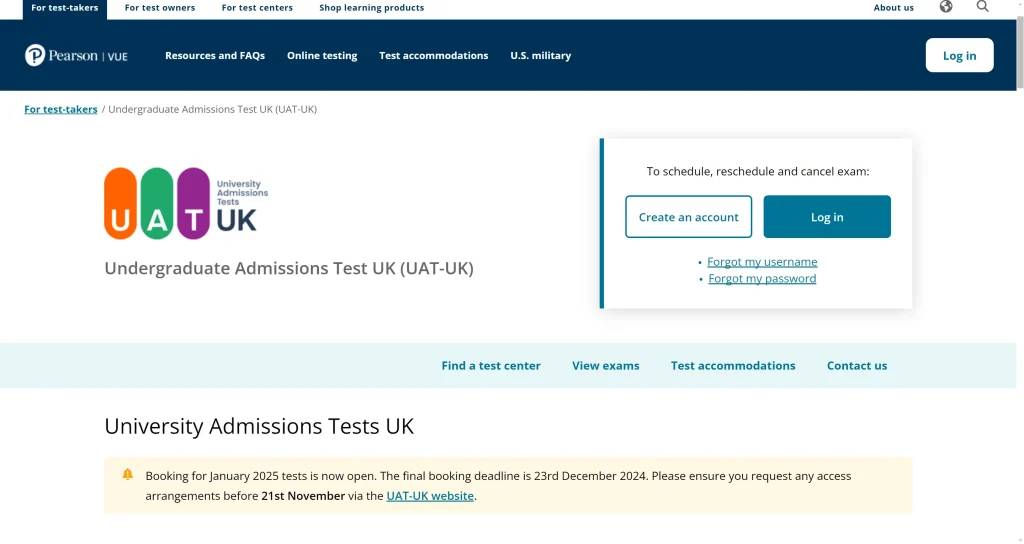
    • Candidates must create a UAT-UK account on the official Pearson VUE website. (It is prudent to consult the official UAT-UK website for the latest registration guidance).
      ESAT & TMUA Registration Guide - Creat your account - 1
    • It is imperative that the name used for UAT-UK account registration precisely matches the name on the candidate’s identification document. Discrepancies may prevent the candidate from sitting the examination. Candidates should also ensure their name matches their UCAS application name.
    • After creating an account, Pearson VUE will email candidates. This email enables them to confirm details and account settings. Candidates should receive it within 24 hours. This email will also include a temporary password for the candidate’s account.

    • Upon receipt of the account confirmation email, candidates may log in using the temporary password, subsequently change their password, and locate their UAT-UK ID (format: UATUK######) in the top left-hand corner of the page navigation bar.

    2. Test Booking

    • Log in to your UAT-UK account on the official Pearson VUE website and select the option to book the TMUA examination.
      ESAT & TMUA Registration Guide - Book a test - 2
    • Provide personal information pertinent to the examination. The system denotes compulsory fields with an asterisk (*).
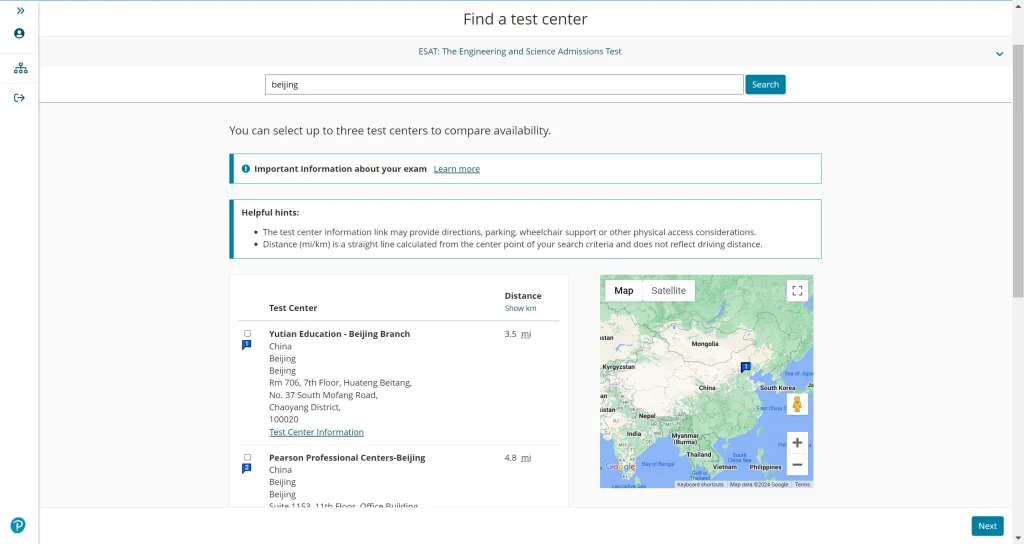
    • Candidates can locate their nearest test centre via the Pearson VUE website to complete their TMUA registration. Please note that sought-after test centres have limited places, especially as the registration deadline approaches. We strongly advise booking well in advance.
      ESAT & TMUA Registration Guide - Choose the test centre - 5

    3. Post-Registration and Pre-Examination Steps

    • Retain Confirmation Letter: It is strongly recommended that candidates save or print the examination confirmation letter issued by Pearson VUE once registration and payment are complete. This document usually serves as proof of entry for the examination.
    • Familiarise Yourself with Test Centre Regulations: Candidates are advised to visit the Pearson VUE website or contact their test centre before the examination to apprise themselves of specific test centre rules and regulations.
    • Official Contact Details: For any queries, candidates may contact the Pearson VUE candidate services helpline on 866 892 4788 (toll-free) or liaise with official customer service through the customer service centre on the Pearson VUE website.

    4. Test Fees

    • For candidates sitting the TMUA examination outside the UK and the Republic of Ireland (including mainland China), the fee is generally £133.
    • For candidates sitting the examination within the UK and the Republic of Ireland, the fee is £78.

    IV. Access Arrangements

    Candidates requiring access arrangements are advised to register for the examination at the earliest opportunity. Registering later may diminish the likelihood of securing arrangements at the preferred date and test centre. UAT-UK may take up to ten working days to process applications for access arrangements. Furthermore, the deadline for applying for access arrangements is typically in advance of the standard registration deadline. It is essential to check and submit such applications with ample time.

    All applications for access arrangements must be substantiated by evidence from a medical practitioner or specialist teacher, clearly detailing the candidate’s disability, medical condition, or other relevant circumstances.

    Types of access arrangements that necessitate application and approval include:

    • 25% extra time
    • Supervised rest breaks
    • Separate invigilation (rooming)
    • Use of a coloured reading overlay or bookmark
    • A reader or scribe
    • Other (please supply specific details of any aids or modifications required)

    V. Cancelling TMUA Registration

    1. Candidates may cancel or amend their examination booking up to 48 hours prior to the scheduled test without penalty.
    2. Cancellations or amendments must be effected by logging into the Pearson VUE website account or by contacting customer services for assistance.
    3. Should a candidate fail to cancel or amend their booking in good time, or fail to attend the examination, the examination fee will be forfeit.
    4. It is important to appreciate that the TMUA is conducted over only 1-2 days for candidates sitting in China, Hong Kong and Macau. The feasibility of successfully rescheduling a test date is dependent upon availability at the selected test centre.
    5. The precise cancellation and amendment policy will be as per the terms and conditions stipulated by Pearson VUE at the point of booking.

    VI. Concluding Thoughts

    In the competitive arena of applications for mathematics, computer science, and economics-related courses at Cambridge, Oxford and other UK universities, a thorough grasp not only of TMUA test content and preparatory techniques but also of the nuances of the registration procedure is essential for a trouble-free application process.

    You may also find it beneficial to peruse our related articles, which offer a comprehensive analysis of the TMUA examination and a study guide designed to augment your preparation and effectively enhance your TMUA score. Please click the link below.