




Comprehensive TMUA Guide

UEIE Founder
Senior Oxbridge preparation mentor and Olympiad gold medal coach with nearly 20 years of international curriculum teaching experience. 55 students coached have received Oxbridge offers, with hundreds more gaining admission to G5 and Ivy League universities.
UEIE Founder
Comprehensive TMUA Guide
I. What is the TMUA Mathematics Test?
TMUA stands for the Test of Mathematics for University Admission. Its primary purpose is to assess an applicant’s ability to apply mathematical knowledge to solve problems, as well as their potential for rigorous mathematical reasoning. As of 2024, the TMUA is managed and operated by UAT-UK (University Admissions Tests – UK), a non-profit organisation jointly established by the University of Cambridge and Imperial College London. The test is conducted as an online computer-based exam at Pearson VUE certified test centres worldwide.
Amidst the comprehensive restructuring of the Oxford and Cambridge admissions testing landscape in 2026, the TMUA has been established by numerous leading UK universities—including Oxford and Cambridge—as a key benchmark for selecting undergraduate students for programs in Mathematics, Computer Science, Economics, and related interdisciplinary fields.
II. Latest Updates of the TMUA (2027 Application Cycle)
The 2027 application cycle marks a historic transformation in the Oxbridge admissions assessment system; candidates must pay close attention to the following four key developments:
Oxford Formally Adopts TMUA (in place of MAT)
This marks one of the most significant policy changes of the year. The University of Oxford has officially announced that its programs in Mathematics, Computer Science, and related joint disciplines (such as Mathematics and Statistics, Mathematics and Computer Science, Computer Science and Philosophy, etc.) will fully adopt the TMUA as the primary benchmark for shortlisting candidates for interviews, thereby formally replacing the Oxford MAT, which had been in use for many years.
Cambridge Mathematics Now Requires TMUA Scores
The University of Cambridge has also swiftly followed suit, explicitly establishing the TMUA as the basis for issuing interview invitations for its Mathematics program. This means that for applicants aspiring to study in the Faculty of Mathematics at the University of Cambridge, the TMUA is no longer an optional component, but a mandatory requirement.
Earlier Registration, Extended Test Window
The test window has been extended this year, but the test booking opens significantly earlier, and fees have been adjusted. (For the specific registration timeline and operational guidelines, please refer specifically to Part IV of this article.)
Specific Date Restrictions for Candidates in China
For the first test window in October 2026, the TMUA for candidates in Mainland China, Hong Kong, and Macau is scheduled exclusively for 15–16th October. Candidates are advised to complete the registration process as early as possible and to secure their preferred test slots on the day test booking opens (20th July).
III. Who Would Have to Take the TMUA?
1. UK Universities and Courses Requiring the TMUA
Based on the latest requirements released for the 2027 application cycle, the following UK universities and their respective courses explicitly require applicants to submit the TMUA scores:
| University | Course(s) (Text with underline indicates a single course) |
|---|---|
| The University of Cambridge | Computer Science, Economics, Mathematics (Note: For the Mathematics program—in addition to the TMUA—candidates may subsequently be required to take the STEP examination and achieve a Grade 1 or higher.) |
| The University of Oxford | Computer Science, Computer Science and Philosophy, Mathematics, Mathematics and Computer Science, Mathematics and Philosophy, Mathematics/Mathematics and Statistics |
| Imperial College London | Mathematics, Mathematics (Pure Mathematics), Mathematics and Computer Science, Mathematics (including Applied Mathematics/Mathematical Physics), Mathematics (including Mathematical Computation), Mathematics with Statistics, Mathematics with Statistics for Finance, Computer Science, Economics, Finance and Data Science |
London School of Economics (LSE) | Economics, Econometrics and Mathematical Economics, Actuarial Science, Data Science, Economics and Data Science, Financial Mathematics and Statistics, Mathematical Statistics and Business, Mathematics (including Data Science), Mathematics (including Economics), Mathematics and Economics |
University College London (UCL) | Economics |
| University of Warwick | Computer Science, Computer Science and Business, Discrete Mathematics, Mathematics, Data Science, Economics, Economics and Management, Economics, Politics and International Studies, Mathematics and Statistics, MORSE |
| Durham University | Mathematics, Mathematics and Statistics |
2. The "TARA Trap" in UCL Courses Related to Computer Science
Of particular note is that, while courses related to computer science at Oxford, Cambridge, and Imperial College all uniformly require applicants to take the TMUA, UCL has explicitly mandated that three specific programs—Computer Science, Computer Science and Mathematics, and Robotics and Artificial Intelligence—will require the TARA, rather than the TMUA, for the 2027 admissions cycle.
This implies that students applying simultaneously to computer-related programs at UCL and other G5 universities will be required to take both the TMUA and the TARA. When formulating your test preparation strategy, please ensure that you incorporate both assessments into your schedule.
IV. Registration Timeline for the TMUA
There are two TMUA sittings for the 2027 Application Cycle: October 2026 (Sitting 1) and January 2027 (Sitting 2). Most Cambridge and Oxford applicants must take the first sitting at October.
1. Primary Schedule: October 2026 sitting
| Key Stage | Date |
|---|---|
| Account Registration Opens | 1st June 2026 (3pm BST) |
| Test Booking Window | from 20th July 2026 (3pm BST) to 28th September 2026 (6pm BST) |
| Test Dates | Candidates sitting in China, Hong Kong and Macau: Only on 15–16th October Candidates sitting in other countries and regions: Any date between 12–16th October |
| Results Release | 16th November 2026 (receive via UAT-UK Account*) |
2. Alternative Schedule: January 2027 sitting
Not applicable for Cambridge or Oxford applicants unless you are applying to a mature college with a January admissions deadline at Cambridge, or an Oxford Foundation Year programme also with a January deadline.
| Key Stage | Date |
|---|---|
| Account Registration Opens | 5th October 2026 (3pm BST) |
| Test Booking Window | from 26th October 2026 (3pm GMT) to 21st December 2026 (6pm GMT) |
| Test Dates | Candidates sitting in China, Hong Kong and Macau: Only on 8th January 2027 Candidates sitting in other countries and regions: Any date between 4–8th January |
| Results Release | 8th February 2027 (receive via UAT-UK Account*) |
*UAT-UK will notify candidates by email when their results are available to view in their UAT-UK account. Candidates will also receive a document explaining their results to provide further information on how to interpret their scores.
3. The Four Key Steps for Registration
Registration for the TMUA must be completed via the Pearson VUE online platform.
- Create a UAT-UK Account (Starting from 1st June)
Register using personal information that exactly matches your identification documents. Note that the email address used to register your UAT-UK account does not need to be the same as the one used for your UCAS account. - Secure a Test Slot (Starting from 20th July)
Test seats in popular regions are in high demand; it is recommended that you register as early as possible once registration opens. - Pay Test Fees
Ensure you have a credit or debit card capable of processing international payments ready (e.g., VISA, MasterCard). - Confirm Registration Details
Verify that all details—including modules, date, and location—are accurate before submitting; be sure to check for the confirmation email.
For a comprehensive, step-by-step tutorial covering specific registration procedures, test centre lookups, payment instructions, and applications for special arrangements, please access our specially compiled TMUA Registration Guide. This guide features complete, detailed, and illustrated instructions with screenshots:
How to Register for TMUA
V. What are the Format and Procedures of the TMUA?
| Test Mode | Online computer-based test |
|---|---|
| Test Location | Pearson VUE certified test centres around the world |
| Test Structure | TMUA consists of two papers: Paper 1 and Paper 2. Specifically: Paper 1: 20 Multiple-Choice Questions Paper 2: 20 Multiple-Choice Questions |
| Timing | Paper 1 and Paper 2 are timed independently; each paper is allotted 75 minutes, resulting in a total test duration of 150 minutes. Any unused time from Paper 1 cannot be carried over for use in Paper 2. |
| Scoring Method | +1 point for a correct answer; no penalty for wrong answers. The maximum raw score is 40 points, which will ultimately be converted into a report score ranging from 1.0 to 9.0. |
| Auxiliary Tools | No calculators or dictionaries allowed. Erasable booklets and pens are provided at the centre. |
VI. How high is an TMUA score considered competitive?
1. Is there an officially established "Passing Line"?
The TMUA does not have an officially standardized “passing line” or a rigid “admission threshold.” Whether a specific score is considered competitive depends entirely on the university and specific program to which you are applying, as well as the overall caliber of applicants globally—and particularly within your specific region—during that application cycle. Admissions officers evaluate this score holistically, weighing it alongside your high school academic records, personal statement (PS), and interview performance.
2. The Competitiveness Tier Model: Where Does Your Score Rank?
Based on an in-depth analysis of official UAT-UK data—combined with years of practical experience guiding students at UEIE—we have developed the following “Competitiveness Tier Model” for the TMUA to serve as a reference for candidates:
Competitiveness Tier Model for
Mathematics, Computer Science, and Economics Programs
(Based on the personal insights of Mr. Xie Tao; tailored specifically for candidates from China and does not constitute an official guarantee of university admission.)
| TMUA Report Score | Global Ranking | Tier | ||
|---|---|---|---|---|
| Mathematics | Computer Science | Economics | ||
| 8.5 | Top ~4% | Grandmaster | Grandmaster | Grandmaster |
| 8.0 | Top ~6% | Master | Master | |
| 7.5 | Top ~8% | Diamond | Diamond | Master |
| 7.0 | Top ~10% | Platinum | ||
| 6.5 | Top ~17% | Gold | Platinum | Diamond |
| 6.0 | Top ~25% | Platinum | ||
| 5.5 | Top ~35% | Silver | Gold | Gold |
| 5.0 | Top ~50% | Silver | Silver | |
Admission Predictions by Rank Tier
| Tier | Admission Prediction |
|---|---|
| Grandmaster | Extremely high probability of Oxbridge admission, allowing you to secure for admission based on academic results alone. |
| Master | Above average probability of Oxbridge admission, with distinct advantages applying to other G5 universities. |
| Diamond | Relatively low probability of Oxbridge admission, but extremely high chances for securing offers from other G5 universities. |
| Platinum | Strong probability of securing interview offers from top-tier universities such as Imperial College and LSE, and still stand a chance of Oxbridge admission, for those who are exceptionally lucky or deliver a truly outstanding performance in the interview. |
| Gold | Basic G5 competitiveness, most likely to get interview offer for Oxbridge admission. |
| Silver | Moderate competitiveness, at a relative disadvantage among applicants to top-tier universities. |
3. Global Data Benchmarks vs. UEIE’s Actual Performance Results
To provide a more intuitive sense of the scores mentioned above, presented below are the officially released global score distribution histograms for the TMUA from October 2025. From these charts, you can clearly observe the scarcity of scores in the high-scoring range.
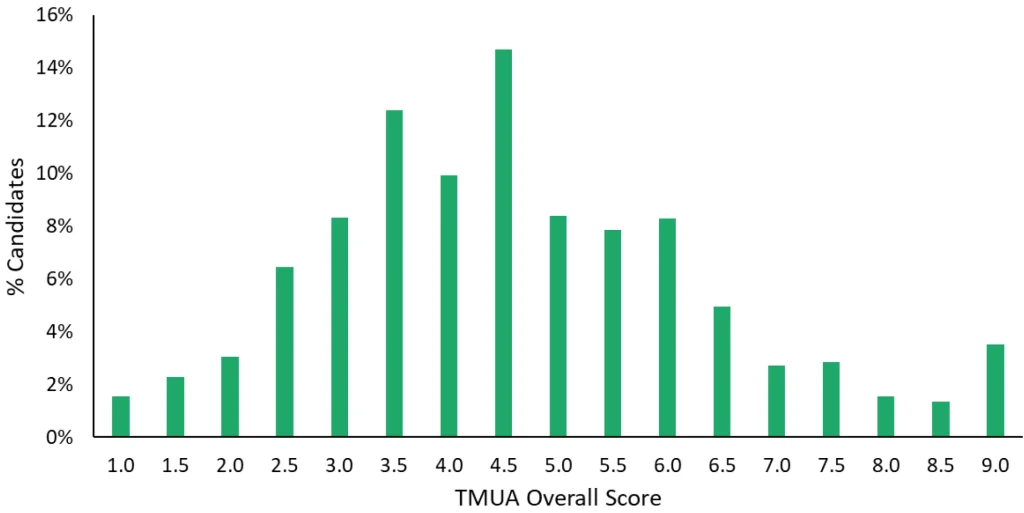
Global Score Distribution for the TMUA — October 2025
(Screenshot from the Official UAT-UK Report)
So, what kind of level can students reach after undergoing systematic training?
In the video below, we present the actual scores achieved by UEIE students at the ESAT and TMUA in October 2025, comparing them directly against the global data distribution. You will be able to visually observe the massive statistical advantage—a distinct “data gap”—that results from a systematic approach to test preparation:
VII. The "Report Score" Algorithm
1. Dynamic Scoring Mechanism: Why do identical numbers of correct answers result in different scores?
Rather than relying on a simple “arithmetic mean,” TMUA employs a highly sophisticated IRT (Item Response Theory) model for scoring. UAT-UK utilises big-data iterative calculations that take into account every candidate’s raw score, the overall difficulty of the test paper, and the specific difficulty level of each individual question.
Since TMUA is a global online computer-based test, different testing centres are assigned distinct—though not entirely identical—test papers as an anti-cheating measure. Consequently, because the difficulty levels of these papers vary, the specific mapping relationship used to convert “raw scores” into “report scores” also differs.
The figure below illustrates the mapping relationship between raw scores and report scores for two test papers of differing difficulty levels (Form A and Form B).
How Test Forms Affect TMUA Report Scores
Select a raw score to see how a student’s final report score changes depending on the specific difficulty of the test form they were assigned.
Form A (Slightly Harder)
0.0
Form B (Slightly Easier)
0.0
For example, suppose both you and a classmate correctly answer 32 questions (out of a total of 40).
If you were assigned Test Paper A (which is slightly more difficult), your reported score might be 7.4.
Conversely, if your classmate was assigned Test Paper B (which is slightly easier), their reported score might be only 6.6.
2. Three Key Takeaways Regarding Scoring
Based on our reverse engineering of the official scoring algorithm, candidates must keep the following conclusions firmly in mind during the actual exam:
- The Essence is “Ranking,” Not “Absolute Score”
In the test sitting at October 2025, the official body strictly defined a score of 4.5 as the 50th percentile benchmark for the entire candidate pool, while a score of 7.0 was firmly anchored to the top 10% of the cohort.
- “Same Paper, Same Score” Rule
Within any specific set of test questions, a single raw score corresponds to only one specific reported score. In other words, the system looks solely at the total number of questions you answered correctly; it does not distinguish between whether those correct answers came from difficult questions or easy ones. (Tip: If you get stuck on a difficult question, skip it immediately! Maximising your total count of correct answers is the ultimate strategy for success.)
- The “Error Tolerance Seesaw” for Papers of Varying Difficulty
a) The more difficult the test paper, the higher the error tolerance: Even if you answer four questions incorrectly, it remains possible to achieve a perfect score of 9.0.
b) The easier the test paper, the lower the margin for error: if the paper is very simple, missing just two questions could result in a direct deduction to 8.3 points—a truly brutal reality.
3. Why is a Score of 7.0 Still "Unsafe" for Chinese Candidates?
Given that the essence of the IRT algorithm is “global ranking,” a more practical and critical question arises: In the eyes of admissions officers, does a score of 7.0 from different testing regions truly carry equivalent weight?
The answer is: They are absolutely not equivalent.
To provide a tangible sense of this reality, I have extracted the TMUA score data officially released by UAT-UK for candidates from a selection of countries and regions:
TMUA Score Distribution in Selected Regions (2024/25 Cycle)
| Country or Region | Number of Candidates | Average Score | 25th Percentile | 50th Percentile | 75th Percentile | 90th Percentile |
|---|---|---|---|---|---|---|
| United Kingdom | 7715 | 3.86 | 2.8 | 3.8 | 4.8 | 5.8 |
| China | 2554 | 5.42 | 4.1 | 5.4 | 6.7 | 8.4 |
| India | 779 | 3.63 | 2.4 | 3.5 | 4.7 | 5.7 |
| Singapore | 316 | 4.78 | 3.6 | 4.7 | 5.8 | 6.9 |
| Hong Kong, China | 296 | 5.06 | 3.8 | 5.0 | 6.3 | 7.6 |
| Malaysia | 231 | 3.80 | 2.7 | 3.8 | 4.7 | 5.7 |
* Source: UAT-UK Official Report
Hidden behind these figures lie two paradigm-shifting—and brutally harsh—realities regarding the actual competitive landscape:
- Your “Passing Line” is Someone Else’s “Ceiling”
The median score for Chinese candidates (5.4 points) is fast approaching the threshold for the top 10% of candidates from the UK (5.8 points). This implies that a Chinese candidate of average proficiency possesses a level of mathematical competence that would likely rank them among the top performers within the UK student population.
- Extreme Regional Competition
In the UK testing region, a score of 7.0 signifies that you belong to the elite top 10%; however, in the Chinese testing region, the top 10% of high-achievers have driven the benchmark score up to a staggering 8.4. This substantial 2.6-point disparity represents the “high-score premium”—the burden Chinese students must bear to offset the intense regional competition among applicants.
Core Advice
In an environment characterized by limited admissions quotas, candidates from China (including high-scoring regions such as Hong Kong) must not aim merely to “clear the threshold,” but rather strive to achieve “the highest of high scores.” Only by firmly anchoring their targets at above 8.0 points (for Mathematics and Computer Science disciplines) or above 7.0 points (for Economics disciplines) can they ensure a decisive advantage within the competitive applicant pools of the world’s most prestigious universities.
A Guide for the Hardcore Academic
If you have a keen interest in data and algorithms—and wish to delve deeper into how the IRT model achieves standardization—you are recommended to read a comprehensive, purely technical article we have written specifically on this subject: Same Raw Marks, Different Results? Unlocking the Hidden Rules of ESAT/TMUA/TARA Scoring.
VIII. Why is the TMUA so Difficult?
Unlike highly demanding mathematics examinations such as STEP, the challenge of the TMUA does not lie in plumbing the depths of extreme difficulty within individual questions. Rather, its essence lies in the uncompromising demand for both speed and accuracy while under immense time pressure. Many students who have worked through past papers share a common sentiment: “The questions themselves all look solvable—the problem is simply that I can’t finish them all!”
Specifically, the core difficulties of the TMUA manifest in the following four areas:
1. Extreme Time Pressure and Rapid Decision-Making
With an average of only 3.75 minutes allotted per multiple-choice question, time pressure constitutes the core challenge of the TMUA. This demands not only an exceptionally solid foundation of knowledge but also places extreme demands on problem-solving efficiency and speed. In the test hall, you must possess exceptional rapid decision-making skills: if you get stuck on a question, you must decisively skip it rather than getting bogged down on a single item, as maximizing the total number of correct answers is the sole criterion for achieving a high score.
2. "Anti-Formulaic" Traps and Rigorous Accuracy Requirements
Although the TMUA consists entirely of multiple-choice questions, do not let your guard down. The questions and options are often crafted with great ingenuity, riddled with traps and distractors specifically designed to target conceptual blind spots. Since multiple-choice questions yield no partial credit for any working process, the test places an extremely high premium on the accuracy of the final answer. Candidates accustomed to rote memorization and formulaic problem-solving routines can easily fall victim to these meticulously designed distractors; the test demands that, even under high pressure, you remain capable of carefully analyzing questions, performing precise calculations, and effectively eliminating incorrect options.
3. Paper 2’s Unique Focus on Logical Reasoning and Error Identification
The assessment dimensions of Paper 2 often prove highly disorienting for newcomers. It goes beyond mere calculation, demanding robust logical thinking and a deep understanding of mathematical proofs—specifically, the ability to keenly identify common errors embedded within given mathematical arguments. This high-level logical reasoning ability is often insufficiently cultivated during traditional A-Level or high school mathematics studies; consequently, specialized training is essential to truly adapt to this format and improve one’s accuracy rate.
4. Breaking "Calculator Dependency" through Core Mental Math Skills
The scope of the TMUA is exceptionally broad, requiring candidates not only to rapidly and accurately recall and apply foundational knowledge but also to complete the entire test without the aid of a calculator. For candidates who have spent years studying international curricula—such as A-Levels—and have developed a deep reliance on calculators, this presents a significant practical hurdle. It places extremely high demands on a candidate’s mental math and manual calculation abilities; this means that during your preparation, you must deliberately cultivate strong estimation skills and develop “muscle memory” for basic arithmetic operations and frequently used formulas.
IX. TMUA Efficient Prep Resources & Action Guide
Faced with the TMUA—a test characterised by an extremely low tolerance for error and a rigorous test of on-the-spot reaction skills—blindly grinding through practice problems will only yield half the results for twice the effort. What you need is a scientifically sound preparation strategy that directly addresses the critical pain points of this computer-based test.
1. Official Resources
The first step in test preparation is always to thoroughly master the scope and boundaries defined by the official authorities. You can access the most essential foundational preparation materials on the UAT-UK official website:
- The latest version of the TMUA syllabus
- Official sample questions and practice materials
- Exam guides and frequently asked questions (FAQs)
- TMUA past papers (2016–2023)
2. UEIE's Exclusive TMUA "Learn-Practice-Test" Comprehensive Prep Matrix
To help ambitious G5 applicants completely break through the algorithmic barriers that lead to “same raw marks with different results,” the UEIE Research and Development Team has poured its expertise into creating the UEIE TMUA On-Demand Prep Suite. This resource undergoes rigorous annual revisions based on the latest exam trends, perfectly covering the core closed loop of effective test preparation:
Say goodbye to fragmented learning. Let UEIE’s top-tier instructors guide you through a systematic review of core exam topics and a deep deconstruction of “anti-pattern” strategies for highly efficient problem-solving.
A complete question bank in English, scientifically categorized by thematic module and difficulty level. Through a massive volume of high-quality, targeted, and timed exercises, we help you completely wean yourself off calculators and build the “muscle memory” required for lightning-fast mental math and rapid decision-making.
This is your ultimate toolkit for conquering the TMUA! We have invested immense effort into developing online mock exams that simulate the official computer-based testing environment with 99% accuracy. This allows you to adapt in advance to the extreme, high-pressure environment of “module-specific countdown timers,” ensuring you maintain a top-tier performance level during the actual test.
3. Advanced Learning & Academic Planning
In addition to the On-Demand Prep Suite, UEIE offers rolling sessions of TMUA preparation programmes throughout the year. If you require expert guidance from renowned instructors and personalised diagnostic assessments for specific modules, please click the link below to view class details and fee arrangements:
TMUA Preparation Programme (October 2026 Sitting)
If you wish to learn how to maximise the utility of the resources mentioned above—including how to formulate a scientific study plan, conduct in-depth reviews of your mistakes, and master time-management tricks for the actual test—we invite you to read the comprehensive guide we have written specifically for you: TMUA Prep Guide.
The Efficient TMUA Preparation Guide
Follow Us on Wechat