Tag: Computer Science Course

  • Comprehensive TMUA Guide

    Comprehensive TMUA Guide

    Comprehensive TMUA Guide - Video Poster

    I. What is the TMUA Mathematics Test?

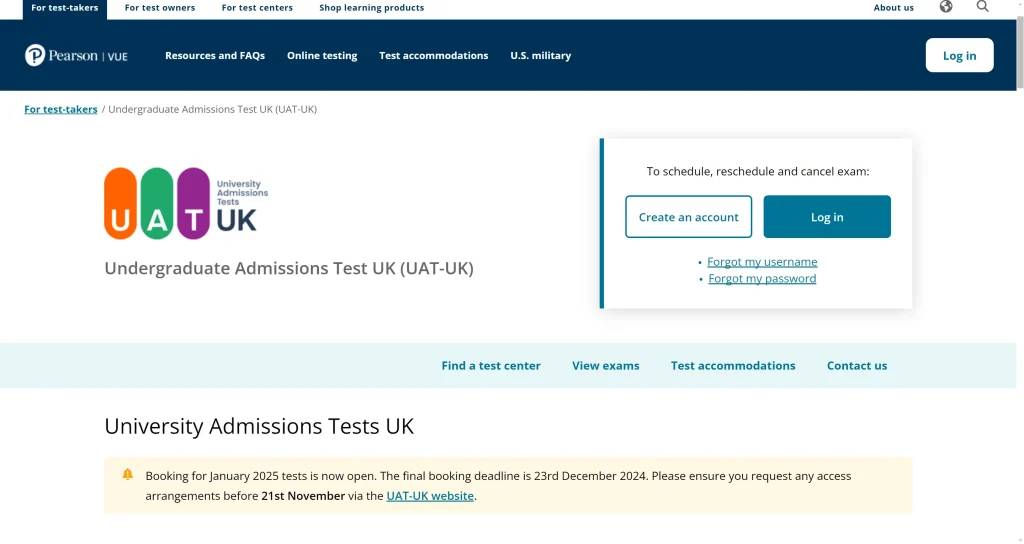
    TMUA stands for the Test of Mathematics for University Admission. Its primary purpose is to assess an applicant’s ability to apply mathematical knowledge to solve problems, as well as their potential for rigorous mathematical reasoning. As of 2024, the TMUA is managed and operated by UAT-UK (University Admissions Tests – UK), a non-profit organisation jointly established by the University of Cambridge and Imperial College London. The test is conducted as an online computer-based exam at Pearson VUE certified test centres worldwide.

    Amidst the comprehensive restructuring of the Oxford and Cambridge admissions testing landscape in 2026, the TMUA has been established by numerous leading UK universities—including Oxford and Cambridge—as a key benchmark for selecting undergraduate students for programs in Mathematics, Computer Science, Economics, and related interdisciplinary fields.

    II. Latest Updates of the TMUA (2027 Application Cycle)

    The 2027 application cycle marks a historic transformation in the Oxbridge admissions assessment system; candidates must pay close attention to the following four key developments:

    Oxford Formally Adopts TMUA (in place of MAT)

    This marks one of the most significant policy changes of the year. The University of Oxford has officially announced that its programs in Mathematics, Computer Science, and related joint disciplines (such as Mathematics and Statistics, Mathematics and Computer Science, Computer Science and Philosophy, etc.) will fully adopt the TMUA as the primary benchmark for shortlisting candidates for interviews, thereby formally replacing the Oxford MAT, which had been in use for many years.

    Cambridge Mathematics Now Requires TMUA Scores

    The University of Cambridge has also swiftly followed suit, explicitly establishing the TMUA as the basis for issuing interview invitations for its Mathematics program. This means that for applicants aspiring to study in the Faculty of Mathematics at the University of Cambridge, the TMUA is no longer an optional component, but a mandatory requirement.

    Earlier Registration, Extended Test Window

    The test window has been extended this year, but the test booking opens significantly earlier, and fees have been adjusted. (For the specific registration timeline and operational guidelines, please refer specifically to Part IV of this article.)

    Specific Date Restrictions for Candidates in China

    For the first test window in October 2026, the TMUA for candidates in Mainland China, Hong Kong, and Macau is scheduled exclusively for 15–16th October. Candidates are advised to complete the registration process as early as possible and to secure their preferred test slots on the day test booking opens (20th July).

    III. Who Would Have to Take the TMUA?

    1. UK Universities and Courses Requiring the TMUA

    Based on the latest requirements released for the 2027 application cycle, the following UK universities and their respective courses explicitly require applicants to submit the TMUA scores:


    UniversityCourse(s)
    (Text with underline indicates a single course)
    The University of Cambridge

    Computer Science, Economics, Mathematics

    (Note: For the Mathematics program—in addition to the TMUA—candidates may subsequently be required to take the STEP examination and achieve a Grade 1 or higher.)

    The University of OxfordComputer Science, Computer Science and Philosophy, Mathematics, Mathematics and Computer Science, Mathematics and Philosophy, Mathematics/Mathematics and Statistics
    Imperial College LondonMathematics, Mathematics (Pure Mathematics), Mathematics and Computer Science, Mathematics (including Applied Mathematics/Mathematical Physics), Mathematics (including Mathematical Computation), Mathematics with Statistics, Mathematics with Statistics for Finance, Computer Science, Economics, Finance and Data Science

    London School of Economics

    (LSE)

    Economics, Econometrics and Mathematical Economics, Actuarial Science, Data Science, Economics and Data Science, Financial Mathematics and Statistics, Mathematical Statistics and Business, Mathematics (including Data Science), Mathematics (including Economics), Mathematics and Economics

    University College London

    (UCL)

    Economics
    University of WarwickComputer Science, Computer Science and Business, Discrete Mathematics, Mathematics, Data Science, Economics, Economics and Management, Economics, Politics and International Studies, Mathematics and Statistics, MORSE
    Durham UniversityMathematics, Mathematics and Statistics

    2. The “TARA Trap” in UCL Courses Related to Computer Science

    Of particular note is that, while courses related to computer science at Oxford, Cambridge, and Imperial College all uniformly require applicants to take the TMUA, UCL has explicitly mandated that three specific programs—Computer Science, Computer Science and Mathematics, and Robotics and Artificial Intelligence—will require the TARA, rather than the TMUA, for the 2027 admissions cycle.

    This implies that students applying simultaneously to computer-related programs at UCL and other G5 universities will be required to take both the TMUA and the TARA. When formulating your test preparation strategy, please ensure that you incorporate both assessments into your schedule.

    IV. Registration Timeline for the TMUA

    There are two TMUA sittings for the 2027 Application Cycle: October 2026 (Sitting 1) and January 2027 (Sitting 2). Most Cambridge and Oxford applicants must take the first sitting at October.

    1. Primary Schedule: October 2026 sitting

    Key Stage
    Date
    Account Registration Opens1st June 2026 (3pm BST)
    Test Booking Windowfrom 20th July 2026 (3pm BST)
    to 28th September 2026 (6pm BST)
    Test DatesCandidates sitting in China, Hong Kong and Macau:
    Only on 15–16th October
    Candidates sitting in other countries and regions:
    Any date between 12–16th October
    Results Release16th November 2026 (receive via UAT-UK Account*)

    2. Alternative Schedule: January 2027 sitting

    Not applicable for Cambridge or Oxford applicants unless you are applying to a mature college with a January admissions deadline at Cambridge, or an Oxford Foundation Year programme also with a January deadline.

    Key Stage Date
    Account Registration Opens 5th October 2026 (3pm BST)
    Test Booking Window from 26th October 2026 (3pm GMT) to 21st December 2026 (6pm GMT)
    Test Dates Candidates sitting in China, Hong Kong and Macau: Only on 8th January 2027 Candidates sitting in other countries and regions: Any date between 4–8th January
    Results Release 8th February 2027 (receive via UAT-UK Account*)

    *UAT-UK will notify candidates by email when their results are available to view in their UAT-UK account. Candidates will also receive a document explaining their results to provide further information on how to interpret their scores.

    3. The Four Key Steps for Registration

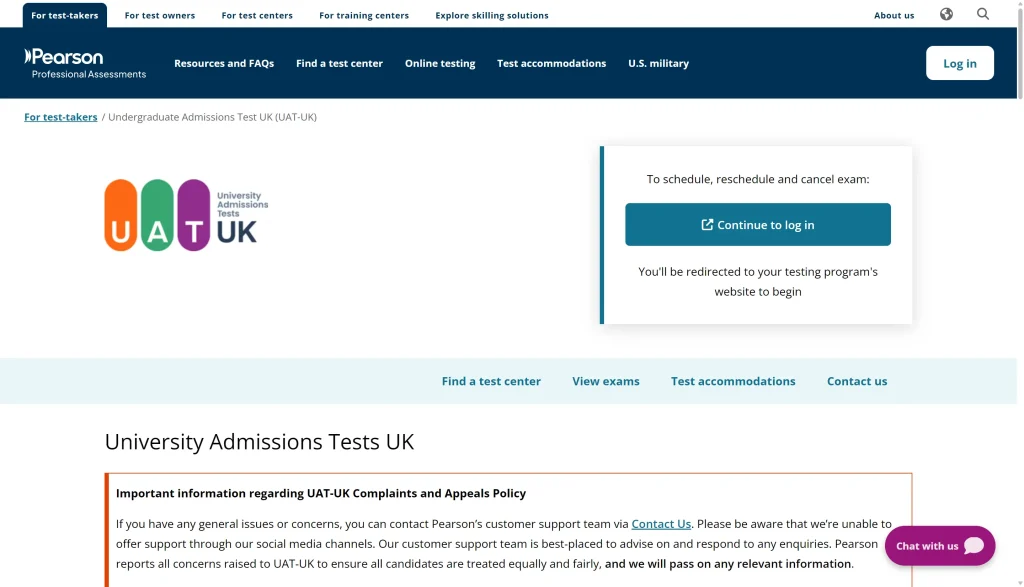
    Registration for the TMUA must be completed via the Pearson VUE online platform.

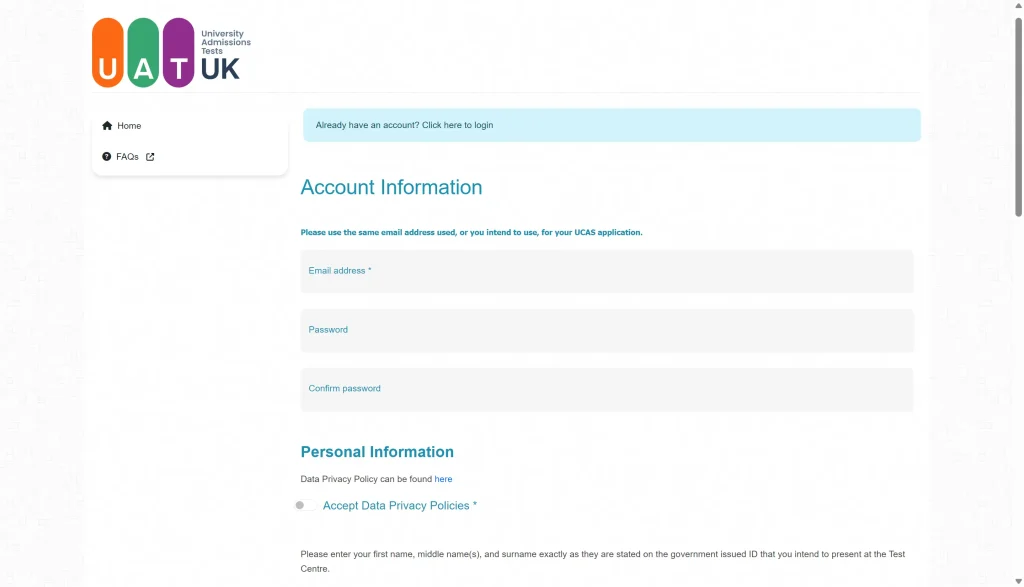
    • Create a UAT-UK Account (Starting from 1st June)
      Register using personal information that exactly matches your identification documents. Note that the email address used to register your UAT-UK account does not need to be the same as the one used for your UCAS account.
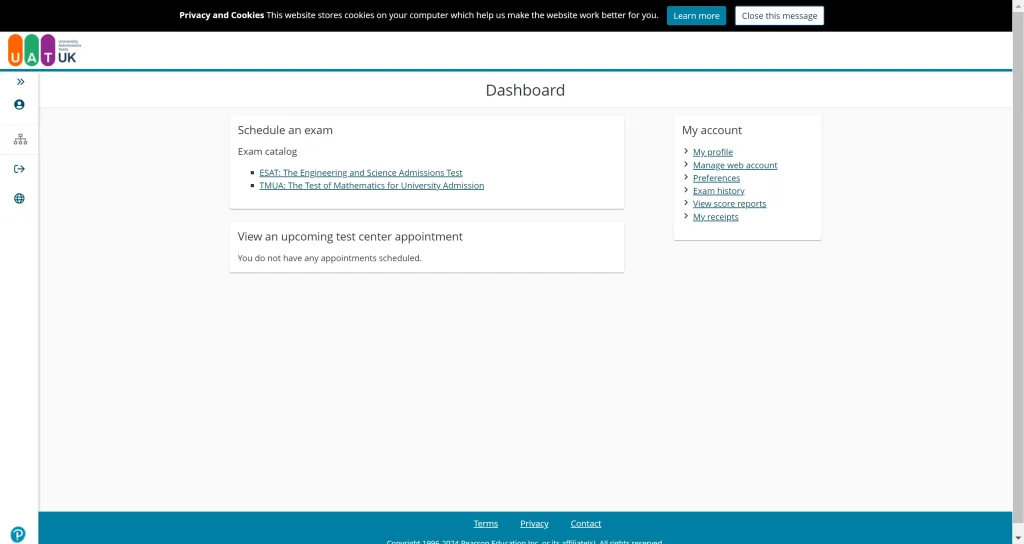
    • Secure a Test Slot (Starting from 20th July)
      Test seats in popular regions are in high demand; it is recommended that you register as early as possible once registration opens.
    • Pay Test Fees
      Ensure you have a credit or debit card capable of processing international payments ready (e.g., VISA, MasterCard).
    • Confirm Registration Details
      Verify that all details—including modules, date, and location—are accurate before submitting; be sure to check for the confirmation email.

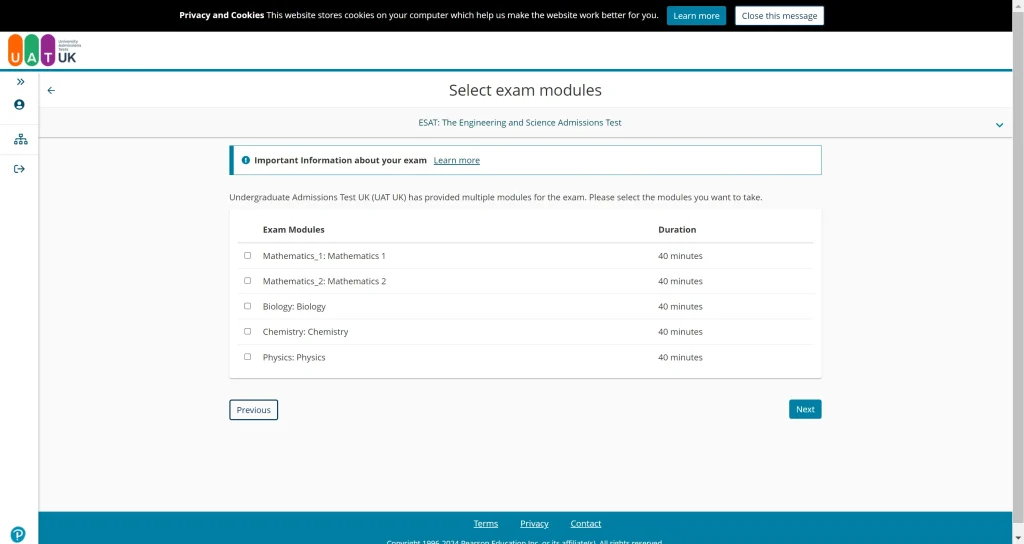
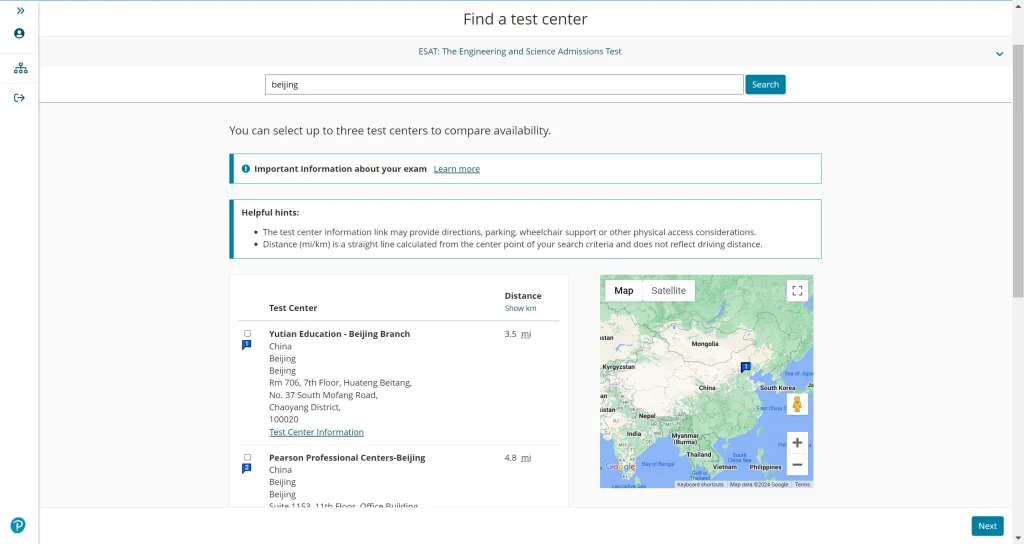
    For a comprehensive, step-by-step tutorial covering specific registration procedures, test centre lookups, payment instructions, and applications for special arrangements, please access our specially compiled TMUA Registration Guide. This guide features complete, detailed, and illustrated instructions with screenshots:

    V. What are the Format and Procedures of the TMUA?

    Test ModeOnline computer-based test
    Test LocationPearson VUE certified test centres around the world
    Test Structure
    TMUA consists of two papers: Paper 1 and Paper 2. Specifically:
    Paper 1: 20 Multiple-Choice Questions
    Paper 2: 20 Multiple-Choice Questions
    TimingPaper 1 and Paper 2 are timed independently; each paper is allotted 75 minutes, resulting in a total test duration of 150 minutes.
    Any unused time from Paper 1 cannot be carried over for use in Paper 2.
    Scoring Method+1 point for a correct answer; no penalty for wrong answers.
    The maximum raw score is 40 points, which will ultimately be converted into a report score ranging from 1.0 to 9.0.
    Auxiliary ToolsNo calculators or dictionaries allowed. Erasable booklets and pens are provided at the centre.

    VI. How high is an TMUA score considered competitive?

    1. Is there an officially established “Passing Line”?

    The TMUA does not have an officially standardized “passing line” or a rigid “admission threshold.” Whether a specific score is considered competitive depends entirely on the university and specific program to which you are applying, as well as the overall caliber of applicants globally—and particularly within your specific region—during that application cycle. Admissions officers evaluate this score holistically, weighing it alongside your high school academic records, personal statement (PS), and interview performance.

    2. The Competitiveness Tier Model: Where Does Your Score Rank?

    Based on an in-depth analysis of official UAT-UK data—combined with years of practical experience guiding students at UEIE—we have developed the following “Competitiveness Tier Model” for the TMUA to serve as a reference for candidates:

    Competitiveness Tier Model for
    Mathematics, Computer Science, and Economics Programs

    (Based on the personal insights of Mr. Xie Tao; tailored specifically for candidates from China and does not constitute an official guarantee of university admission.)

    TMUA Report ScoreGlobal RankingTier
    Mathematics
    Computer Science
    Economics
    8.5
    Top ~4%GrandmasterGrandmasterGrandmaster
    8.0Top ~6%MasterMaster
    7.5Top ~8%DiamondDiamondMaster
    7.0Top ~10%Platinum
    6.5Top ~17%GoldPlatinumDiamond
    6.0Top ~25%Platinum
    5.5Top ~35%SilverGoldGold
    5.0Top ~50%SilverSilver

    Admission Predictions by Rank Tier

    Tier Admission Prediction
    Grandmaster Extremely high probability of Oxbridge admission, allowing you to secure for admission based on academic results alone.
    Master Above average probability of Oxbridge admission, with distinct advantages applying to other G5 universities.
    Diamond Relatively low probability of Oxbridge admission, but extremely high chances for securing offers from other G5 universities.
    Platinum Strong probability of securing interview offers from top-tier universities such as Imperial College and LSE, and still stand a chance of Oxbridge admission, for those who are exceptionally lucky or deliver a truly outstanding performance in the interview.
    Gold Basic G5 competitiveness, most likely to get interview offer for Oxbridge admission.
    Silver Moderate competitiveness, at a relative disadvantage among applicants to top-tier universities.

    3. Global Data Benchmarks vs. UEIE’s Actual Performance Results

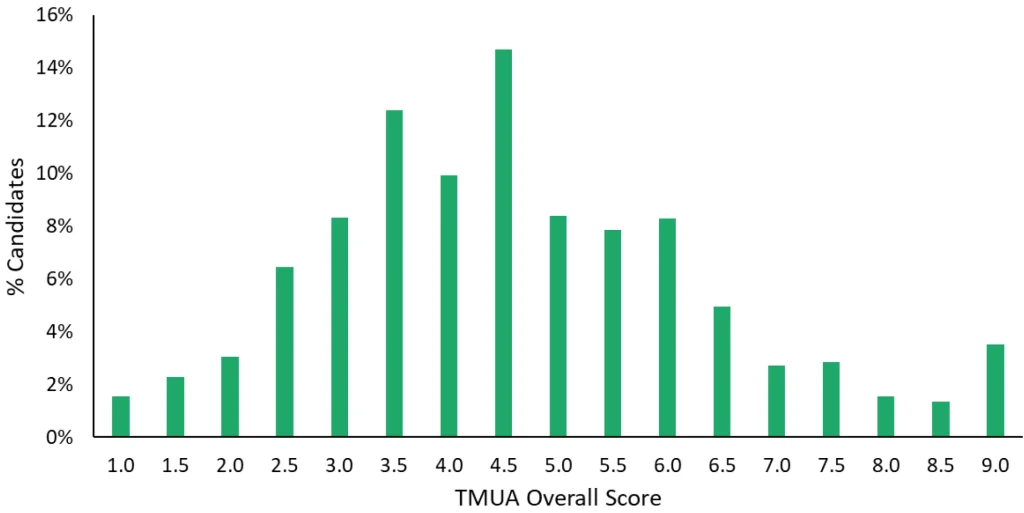
    To provide a more intuitive sense of the scores mentioned above, presented below are the officially released global score distribution histograms for the TMUA from October 2025. From these charts, you can clearly observe the scarcity of scores in the high-scoring range.


    TMUA Oct 2025 Score Distribution

    Global Score Distribution for the TMUA — October 2025

    (Screenshot from the Official UAT-UK Report)

    So, what kind of level can students reach after undergoing systematic training?

    In the video below, we present the actual scores achieved by UEIE students at the ESAT and TMUA in October 2025, comparing them directly against the global data distribution. You will be able to visually observe the massive statistical advantage—a distinct “data gap”—that results from a systematic approach to test preparation:

    VII. The “Report Score” Algorithm

    1. Dynamic Scoring Mechanism: Why do identical numbers of correct answers result in different scores?

    Rather than relying on a simple “arithmetic mean,” TMUA employs a highly sophisticated IRT (Item Response Theory) model for scoring. UAT-UK utilises big-data iterative calculations that take into account every candidate’s raw score, the overall difficulty of the test paper, and the specific difficulty level of each individual question.

    Since TMUA is a global online computer-based test, different testing centres are assigned distinct—though not entirely identical—test papers as an anti-cheating measure. Consequently, because the difficulty levels of these papers vary, the specific mapping relationship used to convert “raw scores” into “report scores” also differs.

    The figure below illustrates the mapping relationship between raw scores and report scores for two test papers of differing difficulty levels (Form A and Form B).

    How Test Forms Affect TMUA Report Scores

    Select a raw score to see how a student’s final report score changes depending on the specific difficulty of the test form they were assigned.

    Chart designed by Xie Tao @ueie.com

    Form A (Slightly Harder)

    0.0

    Form B (Slightly Easier)

    0.0

    For example, suppose both you and a classmate correctly answer 32 questions (out of a total of 40).

    If you were assigned Test Paper A (which is slightly more difficult), your reported score might be 7.4.

    Conversely, if your classmate was assigned Test Paper B (which is slightly easier), their reported score might be only 6.6.

    2. Three Key Takeaways Regarding Scoring

    Based on our reverse engineering of the official scoring algorithm, candidates must keep the following conclusions firmly in mind during the actual exam:

    • The Essence is “Ranking,” Not “Absolute Score”

    In the test sitting at October 2025, the official body strictly defined a score of 4.5 as the 50th percentile benchmark for the entire candidate pool, while a score of 7.0 was firmly anchored to the top 10% of the cohort.

    • “Same Paper, Same Score” Rule

    Within any specific set of test questions, a single raw score corresponds to only one specific reported score. In other words, the system looks solely at the total number of questions you answered correctly; it does not distinguish between whether those correct answers came from difficult questions or easy ones. (Tip: If you get stuck on a difficult question, skip it immediately! Maximising your total count of correct answers is the ultimate strategy for success.)

    • The “Error Tolerance Seesaw” for Papers of Varying Difficulty

    a) The more difficult the test paper, the higher the error tolerance: Even if you answer four questions incorrectly, it remains possible to achieve a perfect score of 9.0.

    b) The easier the test paper, the lower the margin for error: if the paper is very simple, missing just two questions could result in a direct deduction to 8.3 points—a truly brutal reality.

    3. Why is a Score of 7.0 Still “Unsafe” for Chinese Candidates?

    Given that the essence of the IRT algorithm is “global ranking,” a more practical and critical question arises: In the eyes of admissions officers, does a score of 7.0 from different testing regions truly carry equivalent weight?

    The answer is: They are absolutely not equivalent.

    To provide a tangible sense of this reality, I have extracted the TMUA score data officially released by UAT-UK for candidates from a selection of countries and regions:

    Comparison of ESAT Module Scores: Chinese vs. UK Candidates (2024/25 Application Cycle)

    Country or Region Number of Candidates Average Score 25th Percentile 50th Percentile 75th Percentile 90th Percentile
    UK 7715 3.86 2.8 3.8 4.8 5.8
    China 2554 5.42 4.1 5.4 6.7 8.4
    India 779 3.63 2.4 3.5 4.7 5.7
    Singpore 316 4.78 3.6 4.7 5.8 6.9
    Hong Kong, China 296 5.06 3.8 5.0 6.3 7.6
    Malaysia 231 3.80 2.7 3.8 4.7 5.7

    * Source: UAT-UK Official Report

    Hidden behind these figures lie three paradigm-shifting—and brutally harsh—realities regarding the actual competitive landscape:

    • Your “Passing Line” is Someone Else’s “Ceiling”

    The median score for Chinese candidates (5.4 points) is fast approaching the threshold for the top 10% of candidates from the UK (5.8 points). This implies that a Chinese candidate of average proficiency possesses a level of mathematical competence that would likely rank them among the top performers within the UK student population.

    • Extreme Regional Competition

    In the UK testing region, a score of 7.0 signifies that you belong to the elite top 10%; however, in the Chinese testing region, the top 10% of high-achievers have driven the benchmark score up to a staggering 8.4. This substantial 2.6-point disparity represents the “high-score premium”—the burden Chinese students must bear to offset the intense regional competition among applicants.

    Core Advice

    In an environment characterized by limited admissions quotas, candidates from China (including high-scoring regions such as Hong Kong) must not aim merely to “clear the threshold,” but rather strive to achieve “the highest of high scores.” Only by firmly anchoring their targets at above 8.0 points (for Mathematics and Computer Science disciplines) or above 7.0 points (for Economics disciplines) can they ensure a decisive advantage within the competitive applicant pools of the world’s most prestigious universities.

    A Guide for the Hardcore Academic

    If you have a keen interest in data and algorithms—and wish to delve deeper into how the IRT model achieves standardization—you are recommended to read a comprehensive, purely technical article we have written specifically on this subject: Same Raw Marks, Different Results? Unlocking the Hidden Rules of ESAT/TMUA/TARA Scoring.

    VIII. Why is the TMUA so Difficult?

    Unlike highly demanding mathematics examinations such as STEP, the challenge of the TMUA does not lie in plumbing the depths of extreme difficulty within individual questions. Rather, its essence lies in the uncompromising demand for both speed and accuracy while under immense time pressure. Many students who have worked through past papers share a common sentiment: “The questions themselves all look solvable—the problem is simply that I can’t finish them all!”

    Specifically, the core difficulties of the TMUA manifest in the following four areas:

    1. Extreme Time Pressure and Rapid Decision-Making

    With an average of only 3.75 minutes allotted per multiple-choice question, time pressure constitutes the core challenge of the TMUA. This demands not only an exceptionally solid foundation of knowledge but also places extreme demands on problem-solving efficiency and speed. In the test hall, you must possess exceptional rapid decision-making skills: if you get stuck on a question, you must decisively skip it rather than getting bogged down on a single item, as maximizing the total number of correct answers is the sole criterion for achieving a high score.

    2. “Anti-Formulaic” Traps and Rigorous Accuracy Requirements

    Although the TMUA consists entirely of multiple-choice questions, do not let your guard down. The questions and options are often crafted with great ingenuity, riddled with traps and distractors specifically designed to target conceptual blind spots. Since multiple-choice questions yield no partial credit for any working process, the test places an extremely high premium on the accuracy of the final answer. Candidates accustomed to rote memorization and formulaic problem-solving routines can easily fall victim to these meticulously designed distractors; the test demands that, even under high pressure, you remain capable of carefully analyzing questions, performing precise calculations, and effectively eliminating incorrect options.

    3. Paper 2’s Unique Focus on Logical Reasoning and Error Identification

    The assessment dimensions of Paper 2 often prove highly disorienting for newcomers. It goes beyond mere calculation, demanding robust logical thinking and a deep understanding of mathematical proofs—specifically, the ability to keenly identify common errors embedded within given mathematical arguments. This high-level logical reasoning ability is often insufficiently cultivated during traditional A-Level or high school mathematics studies; consequently, specialized training is essential to truly adapt to this format and improve one’s accuracy rate.

    4. Breaking “Calculator Dependency” through Core Mental Math Skills

    The scope of the TMUA is exceptionally broad, requiring candidates not only to rapidly and accurately recall and apply foundational knowledge but also to complete the entire test without the aid of a calculator. For candidates who have spent years studying international curricula—such as A-Levels—and have developed a deep reliance on calculators, this presents a significant practical hurdle. It places extremely high demands on a candidate’s mental math and manual calculation abilities; this means that during your preparation, you must deliberately cultivate strong estimation skills and develop “muscle memory” for basic arithmetic operations and frequently used formulas.

    IX. TMUA Efficient Prep Resources & Action Guide

    Faced with the TMUA—a test characterised by an extremely low tolerance for error and a rigorous test of on-the-spot reaction skills—blindly grinding through practice problems will only yield half the results for twice the effort. What you need is a scientifically sound preparation strategy that directly addresses the critical pain points of this computer-based test.

    1. Official Resources

    The first step in test preparation is always to thoroughly master the scope and boundaries defined by the official authorities. You can access the most essential foundational preparation materials on the UAT-UK official website:

    • The latest version of the TMUA syllabus
    • Official sample questions and practice materials
    • Exam guides and frequently asked questions (FAQs)
    • TMUA past papers (2016–2023)

    2. UEIE’s Exclusive TMUA “Learn-Practice-Test” Comprehensive Prep Matrix

    To help ambitious G5 applicants completely break through the algorithmic barriers that lead to “same raw marks with different results,” the UEIE Research and Development Team has poured its expertise into creating the UEIE TMUA On-Demand Prep Suite. This resource undergoes rigorous annual revisions based on the latest exam trends, perfectly covering the core closed loop of effective test preparation:

    Say goodbye to fragmented learning. Let UEIE’s top-tier instructors guide you through a systematic review of core exam topics and a deep deconstruction of “anti-pattern” strategies for highly efficient problem-solving.

    A complete question bank in English, scientifically categorized by thematic module and difficulty level. Through a massive volume of high-quality, targeted, and timed exercises, we help you completely wean yourself off calculators and build the “muscle memory” required for lightning-fast mental math and rapid decision-making.

    This is your ultimate toolkit for conquering the TMUA! We have invested immense effort into developing online mock exams that simulate the official computer-based testing environment with 99% accuracy. This allows you to adapt in advance to the extreme, high-pressure environment of “module-specific countdown timers,” ensuring you maintain a top-tier performance level during the actual test.

    3. Advanced Learning & Academic Planning

    In addition to the On-Demand Prep Suite, UEIE offers rolling sessions of TMUA preparation programmes throughout the year. If you require expert guidance from renowned instructors and personalised diagnostic assessments for specific modules, please click the link below to view class details and fee arrangements:

    If you wish to learn how to maximise the utility of the resources mentioned above—including how to formulate a scientific study plan, conduct in-depth reviews of your mistakes, and master time-management tricks for the actual test—we invite you to read the comprehensive guide we have written specifically for you: TMUA Prep Guide.

  • 2025 TMUA Post-Exam Analysis: A Quantitative Validation of Our High-Fidelity Mock Exams

    2025 TMUA Post-Exam Analysis: A Quantitative Validation of Our High-Fidelity Mock Exams

    The 2025 TMUA is all done and dusted. While all the talk was about ‘multiple papers’ and candidates were getting anxious about whether the difficulty was even fair, we were chuffed to find that the feedback from UEIE students was just… calm and confident.

    And that calm wasn’t a fluke. It was the inevitable result we’d already predicted and proven. The bottom line is: even though the papers were all different, their core difficulty was precisely locked into a very specific range.

    That is all down to the smart design of our prep system. In this article, I’m going to properly deconstruct that system and reveal the logic behind how our students stay so composed.

    I. A Prep System Designed to Work: How to Handle the Real TMUA Challenge

    The reason the UEIE prep system is so effective is that it’s not just theory. It’s a smart system, properly designed from the ground up to handle the messy, complex challenges of the real exam. The whole thing is built around our eight mock papers, which are split into three difficulty modes: ‘Simulation’, ‘Challenge’, and ‘Confidence’. Right, I’m going to break down the logic behind this, using what we saw in this year’s real TMUA exams.

    1. The ‘Simulation’ Mode: Replicating the Battlefield to Beat the Clock

    As always, the TMUA demands you be incredibly slick with your calculations, and the time pressure is relentless, from start to finish. The entire point of the ‘Simulation Mode‘ is to train students to make quick, accurate calculations and decisions under that exact pressure. By running these high-intensity mocks under strict exam conditions, our students just get used to the pace. That exam-hall ‘stress’ becomes their everyday ‘normal’. It means that when the time comes, they can comfortably bank all the marks from the standard questions without running out of time.

    2. The ‘Challenge’ Mode: Pushing Your Limits to Tackle Those Weird, New Questions

    Just like in previous years, there are always a few curveball questions designed to sort the top students from the rest. That’s exactly what our ‘Challenge Mode‘ is for. The goal is to smash through a student’s ‘thinking ceiling’. By training them with much harder, higher-level thinking, we give them the mental flexibility they need. When a student who’s been through the ‘Challenge Mode’ wringer sees a weird-looking question , they’re just much faster at seeing the underlying maths and finding a way in.

    3. The ‘Confidence’ Mode: Building a Rock-Solid Foundation to Beat the ‘Trap Questions’

    One of the main things about this year’s exam was the sheer number of ‘trap’ questions. We’re talking nasty little traps hidden in the most basic definitions, logic, or boundary conditions—dead easy to fall for and hard to spot. This is exactly why our ‘Confidence Mode‘ is so essential. The aim here is to do a ‘carpet-bomb’ review of every single core topic, making sure those fundamentals are absolutely rock-solid. That way, our students can spot and dodge these simple-looking traps on autopilot, protecting all their hard-earned basic marks.

    II. From Theory to Practice: How the Data Proves Our ‘Two-Round, Three-Mode’ System Works

    Whether a prep system is actually any good all comes down to the data. Our system—what we call ‘Two Rounds, Three Modes, Four Stages, Eight Mocks’ – is built around this idea. It’s two rounds of the three difficulty modes, run in an alternating four-stage pattern of ‘Simulation-Challenge-Simulation-Confidence. We’ve got the hard, quantitative proof from our back-end data that this cyclical training flat-out works.

    1. The ‘Macro’ Evolution: The Rhythm Behind the ‘Growth Ladder’

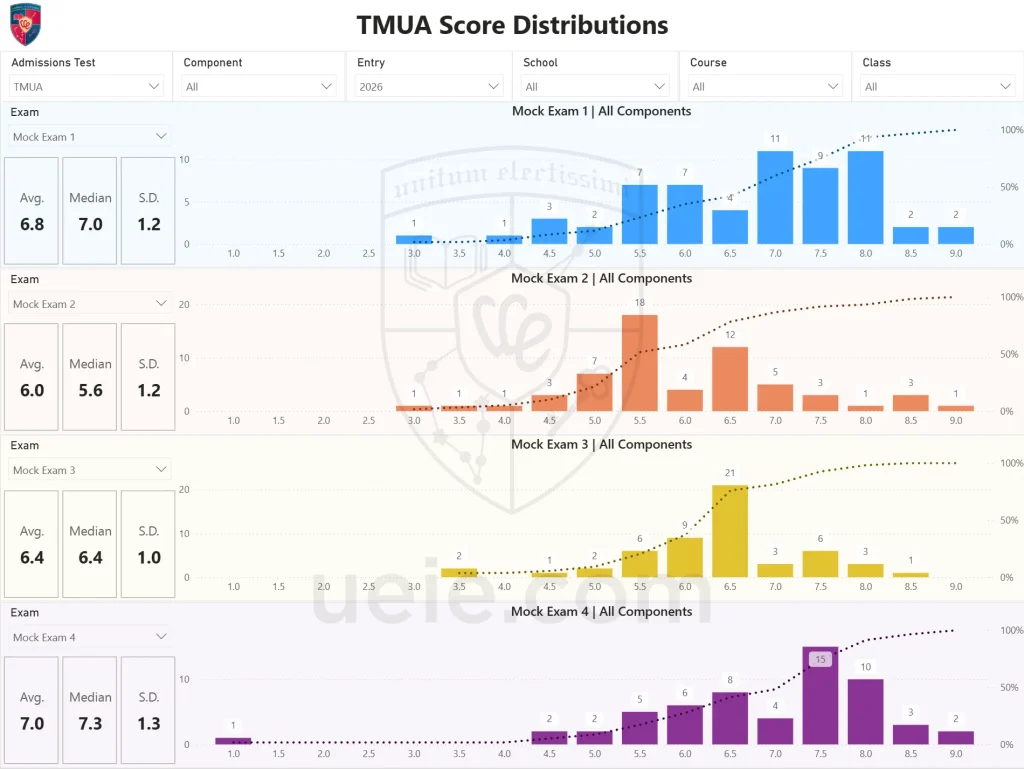
    Our TMUA Score Distribution Graph (see below) perfectly captures how the whole group of student ‘evolved’ through these repeating ‘stress-and-recover’ cycles. Let’s break down the rhythm behind these curves.

    Round 1: ‘Pressure and Recovery’ (Mocks 1-4)

    2025 TMUA Post-Exam Analysis
    UEIE Mocks 1-4: TMUA Score Distribution & Averages
    (Exam Period: Sept-Oct 2025)

    First, the students set their baseline in Mock 1 (‘Simulation’). Then, we immediately hit them with a high-intensity stress test in Mock 2 (‘Challenge’), and you can see the scores clearly shift to the left (the average dropped from 6.8 to 6.0). This ‘planned dip’ was designed to expose all their weak spots. After that, Mock 3 (‘Simulation’) let them apply what they’d learned in a realistic test, and Mock 4 (‘Confidence’) pulled the difficulty back a bit. This let them consolidate their knowledge, rebuild their confidence, and you see the scores shoot right back up (average climbing to 7.0).

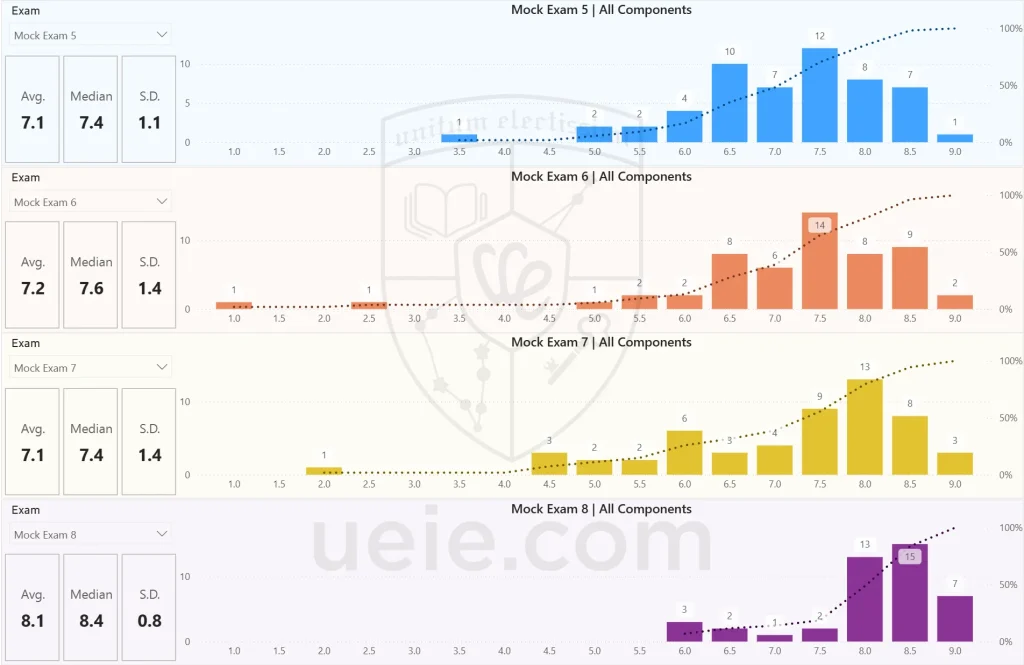
    Round 2: ‘Forging and Peaking’ (Mocks 5-8)

    2025 TMUA Post-Exam Analysis
    UEIE Mocks 5-8: TMUA Score Distribution & Averages
    (Exam Period: Oct 2025)

    Then, we simply repeated the cycle. But look closely: in Mock 6 (the second ‘Challenge’ test), the group’s scores didn’t nosedive this time. This is the single best bit of proof that the training was working: their knowledge base and their ability to handle pressure had been systematically toughened up, so they could take on the hard stuff without buckling. Finally, by Mock 8 (‘Confidence’), the entire group surged to a peak average of 8.1 and a median of 8.4, and they were all tightly clustered together with a standard deviation of just 0.8.

    2. The ‘Micro’ Journeys: Two Classic Paths to the Top

    Of course, this clever training rhythm needs to be paired with spot-on diagnostics. Our Student Personal Report system plots a totally unique growth curve for every single student. Here are the two most typical success stories.

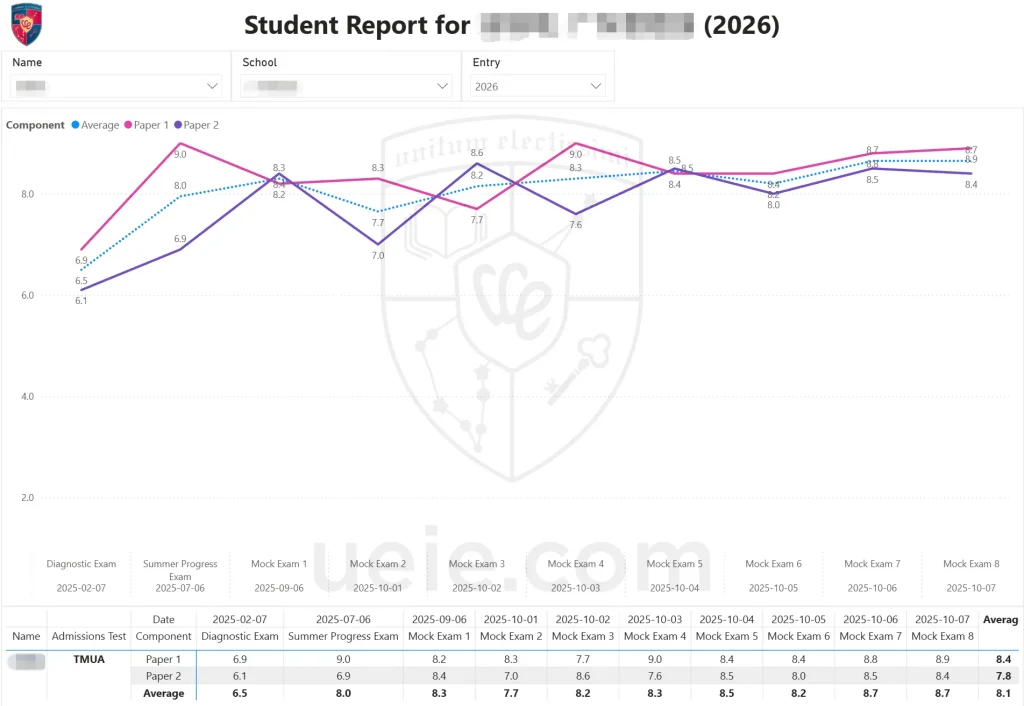
    The Textbook Case of ‘Excellence and Stability’

    2025 TMUA Post-Exam Analysis
    Typical Student (A) – Mock History
    (Studying from Feb-Oct 2025)

    Look at this student’s curve. It barely flinched, even during the two ‘Challenge’ mocks (2 and 6). It just shows how incredibly resilient they are. This proves our system helps top-tier students stay on top, handle the pressure, and turn excellence into a stable, repeatable habit.

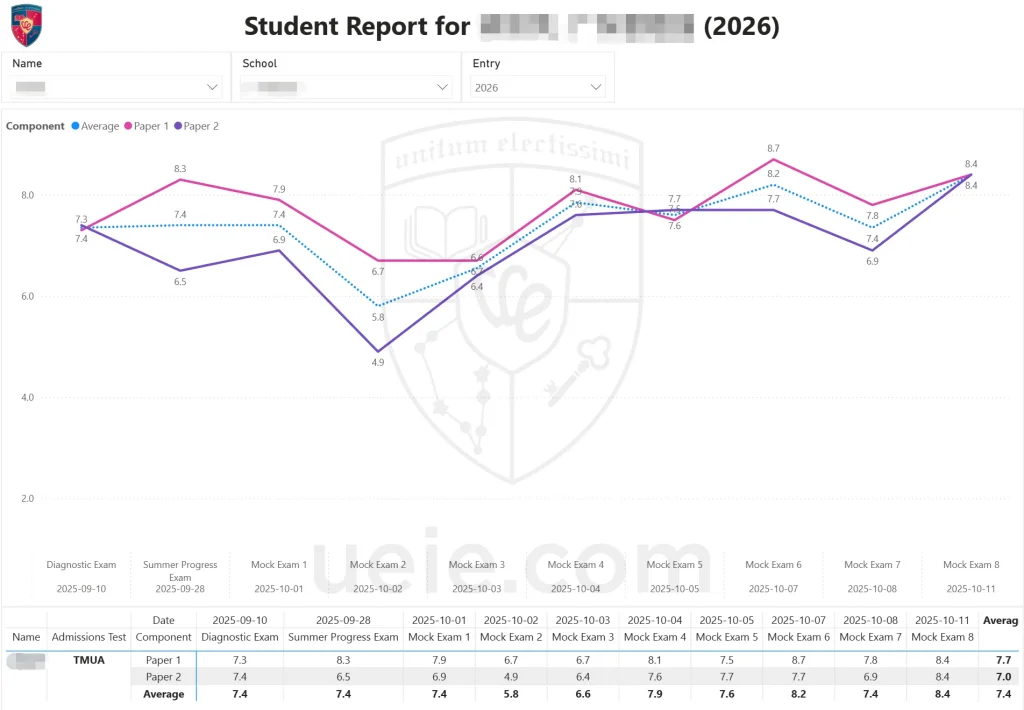
    The Definition of ‘Resilience and Breakthrough’

    2025 TMUA Post-Exam Analysis
    Typical Student (B) – Mock History
    (Studying from Sept-Oct 2025)

    This student did a full sprint-prep in less than two months, and their graph is the perfect ‘pressure-and-recovery’ story. This is what efficient prep and a personal breakthrough look like. They took a massive hit in Mock 2, but that became the catalyst. They used it to push on, climbed steadily through the rest of the mocks, and hit a new personal best in Mock 8. It’s just undeniable proof that our system can effectively guide students to learn from their ‘failures’ and come out stronger on the other side.

    III. What’s Next: Turning Your TMUA Edge into an Interview Win

    Look, a top-notch TMUA score is a massive piece of academic proof when you’re applying for courses like Computer Science, Maths, or Economics at places like Cambridge, Imperial, and Warwick. But let’s be honest: all it does is get your foot in the first door.

    The real decider is the interview. And it’s testing a completely different set of skills from the written exam. This is where you go from ‘theory on paper’ to a ‘face-to-face showdown’. The interviewers aren’t just looking for a student who can churn out the right answer anymore. They want to see a future academic—someone who can clearly explain how they’re thinking, even when they’re under pressure, and who shows genuine academic curiosity and a logical mind.

    So, we’ve taken the exact same hardcore, systematic approach we used to deconstruct the TMUA exam, and we’ve applied it to deconstructing the interview. That’s why the UEIE Oxbridge Interview Coaching programme is now officially live. Our goal is dead simple: to take all the knowledge and confidence you built up for the exam and turn it into a decisive, winning performance in that interview room. We’re here to get you over that ‘final mile’.

    Our entire course is built around three core modules:

    1. 1-to-1 High-Fidelity Mock Interviews

    These are led by tutors with serious, senior-level interview experience from Oxbridge and Imperial. We perfectly replicate the pressure and academic depth of the real thing, giving you proper, hands-on combat practice.

    2. Logical Framework & Verbal Expression Training

    We don’t feed you ‘standard answers’. We train you how to build and communicate your thought process, clearly, even when you’re under the cosh. This is the toolkit that will let you handle any curveball question they throw at you with total confidence.

    3. Pushing Your Horizons to the Academic Frontier

    We’ll get you discussing cutting-edge topics that go way beyond the A-Level syllabus. This is all about helping you build your own unique academic perspective, so you can walk in there and show them you’ve got real passion and huge potential for the subject.

    Act Now

    To make sure the coaching quality is absolutely top-tier, our interview places are strictly limited, and they are only available to students who have already bought UEIE courses or study materials. If history is anything to go by, these spots will be snapped up incredibly fast.

  • ESAT & TMUA Sprint Playbook

    ESAT & TMUA Sprint Playbook

    In early September 2025, with just one month remaining until key admissions exams like the ESAT and TMUA, we conducted our third stage of benchmark exams. This serves not only as an assessment of past efforts but also as our most valuable strategic roadmap for the final push.

    This report provides an in-depth analysis of the exam data, helping you to clearly see your progress, pinpoint areas for improvement, and formulate the most effective preparation strategy for the final thirty days. Remember, every moment of reflection now is an investment in a successful outcome.

    I. About the Exams

    1. Exam Details

    ProgramStage 1:
    Diagnostic Exam
    Stage 2:
    Summer Progress Exam
    Stage 3:
    Benchmark Exam
    Exam TypeESAT & TMUA
    Question SourceOriginal Mock Exams
    Exam FormatTime-limited Online Exam
    Exam Difficulty★★★★★★★☆★★★★
    Exam DatesFeb-Jun, 2025Jul-Aug, 2025Early Sep, 2025
    Exam Scope

    Open to the public globally*

    Internal Exam

    Internal Exam

    No. of Participants150+50-6060-70

    * The exam was open to participants of all nationalities and ages, with the majority coming from over 30 countries and regions, including mainland China, the UK, India, and Hong Kong.

    ** The difficulty level was benchmarked against the October 2024 ESAT and TMUA examinations: ★★★

    2. Exam Papers and Score Conversion

    To ensure fairness and validity, all exams used highly realistic, custom-written questions, with no past paper content. The time limits were identical to the actual exams, and the computer-based exam interface replicates the official platform with over 99% accuracy.

    Links to all exam papers and their score conversion tables can be found below. Please note that access to most papers, excluding the diagnostic exam, requires authorisation.

    Exam Stage
    Exam Papers (and Links)Score Conversion Table
    Conversion Table Version Used
    Diagnostic Exam
    TMUA Diagnostic ExamPaper 1
    Paper 2
    2025.06.30
    ESAT Diagnostic ExamMaths 1
    Maths 2
    Physics
    Chemistry
    Biology
    Summer Progress Exam
    TMUA Summer Progress ExamPaper 1
    Paper 2
    2025.08.30
    ESAT Summer Progress ExamMaths 1
    Maths 2
    Physics
    Chemistry
    Biology
    Benchmark ExamTMUA Mock Exam 1Paper 1
    Paper 2
    2025.09.08

    ESAT Mock Exam 1

    Maths 1
    Maths 2
    Physics
    Chemistry
    Biology

    3. Explanation of the Score Conversion Table

    To ensure that a student’s score accurately reflects their relative standing among global candidates, UEIE academic team applies its deep professional experience and a unique algorithmic model to conduct a curve-fitting analysis of the exam data. This process generates a unique score conversion curve for each exam paper, from which the corresponding score conversion table is derived.

    Please note that as we continuously acquire new performance data, the conversion curve for each exam is dynamically optimised. Consequently, minor differences may be observed in tables viewed at different times.

    Furthermore, although the difficulty level varies between exams, our conversion model has minimised the impact of this variable on the final score to a negligible level.

    4. A Brief Guide to the Reported Score

    The percentage score is converted into a Reported Score on a scale of 1.0 to 9.0, with 9.0 being the maximum mark.

    The number of correct answers needed for a certain score varies by paper and is detailed in each conversion table.

    The table below shows the general correlation between Reported Scores and global candidate rankings.

    Reported Score
    Approximate Global Ranking
    8.5Top 3%
    8.0Top 5%
    7.5Top 10%
    7.0Top 15%
    6.5Top 20%
    6.0Top 25%
    5.0Top 50%

    (The data in the table represents the personal opinion of Xie Tao.)

    II. Performance Data and Statistics

    To simplify this analysis, the Reported Scores for students across the ESAT and TMUA exams have been combined.

    • For TMUA, the average of the two papers is used.
    • For ESAT, the average of the three sections is used.
    • The average Reported Scores of all students from each exam onstitute the raw data.

    1. Performance Trend Over Time

    MetricDiagnostic ExamSummer Progress Exam
    Benchmark Exam
    Mean Score
    5.376.376.78
    Median5.46.46.9
    Standard Deviation
    1.510.970.89

    2. Performance Histograms from Each Exam Stage

    ESAT & TMUA Sprint Playbook
    Diagnostic Exam Scores
    (February – June 2025)
    ESAT & TMUA Sprint Playbook
    Summer Exam Scores
    (July – August 2025)
    ESAT & TMUA Sprint Playbook
    Benchmark Exam Scores
    (Early September 2025)

    III. Our Progress: Growth Demonstrated by Data

    Comparing the data across the three exam stages reveals encouraging signs of progress:

    • Significant improvement in overall performance: Both the mean and median scores show a steady upward trend, with the mean score rising from 5.37 to 6.78. This proves the effectiveness of the systematic revision and training from the first two stages.
    • The performance gap is narrowing: A steady decrease in the standard deviation (from 1.51 to 0.89) shows that the gap between students is closing. Higher-performing students are consolidating their strengths, while others are working hard to catch up, creating a positive and competitive atmosphere.

    IV. Priorities for the Home Straight: Eight Key Areas to Conquer

    While this improvement is commendable, we must address the common challenges revealed in this exam. Think of these not as “problems,” but as your clearest opportunities to boost your score.

    1. Knowledge Retention: Forgetting recently learned topics, particularly in TMUA Paper 2 and the ESAT science sections.
    2. Conceptual Ambiguity: Imprecise understanding of fundamental concepts and definitions, leading to lost marks on “trick” questions.
    3. Calculator Dependency: Reduced speed and proficiency in manual calculation due to long-term reliance on calculators.
    4. Reading Speed Bottlenecks: Slow processing of technical English and long questions, which impacts problem-solving efficiency.
    5. Sub-optimal Strategies: Using conventional methods to solve problems when faster, more elegant techniques would save valuable time.
    6. Reduced Practice Time: Summer activities and personal statements have squeezed practice time, leaving students feeling out of touch.
    7. Stamina and Endurance: A noticeable decline in concentration and energy during longer exams (over 1.5 hours).
    8. Mindset and Focus Under Pressure: Performance being affected by technical issues, simple errors, or seeing an interim score update.

    V. To Our Students: Execute Your Final Push Plan

    To address these key areas, execute the following strategies with focus and precision over the final month:

    Consolidate Knowledge (For points 1 & 2)

    Action: Don’t just review your mistakes—dissect them. Group errors by topic for deeper reflection. Write out key definitions and formulae and place them where you’ll see them every day.

    Practise Deliberately (For points 3 & 4)

    Action: Take the “Calculator Detox” challenge. From now on, do all calculations with pen and paper. For reading, set a timer and practise reading technical texts or long-form questions every day to improve your speed.

    Optimise Your Technique (For points 5 & 6)

    Action: Time is your most valuable asset. Commit to a fixed practice schedule. When practising, don’t just aim for the right answer—strive for the “optimal solution.” Master the smart techniques taught in class.

    Simulate Exam Conditions (For points 7 & 8)

    Action: Physical and mental stamina are critical. Use the 7 upcoming mock exams as your training ground. Adhere strictly to official timings and conditions. Remember: the purpose of a mock is to expose weaknesses. Every setback now is designed to ensure a smooth performance on exam day.

    VI. To Our Parents: Providing the Strongest Support

    In this final sprint, your support is your child’s greatest asset. We sincerely recommend that you:

    • Focus on reassurance, not scores: Mock scores are part of the process. Help your child focus on the “why” behind their results and the “how” of their improvement plan. Your trust is the cornerstone of their confidence.
    • Manage the logistics: A consistent routine, nutritious meals, and a quiet study environment are the foundation of effective preparation.
    • Provide emotional support: Pay attention to your child’s emotional state. When they feel anxious, listen more and lecture less. A walk or a relaxed chat can be more effective than any motivational speech.
    • Work in partnership with us: Trust the school, the teachers, and your child. Maintain communication with us so that, together, we can help them succeed.

    VII. Conclusion: Trust the Process, Embrace the Challenge

    This final month is for consolidating knowledge, refining skills, and, crucially, mastering your mindset. We hope this analysis helps clarify the path ahead. Please trust that every ounce of effort you have put in has forged the strength you possess today.

  • TMUA vs MAT Synergy: An Efficient Strategy for Joint Preparation

    TMUA vs MAT Synergy: An Efficient Strategy for Joint Preparation

    I. TMUA vs Oxford MAT: Why Are They So Often Mentioned Together?

    Prospective students and parents targeting mathematics, computer science, economics, or other sought-after degree programmes at Oxbridge or other G5 universities will likely be familiar with the TMUA and the Oxford MAT (hereafter MAT) – two key mathematics admissions tests. Astute parents and students may have already spotted a crucial distinction: TMUA vs MAT — one examination (TMUA) is composed entirely of multiple-choice questions, while the other (MAT) features both multiple-choice and extended-response questions. These are fundamentally different examinations, so why are they often mentioned in the same breath, or even recommended for concurrent preparation? Could this approach dilute one’s focus?

    This is an exceedingly common and pertinent query. This article aims to demystify the situation by directly comparing the TMUA and MAT, thereby revealing their ‘intrinsic connection’. I will explain why, for many students, preparing for these two examinations in tandem is, in fact, a more astute and efficient strategy – one capable of producing a synergistic effect greater than the sum of its parts (a ‘1+1>2’ outcome) – and will outline a clear and practical path to achieve this.

    II. TMUA vs MAT: A Table for Understanding Core Similarities and Differences

    First, let us consolidate the key information for the TMUA and MAT into a table, enabling you to discern their most crucial similarities and differences at a glance:

    Dimension TMUA Oxford MAT
    Managing Body UAT-UK University of Oxford
    Exam Delivery Partner Pearson VUE Pearson VUE
    Response Format Online, computer-based Online, computer-based
    Question Types & Quantity 40 multiple-choice questions 25 multiple-choice questions + 2 extended-response questions
    Examination Duration 2.5 hours 2.5 hours
    Knowledge Base Primarily based on A Level Mathematics + some GCSE Mathematics Primarily based on A Level Mathematics
    Further Mathematics Not required Not required
    Examination Style Emphasis on speed and precision Emphasis on thinking and logic
    Assessed Abilities Rapid and accurate application of knowledge; logical reasoning agility. Rigorous logical thinking; creative problem-solving.
    Permitted Aids Calculators, formula sheets, and dictionaries are all prohibited. Calculators, formula sheets, and dictionaries are all prohibited.
    Scoring Method Standardised score: 1.0-9.0 (converted from raw score) Raw score: 0-100
    Typical Universities / Majors
    • Cambridge (Computer Science, Economics) and compulsory for some Imperial/LSE/UCL programmes.
    • Accepted or alternative for some Warwick/Durham programmes.
    • Compulsory for Oxford Mathematics/Computer Science related programmes.
    Keywords Speed, accuracy, logical reasoning, broad application Logic, problem-solving, mental flexibility, Oxford

    Brief Summary

    Upon reviewing the table, you will observe that the TMUA and MAT do indeed exhibit distinct differences in question format (one being purely multiple-choice, the other a hybrid) and style (one prioritising speed, the other depth). However, their commonalities are also remarkably prominent: both are computer-based examinations, neither necessitates Further Mathematics, both are founded upon A Level core mathematics knowledge, and both place considerable emphasis on logical aptitude. These shared characteristics precisely form the basis upon which we can implement an effective joint preparation strategy.

    III. ‘Combination’ and ‘Separation’: The Rationale and Key Aspects of TMUA MAT Joint Preparation

    Having understood the core similarities and differences, you can now appreciate why the TMUA and MAT are suitable for ‘combined’ preparation, and yet necessitate ‘separate’ training in certain aspects.

    1. Why ‘Combine’? – Unveiling the Intrinsic Connection

    The feasibility and efficacy of joint preparation primarily stem from their close ‘intrinsic connection’.

    A Highly Overlapping Knowledge System is Core

    This is the most crucial point! Both the TMUA and MAT predominantly assess A Level Mathematics knowledge (mainly Pure Mathematics with a small amount of Statistics). Both are built upon core secondary school mathematics knowledge and neither requires the additional burden of studying Further Mathematics. This implies that when revising fundamental modules such as functions, algebra, calculus, and coordinate geometry, a single study pass can satisfy the majority of the knowledge requirements for both examinations, thereby avoiding substantial duplication of effort. This is the most significant efficiency gain!

    Underlying Skills are Transferable

    Whether it is the TMUA’s demand for rapid and accurate logical judgement or the MAT’s requirement for rigorous and in-depth logical analysis, a sound foundation in logical thinking is essential. Similarly, solid fundamental calculation skills, the ability to accurately express oneself using mathematical language, and basic problem deconstruction capabilities are vital for both examinations. Training these underlying skills can yield a ‘dual benefit from a single effort’.

    Consistent Examination Environment

    Both are computer-based examinations conducted at Pearson VUE test centres. Familiarity with the computer-based testing environment, on-screen reading, and online answering procedures is entirely transferable, reducing adaptation costs.

    In simple terms, if we liken examination preparation to constructing a house, the foundational materials and load-bearing columns (core knowledge, underlying skills, examination environment) for the TMUA and Oxford MAT are largely identical. Tutors can construct them simultaneously, saving both time and effort.

    2. Why ‘Separate’? – Unique Skills Require Dedicated Practice

    Naturally, identical foundations do not equate to identical houses. The TMUA and MAT have different emphases regarding skill requirements; therefore, students must undertake specialised training separately.

    TMUA is like a ‘Sprint’

    It demands that students unleash their maximum problem-solving speed and accuracy within an extremely limited timeframe. Consequently, extensive timed multiple-choice question practice is imperative. Students must become proficient in various multiple-choice techniques (such as rapid elimination, substitution of special values, etc.) and develop time management into an ingrained habit. Merely possessing knowledge without the requisite techniques and speed will not suffice to achieve a high score in the TMUA.

    MAT is like ‘Puzzle Solving and Questing’

    It places greater emphasis on a student’s depth of thought and creativity when confronted with unfamiliar problems. Therefore, dedicated practice is needed in deconstructing novel problems, conducting in-depth logical analysis, and learning how to articulate problem-solving processes clearly via the keyboard (to address the extended-response questions). Practising only multiple-choice techniques will not adequately prepare one for the unique intellectual challenges posed by the MAT.

    3. TMUA vs MAT: Brief Summary

    The foundational elements of TMUA and MAT preparation can be tackled together, akin to building overall physical fitness; however, specific skills must be honed separately – a sprinter and a puzzle master will undoubtedly have different specialised training regimens.

    IV. The Efficient Path: The ‘1+1>2’ Approach to Joint Preparation

    Understanding the rationale behind ‘combination’ and ‘separation’ allows us to devise an efficient joint preparation path that truly achieves a ‘1+1>2’ effect.

    1. Wherein Lie the Advantages of ‘1+1>2’?

    The benefits of jointly preparing for the TMUA and MAT are tangible:

    • Time-saving: This is the paramount advantage. Foundational knowledge need only be revised once, averting the repetitive investment of substantial time.
    • Efficient: The enhancement of core abilities (such as logic and calculation) simultaneously benefits both examinations, creating a synergistic learning effect.
    • Effort-saving: Familiarisation with the computer-based testing platform and procedures is only required once.
    • Pragmatic: For students planning to apply simultaneously to Oxford and other top universities requiring the TMUA, this is the most natural and highly efficient strategy.

    2. How to Achieve Efficient TMUA MAT Joint Preparation?

    The key to efficient joint preparation lies in ‘strategy’:

    Fundamental Path: Communalities First, Differences Later

    • Step One (Laying the Foundation): Concentrate efforts on revising and consolidating the common A Level/AS core mathematics knowledge, ensuring conceptual clarity, formulaic proficiency, and computational accuracy. Concurrently, cultivate fundamental logical thinking skills.
    • Step Two (Building the Framework, Dividing the Rooms): Once the foundation is solid, begin introducing targeted practice. On one hand, commence MAT-style in-depth thinking and problem-solving training; on the other, start TMUA-style timed practice to cultivate an initial sense of speed and multiple-choice question response capability.
    • Step Three (Fine-Tuning): Enter the intensive phase, increasing the intensity of specialised training. Engage in extensive timed TMUA multiple-choice question practice, rigorously focusing on speed and accuracy. Simultaneously, concentrate on tackling past MAT papers and challenging problems to refine depth of thought and skills for answering short-answer questions.

    Recommended Preparation Time

    Generally, a systematic preparation period of 5-10 months is considered reasonable (the specific duration will vary depending on the student’s foundational knowledge). The crucial aspect is to commence early and ensure consistent, sustained effort.

    Official Resources are Fundamental

    Official materials (such as sample questions from the TMUA and MAT official websites, syllabuses, past papers, etc.) are fundamental and must be utilised effectively.

    Considering the unique aspects of joint preparation, opting for specially designed joint preparation courses and materials tailored to the characteristics of both the TMUA and MAT will prove to be significantly more effective. For example, the TMUA+MAT On-Demand Prep Suite and the TMUA+MAT Live Classes offered by UEIE.

    Key Recommended Resources

    The greatest value of such resources lies in their optimised design, which already incorporates the ‘combination’ and ‘separation’ learning paths and training content based on the similarities and differences between the two examinations. They can clearly guide students on what to learn first, what to practise subsequently, and how to practise most efficiently, thereby averting the potential waste of time and energy that might arise from students’ own trial-and-error efforts. For those pursuing highly efficient preparation, this is an exceedingly judicious choice.

    3. Reassurance for Parents

    Some parents may harbour concerns: Will preparing for both simultaneously result in neither being mastered thoroughly? On the contrary, a scientific approach to joint preparation is a more intelligent learning strategy. It does not merely amalgamate the content of the two examinations; rather, by integrating the common foundational components, it conserves precious time and energy, enabling the child to address the unique difficulties and skill requirements of each examination with greater composure and focus. This is a structured, efficiency-oriented method, the objective of which is to maximise the outcome of the preparation.

    V. Conclusion: Bid Farewell to Indecision, Progress Efficiently

    In summary, whilst the TMUA and MAT differ in their assessment styles and specific question types, their close ‘intrinsic connection’ in terms of knowledge base and core competency requirements makes joint preparation not only entirely feasible but, for many ambitious students, an intelligent path capable of genuinely enhancing efficiency and achieving a ‘1+1>2’ effect.

    The key to success lies in employing appropriate methodology: fully leveraging their commonalities to efficiently establish a solid foundation, whilst also clearly recognising their differences and undertaking precise, specialised skills training.

    It is hoped that the analysis herein will help to dispel any doubts and instil confidence in your forthcoming preparation planning. It is advisable to consider adopting structured, systematic joint preparation schemes and high-quality resources to ensure a smoother and more efficient preparation journey.

    Want to learn more? Please see:

  • STEP vs TMUA vs MAT: A Strategic Comparison to Choose Your Maths Test

    STEP vs TMUA vs MAT: A Strategic Comparison to Choose Your Maths Test

    If you intend to apply for mathematics, computer science, or economics-related courses at top G5 universities in the UK, such as Oxbridge or Imperial College, you may need to face one of three examinations: STEP, TMUA, or MAT. The requirements for these examinations vary, often leaving applicants perplexed: STEP vs TMUA vs MAT — Which one should I prepare for? What are the differences between them? Which is most suitable for me?

    Choosing the right examination and planning your preparation schedule appropriately can help you avoid detours and improve efficiency. This article will provide you with a clear and comprehensive comparative guide, analysing the core differences between STEP, TMUA, and MAT in terms of assessment focus, examination format, knowledge requirements, difficulty level, style, and specific university requirements. After reading this article, you will be better able to determine which examination best matches your target institutions and personal circumstances, thereby enabling you to make the most informed choice.

    I. STEP vs TMUA vs MAT: Overview of the Three Examinations

    To begin with, and before delving into a detailed comparison, the table below provides a quick outline of the core information for each of the three examinations – STEP, TMUA, and MAT – to help you form a basic impression.

    DimensionCambridge STEPTMUAOxford MAT
    Managing BodyUniversity of CambridgeUAT-UKUniversity of Oxford
    Exam Delivery ProviderOCR Examination BoardPearson VUEPearson VUE
    Answering FormatPen-and-paperOnline computer-basedOnline computer-based
    Question TypesExtended answer questionsMultiple-choice questionsMultiple-choice + Extended answer questions
    Key CharacteristicsLong, challenging questions; requires Further Mathematics knowledge; emphasises proof process.High time pressure; requires A-Level Mathematics; assesses speed, precision, logical judgment.Based on A-Level Mathematics, does not require Further Mathematics; emphasises flexibility of thought.
    Typical Universities / Courses Requiring Exam
    • Mandatory for Mathematics at Cambridge
    • Accepted or recommended by Imperial/Warwick etc.
    • Mandatory for Computer Science, Economics at Cambridge & certain courses at Imperial/LSE/UCL
    • Accepted/alternative at Warwick/Durham etc.
    • Mandatory for Mathematics/Computer Science related courses at Oxford.
    KeywordsDepth, Rigour, Proof, CambridgeSpeed, Accuracy, Logical Reasoning, Wide ApplicabilityLogic, Problem Solving, Flexibility of Thought, Oxford

    II. STEP vs TMUA vs MAT Comprehensive Comparison: Analysis of Key Dimensions

    Having gained a basic impression of the three examinations, this section will provide a more comprehensive and detailed analysis, comparing the differences between STEP, TMUA, and MAT across multiple key dimensions.

    1. Assessment Objectives and Focus

    • Cambridge STEP: The core objective is to test profound mathematical thinking and rigorous proof-writing ability. Specifically, it requires students not only to solve problems but also to clearly and completely justify every step of their solution process, akin to conducting a small mathematical investigation. Therefore, it is suited for demonstrating a solid mathematical foundation and logical reasoning capability.
    • TMUA: The core objective is to test the fluent application of mathematical knowledge and the agility of mathematical reasoning. It demands that students, under strict time constraints, quickly and accurately recall foundational knowledge (primarily AS Level) and make logical judgments. It is suited for demonstrating a solid foundation and efficient cognitive responsiveness.
    • Oxford MAT: The core objective is to test a deep understanding of mathematical concepts and creativity in solving novel problems. It requires students to flexibly apply foundational knowledge (primarily A Level) and find breakthroughs via logical analysis in situations without fixed ‘routines’. It is suited for demonstrating flexibility of thought and mathematical intuition.

    2. Applicable Universities and Course Requirements

    University admissions policies may change annually. The table below is for reference only, based on information current as of 2025. Applicants for 2026 entry and beyond must consult the official websites of their target universities and courses for the latest, definitive information.

    DimensionCambridge STEPTMUAOxford MAT
    Main Mandatory Requirements (Uni/Course)
    • University of Cambridge: Mathematics
    • University of Cambridge: Computer Science, Economics
    • Imperial College: Mathematics Dept., Economics, Finance & Data Science, some Computer Science Dept. courses etc.
    • LSE: Economics, Econometrics, Mathematics & Economics etc.
    • UCL: Economics
    • University of Warwick: Mathematics, Statistics, Computer Science, Economics etc.
    • Durham University: Some courses
    • University of Oxford: Mathematics, Computer Science related courses
    Recommended / Accepted Alternative / Other
    • University of Warwick: Can be substituted with TMUA/AEA
    • Imperial College: Can supplement TMUA in special circumstances
    • UCL: Can be used to lower A Level requirements, or substituted with AEA
    • University of Bath etc.: May accept/recommend
    • University of Oxford: Participation officially encouraged
    • Warwick: Mathematics, Statistics accept STEP/AEA as alternatives
    • Imperial, Warwick etc.: no longer require or accept MAT
    Summary PositioningCore requirement for Cambridge Mathematics, accepted by some other institutions.Widest applicability, covering Maths, Comp Sci, Economics at many top institutions.Core requirement for University of Oxford.

    3. Examination Format and Structure

    Dimension Cambridge STEP TMUA Oxford MAT
    Examination Mode Pen-and-paper Paperless computer-based Paperless computer-based
    Question Types Extended answer questions Multiple-choice questions Multiple-choice + Extended answer questions
    Paper Construction Globally uniform paper Question bank based (papers may differ slightly by region/session) Globally uniform paper
    Number of Questions STEP 2 & STEP 3: 12 questions per paper, answer any 6. Papers 1 & 2: 20 questions each, total 40 multiple-choice, answer all. Total 25 multiple-choice + 2 extended answer (keyboard input), answer all.
    Examination Duration 3 hours / per paper 2.5 hours (75 mins each for Paper 1 & 2) 2.5 hours
    Permitted Aids Calculators, formula sheets, dictionaries NOT allowed. Calculators, formula sheets, dictionaries NOT allowed. Calculators, formula sheets, dictionaries NOT allowed.

    4. Marking Scheme and Result Presentation

    DimensionCambridge STEPTMUAOxford MAT
    Scoring MethodOnly the best 6 questions scored (20 marks each), total 120.All 40 multiple-choice questions scored (1 mark each), raw total 40.All questions scored (MCQ weighted by difficulty, total 70; Extended answers 15 marks each with partial credit), total 100.
    Result FormatGrades: S, 1, 2, 3, U (S highest)Standardised score: 1.0 – 9.0 (one decimal place)Raw score: 0 – 100
    Score ThresholdsVariable, adjusted annually based on paper difficulty and candidate performance.No ‘pass mark’; score significance depends on application context.No fixed ‘offer threshold’; Oxford uses holistic assessment, score significance interpreted against historical data.
    Competitiveness ReferenceCambridge typically requires Grade 1 or S; other institutions may require Grade 2 or above.Generally, 6.5+ considered competitive; 7.0+ strong; 8.0+ highly competitive.Oxford offer-holders often average around 70; recent trend suggests rising scores, mainland Chinese students may need higher for interview.

    5. Comparison of Knowledge, Difficulty, and Style

    DimensionCambridge STEPTMUAOxford MAT
    Knowledge RequirementSTEP 2: A Level Maths + AS Further Maths
    STEP 3: A Level Maths + A Level Further Maths
    Primarily based on A Level Maths + some GCSE MathsPrimarily based on A Level Maths
    Further MathematicsRequiredNot requiredNot required
    Question StyleDepth & Rigour: Assesses deep understanding and complex application of knowledge, emphasising rigorous, multi-step proof processes. Structured, progressive questions, akin to mini mathematical research.Speed & Application: Assesses fluent mastery and rapid, accurate application of foundational knowledge, plus agility in logical reasoning. Short, fast-paced questions focused on reaction speed and calculation/judgment precision.Flexibility & Creativity: Assesses profound understanding of basic concepts and flexible application in novel contexts, emphasising logical analysis and creative problem-solving. Cleverly designed questions, sometimes like mathematical puzzles, prioritising insightful approaches.
    Source of DifficultyDepth and breadth of knowledge (esp. Further Maths); high standard for proof rigour; question length and computational complexity; requires problem-solving stamina.Extreme time pressure (avg. 3.5 mins/question); demands exceptional speed and accuracy in calculation/judgment; requires swift judgement in logical reasoning questions.Novelty/’non-routine’ nature of questions; demands depth and rigour in logical thinking; requires creative application of basic knowledge to unfamiliar scenarios.
    Difficulty Rating★★★★★★★★★★★☆
    Comparison with A-LevelFar exceeds A-Level, particularly in depth of thought, proof requirements, and breadth of knowledge (incl. Further Maths).Significantly exceeds A-Level, mainly in demands for speed, precision, and logical application.Far exceeds A-Level, especially in depth of logical reasoning, creativity in problem-solving, and flexibility of thought.

    Summary Points

    • Knowledge Threshold: STEP has mandatory Further Mathematics requirements, the highest amongst the three. The knowledge base for TMUA and MAT is relatively closer to standard A Level.
    • Core Challenge: STEP’s difficulty lies in depth and proof; TMUA’s in speed and efficiency; MAT’s in thinking and novelty.
    • Difficulty Consensus: All three examinations are considerably more challenging than A Level examinations, requiring a higher level of mathematical proficiency and ability.

    III. How to Choose: Selecting the Most Suitable Examination for You

    Having understood the detailed differences between the three examinations, the question now is: which examination(s) do you need to prepare for? The following steps will guide you in making an initial determination:

    1. Step 1: Identify Mandatory Requirements

    This is the decisive starting point for choosing an examination, overriding all other factors.

    Clarify Targets: Clearly identify all the universities and specific courses you plan to apply for.

    Verify Official Websites: Visit the official admissions pages for each of these university courses one by one. First, find and confirm the latest, most accurate entrance examination requirements for your intended year of entry (e.g., 2026). Crucially, pay attention to keywords such as ‘Required,’ ‘Recommended,’ ‘Accepted Alternative,’ etc..

    Determine Mandatory Exams: Based on the official information, determine which examinations you must take.

    • Applying to Oxford Mathematics/Computer Science etc. → MAT is mandatory.
    • Applying to Cambridge Mathematics → STEP is mandatory.
    • Applying to Cambridge Computer Science/Economics → TMUA is mandatory.
    • Applying to Imperial/LSE/UCL/Warwick etc. for Mathematics, Computer Science, Economics → Check specific requirements; TMUA is often mandatory, but note if alternatives are accepted.

    Completing this step clarifies the examination hurdles you must overcome. Consequently, for some students, the result might be needing to prepare for only one examination; in contrast, for others, it might mean facing the challenge of two or even three examinations simultaneously.

    2. Step 2: When Options Exist, Match with Personal Attributes

    You only need to consider this second step under the following circumstances:

    • University Offers Multiple Options: Your desired university/course accepts more than one examination result (e.g., Warwick accepts TMUA/STEP/AEA).
    • Saving Preparation Time and Effort: You are required to take multiple examinations and need to judge which one better aligns with your natural strengths to allocate preparation effort more reasonably.
    • Considering Optional Exams for Enhancement: You are considering taking a non-mandatory examination (e.g., Oxford encourages STEP) to strengthen your application competitiveness.

    In such cases, consider the following personal factors to determine which examination allows you to best leverage your strengths:

    Academic Background and Strengths

    • Is Further Mathematics your comfort zone, and do you enjoy rigorous proofs? → STEP might be a good fit.
    • Is your foundational mathematics exceptionally solid, are you fast and accurate in calculations, and is your logic clear? → TMUA’s requirements might highly match your abilities.
    • Can you demonstrate profound understanding without relying on Further Mathematics, are you flexible in thinking, and adept at clever solutions? → MAT’s style might suit you better.

    Learning and Examination Preferences

    • Prefer immersive problem-solving on a few challenging questions? → STEP’s format (choose 6 from 12).
    • Prefer fast-paced responses to a variety of questions (multiple-choice)? → TMUA’s format.
    • Prefer logical puzzles and showcasing thought processes (multiple-choice + extended answers)? → MAT’s format.

    Available Preparation Time

    • Ample time, able to commit long-term (9-12 months+)? → Better equipped to handle STEP’s depth requirements.
    • Relatively limited preparation time, needing efficient improvement? → Preparation for TMUA or MAT (especially a TMUA+MAT combination) might offer higher time efficiency.

    3. Summary

    The primary basis for choosing an entrance examination is the undeniable mandatory requirement set by the target university. Beyond that, personal academic strengths, learning preferences, and time planning are important considerations for making a choice (when options exist) or optimising your preparation strategy.

    IV. Addressing Multiple Challenges: Common Examination Combinations and Preparation Strategies

    If you plan to apply simultaneously to several top universities (e.g., Oxbridge, Imperial, LSE) for mathematics, computer science, or economics courses, you will likely need to prepare for multiple entrance examinations. Below are suggestions for preparation timelines and strategies for common combinations of these three examinations.

    1. STEP + TMUA Combination

    Applicable Universities and Courses: Simultaneously applying to Cambridge University and other G5 universities for mathematics-related courses.

    Suggested Preparation Period: 12 months or more. Sufficient time is needed to separately hone the depth required for STEP and the speed for TMUA.

    Core Preparation Strategy:

    • Specialised Training: Independent, high-intensity specialised practice sessions must be arranged to address STEP’s depth of proof and Further Mathematics, alongside TMUA’s timed multiple-choice answering, speed, and precision.
    • Style Switching: Focus on adaptability training to switch between two vastly different problem-solving styles and thinking modes.

    2. TMUA + MAT Combination

    Applicable Universities and Courses: Simultaneously applying to Oxford University and other G5 universities for mathematics or computer science related courses.

    Suggested Preparation Period: Preparation time varies depending on mathematical foundation, generally 5-10 months is recommended.

    Core Preparation Strategy:

    • Integrated Foundation: Leverage the high degree of knowledge overlap to consolidate foundational review and core competency training.
    • Differentiated Training: Specifically strengthen TMUA’s timed multiple-choice speed and techniques, alongside MAT’s logical depth and extended answer argumentation.
    • Resource Utilisation: Consider using resources specifically targeting this combination (e.g., the UEIE TMUA+MAT series) to maximise preparation efficiency.

    3. STEP + TMUA + MAT Combination

    Applicable Universities and Courses: Uncertain initially whether applying for Cambridge or Oxford mathematics, or wishing to enhance mathematical proficiency through STEP preparation, ultimately deciding to apply for Oxford and other G5 universities for mathematics or computer science related courses.

    Suggested Preparation Period: 18 months or more. An extreme challenge to time, ability, and perseverance.

    Core Preparation Strategy:

    • Realistic Assessment: Prudently evaluate your own abilities and goals, setting feasible expectations.
    • Intensive Planning: Develop an extremely detailed plan integrating the requirements of all three, potentially requiring trade-offs in some areas.
    • Seek Support: Strongly recommended to seek guidance from experienced professionals and efficiently utilise all available resources.
    • Focus on Core: Within extremely limited time, prioritise ensuring absolute solidity in core knowledge and common competencies before undertaking the most efficient training for specialised skills.

    V. Conclusion and Action Recommendations

    Through the comprehensive comparison in this article, it is hoped you now have a clearer understanding of the three entrance examinations: STEP, TMUA, and MAT. Let us summarise the core points:

    • Cambridge STEP: Characterised by its depth, rigour, and requirement for Further Mathematics, it focuses on assessing students’ ability to undertake complex mathematical proofs and deep thinking, serving as a hallmark threshold for courses like Cambridge Mathematics.
    • TMUA: With its high demands on speed, accuracy, and logical reasoning, it focuses on assessing students’ ability to fluently apply core mathematical knowledge under time pressure, having the broadest range of applications.
    • Oxford MAT: By examining flexibility of thought, logical depth, and creative application of foundational knowledge, it focuses on assessing students’ mathematical potential and ability to solve novel problems, serving as Oxford University’s distinctive selection tool.

    So, having clarified these differences, what should you do next?

    First Priority

    Verify Official Requirements! To reiterate, the final decision on which examination(s) to take rests with the universities and courses you are applying to. You need to log onto the official admissions websites of your target institutions to understand the latest, most accurate entrance requirements. Any non-official information (including this article) can only serve as a reference.

    Gain In-depth Understanding of Relevant Exams

    After determining the examination(s) you need to take, it is recommended you read my detailed guides and preparation guides for the relevant examinations to obtain more in-depth information:

    Focus on Specific Combinations

    If you find you need to take both TMUA and MAT, you can further read my analysis on preparation strategies for this combination:

    Understand the Registration Process

    Once you have decided on the examination(s), familiarise yourself with and prepare for the registration procedures in a timely manner:

    Plan and Prepare Early

    Regardless of which examination you choose, thorough preparation is key to success. Utilise the relevant preparation guides, formulate a detailed preparation plan early on, and put it into action. If needed, consider leveraging high-quality preparation resources, such as:

    Choosing the correct entrance examination is a significant step towards your dream university. I hope the comparative analysis in this article illuminates the path ahead, helping you make the decision best suited to you. Wishing you smooth preparation and successful applications!

  • Conquer the TMUA: Speed & Accuracy Training for Top Maths Scores

    Conquer the TMUA: Speed & Accuracy Training for Top Maths Scores

    TMUA Prep Guide

    Preparing for the TMUA test can often leave students feeling uncertain: How much preparation time is really needed? How can I effectively improve my speed and accuracy? Which study methods will work best for me? This TMUA Preparation Guide aims to address questions like these.

    This guide draws on my years of practical experience and insights gained from coaching students for Oxbridge admissions tests and mathematics competitions. It focuses on how to set realistic preparation goals, develop the core mathematical abilities needed for TMUA, employ effective study strategies, plan your preparation time sensibly, make the best use of various resources, and sidestep common preparation pitfalls.

    Before you dive into this guide, it’s a good idea to familiarise yourself with the basics of the exam by reading the TMUA Comprehensive Guide.

    I. Setting Goals and Adjusting Your Mindset for TMUA Preparation

    Getting started with your TMUA preparation first requires a clear sense of direction and some self-awareness. Setting sensible goals and having the right mindset will provide a solid foundation for your subsequent systematic preparation.

    1. Clarify Target Requirements

    What specific TMUA score does your chosen university and course require? Roughly what score range is considered competitive? This information essentially sets your target. Please carefully check your target university’s official website. Confirm the latest admission requirements for your application year. (You can find an overview of this information in Section III of the TMUA Comprehensive Guide.)

    2. Conduct a Preliminary Self-Assessment

    Before formally starting your systematic preparation, taking a diagnostic test (a baseline test) to gauge your starting point is crucial. This helps you to:

    • Get a feel for the style of TMUA questions, the time pressure involved, and the actual difficulty level.
    • Get an initial idea of your current mathematical proficiency and where the gaps lie compared to what TMUA requires.

    3. How to Conduct a Diagnostic Test?

    • Choosing a Test
      • You could use official past papers from earlier years for a practice run.
      • Recommended Approach: To help you get a more accurate and comprehensive self-assessment, based on years of research into the TMUA exam, I (Teacher Xie Tao) have created a dedicated Free TMUA Diagnostic Exam (online computer-based). This test reflects the latest TMUA syllabus and difficulty standards, designed to more effectively assess the core knowledge and skills needed for TMUA. Click the link below for more details and to take the test online.
      • UEIE Free TMUA Diagnostic Exam
    • Taking the Test
      • Environment: Whichever paper you use, you should replicate real exam conditions as closely as possible (online computer-based or a quiet paper-based setting) and complete it on your own.
      • Timing: Time Paper 1 and Paper 2 separately, sticking strictly to the 75-minute limit for each.
      • Marking: Use the official marking scheme or the reference answers and marking guide provided with the diagnostic test to mark it objectively.
      • Result Interpretation and Mindset: Remember, this initial score is just a baseline. The aim is to see where you stand, not to predict your final score. What matters is analysing your mistakes and identifying weak spots. Keep hold of your paper and analysis to track your progress later.

    4. Setting Realistic TMUA Score Goals

    Once you understand the target requirements and your own starting point, the next step is to set sensible, achievable TMUA preparation goals.

    • Understanding Scores
      Remember, TMUA’s 9.0-scale standard score needs to be seen in context – considering both university requirements and the overall competition. Please refer to the analysis of competitiveness across different score bands (e.g., 4.5, 7.0, 8.0+) in Section VI of the TMUA Comprehensive Guide to get a sense of where your target score sits.
    • Setting SMART Goals
      Based on your diagnostic test results, target university requirements, and the time you can realistically commit, set goals that are Specific, Measurable, Achievable, Relevant, and Time-bound (SMART).
      For instance: ‘My target is a score of 7.0 in the October TMUA test. To get there, over the next four months, I aim to consistently achieve a raw score of 32 (which converts to roughly 7.0) in practice mocks, while completing each paper within the 75-minute limit.’
    • Balancing Ambition with Realism
      Your goals need to be challenging enough to push you, but they must also be realistic given your assessment and available time, ensuring they are achievable with effort. Setting overly ambitious goals can easily lead to frustration, which can put you off. It’s also fine, and often necessary, to adjust your goals as you go along based on your progress.

    II. Knowledge Foundation Required for TMUA Preparation

    To prepare successfully for TMUA, you first need a clear picture of the knowledge the exam requires and understand how this applies to you (e.g., whether you’ve finished A Level Maths, or if you’re studying AP/IB).

    1. TMUA Requirements regarding A Level Knowledge

    As mentioned in Section VII, TMUA Syllabus Overview, of the TMUA Comprehensive Guide, the TMUA syllabus is primarily based on AS Level Mathematics content, along with some topics from GCSE Mathematics. Therefore, a solid grasp of the relevant AS and GCSE Maths content is essential.

    2. Is it Necessary to Study A Level Further Mathematics in Advance?

    No, it’s not required. The TMUA syllabus content doesn’t go beyond AS Maths and GCSE. However, in terms of deepening your mathematical thinking and getting ready for university interviews and future study, I strongly recommend studying A Level Further Mathematics if you have the time and capacity. Although not directly tested, the thinking skills and broader knowledge it develops are very useful for tackling some tricky TMUA problems and for your studies later on.

    3. Is a Foundation in Mathematics Competitions Necessary?

    It helps, but isn’t essential. Recently, some TMUA questions have shown a style and difficulty similar to maths competitions, occasionally using basic knowledge and methods common in competitions (like number theory, basic combinatorics, recursive thinking). Consequently, students with competition experience might have a slight advantage with certain difficult problems. For students without this background, don’t worry too much; the core of TMUA is still about applying the syllabus knowledge proficiently. However, during your preparation, if you come across questions with this flavour, it can be helpful to look into some basic competition concepts and techniques to broaden your skills.

    4. Knowledge Alignment for Students from Different Curriculum Systems

    Students studying AP or IB need to be aware of how the coverage differs and prepare accordingly.

    • Advice for AP Students: AP Calculus AB or BC provides a good grounding for much of the pure maths needed for TMUA Paper 1 (especially calculus). However, be aware that TMUA expects more proficiency in sketching graphs by hand, whereas AP Calculus focuses more on using graphic calculators. Therefore, this might need specific practice.
    • Advice for IB Students: Compared to the TMUA syllabus, IB Maths HL (both AA and AI) might not cover certain topics or go into the same breadth in pure maths and statistics. Furthermore, the emphasis on basic calculation and algebraic skills might also be different from what TMUA expects. Combined with the often demanding workload of the IB programme, students doing the IB often find TMUA more challenging.

    III. Core Abilities Essential for High TMUA Scores

    Mastering the required knowledge base is the first step, but to achieve a high score in TMUA, you also need to sharpen the following core skills, which are crucial given the test format (multiple-choice, tight time limits).

    1. Calculation Speed and Precision

    • Core Requirement
      • You can’t use a calculator at any point in the TMUA, and the timing is extremely tight (less than 4 minutes per question on average). This presents a double challenge: you need speed, and critically, accuracy. In a multiple-choice format, any calculation slip-up can lead directly to lost marks, with no marks given for your working.
    • Key Areas for Improvement
      • Sharpening Basic Calculations: Get completely fluent with mental maths and written calculation techniques, especially for common values, formulas, algebraic manipulations, differentiation, integration, etc., until it’s almost second nature.
      • Practising for Speed: Make a point of practising calculations under timed conditions without a calculator to improve how much you can accurately get done in a set time.
      • Prioritising Precision: Get into the habit of being careful and checking your work, particularly with multiple-choice questions, where small errors can easily lead you to pick the wrong answer (a ‘distractor’).

    2. Agility in Mathematical Reasoning

    • Core Requirement
      • Particularly in Paper 2 (Mathematical Reasoning), the test doesn’t just assess logical rigour, but also how quickly you can understand, apply, and evaluate mathematical logic and proofs under pressure. You need to quickly spot the logical connections within problems and identify valid arguments or common mistakes in reasoning.
    • Key Areas for Improvement
      • Understanding Logical Terms: Make sure you precisely understand terms like sufficient, necessary, if and only if, and negation.
      • Recognising Patterns: Practise quickly spotting common proof structures (like the beginning of a proof by contradiction or the structure of induction) so you can grasp their core logic, even if you don’t need to write the full proof.
      • Spotting Errors Quickly: Focus on practising how to spot potential logical flaws or incorrect steps in mathematical arguments.
      • Getting to the Crux: Practise quickly identifying the main line of reasoning within complex descriptions or mathematical statements.

    3. Multiple-Choice Test Strategies and Techniques

    • Core Requirement
      • As TMUA is purely multiple-choice, knowing effective test-taking strategies is just as important as knowing the maths itself. High scorers are often good at using different techniques flexibly to maximise their score in the limited time. Plus, when faced with unusual question types or phrasing, you need to be adaptable.
    • Mastering Multiple-Choice Techniques:
      • Process of Elimination: Get good at using elimination to quickly narrow down the possible answers.
      • Using Special Cases: Try plugging in special values or considering extreme situations to check or rule out options.
      • Estimation & Checking Units: For some questions, check if options are plausible by estimating the magnitude or checking the units.
      • Working Backwards: Sometimes plugging the answers back into the question is quicker than working forwards to the solution.
    • Managing Your Time:
      • Quick Decisions: Practise quickly judging how hard a question is, so you can decide whether to tackle it now, leave it for later, or just make a guess. Avoid getting bogged down on difficult problems.
      • Marking Questions: Mark questions you’re unsure about so you can come back to them if you have time at the end.
      • Being Adaptable: Get better at handling unusual question types by practising problems from different sources and in different styles (including some competition-style problems).
    • To sum up, scoring well in TMUA means being able to calculate quickly and accurately, reason logically and swiftly, and use smart multiple-choice strategies, all under pressure. Developing all three of these skills is key to your TMUA test preparation.

    IV. Core Preparation Strategy and Resource Integration

    1. Core Principle: Fluency, Precision, and Speed

    Unlike STEP, which focuses on deep exploration, the core of TMUA test preparation is getting extremely fluent with the syllabus material and being precise and quick under pressure. Since only a limited number of official past papers have been released, simply drilling these isn’t enough. Successful preparation must be built on solid knowledge fluency, backed up by plenty of targeted practice to sharpen your speed, accuracy, and test-taking technique.

    2. Phase 1: Building Fluency and Consolidating Knowledge

    Goal

    • Go through all the AS and GCSE Maths topics covered by the TMUA syllabus, making sure you know them fluently and can recall them quickly. The focus here is on strengthening your foundations and improving calculation speed and accuracy.

    Actions and Resources

    • Check the Syllabus: Use the latest official syllabus as your guide, going through the topics one by one to ensure nothing is missed.
    • Systematic Revision: Use your AS/GCSE textbooks or resources like MEI to revise or consolidate basic concepts and methods.
    • Practise the Basics: Do plenty of targeted practice with basic and standard problems, focusing on getting fluent and accurate with algebraic manipulation, properties of functions, basic calculus, and so on.
    • Using UEIE Prep Resources: The TMUA Video Lecture Series (with textbook) and TMUA Practice Question Bank can offer systematic topic reviews, explanations of key points, and basic examples during this phase.

    3. Phase 2: Targeted Skill Training and Technique Refinement

    Goal

    • Focus on the specific types of questions and skills TMUA tests. Improve your speed, use of multiple-choice strategies, and quick mathematical thinking. Make up for the lack of official past papers.

    Actions and Resources

    • Analysing Official Materials: Use the limited official sample questions and past papers strategically. Analyse every question in detail, focusing on the approach, common traps, and time allocation. Use the official explanations to understand key techniques.
    • Targeted Practice: You’ll need good quality extra practice resources. The TMUA Practice Question Bank contains loads of practice questions and is key for this stage, allowing for high-intensity, timed training by question type or topic.
    • Refining Techniques: Consciously practise using multiple-choice techniques (elimination, substitution, estimation, etc.), and figure out which methods work best for you.
    • Tackling Harder Problems: For challenging problems in official papers or practice sets, use the explanations for difficult problems in the TMUA Video Lecture Series to learn efficient methods and ways of thinking.

    4. Phase 3: Mock Exams and Final Adjustments

    Goal

    • Fully replicate exam conditions to test your overall level, fine-tune your test-taking strategy, and get into peak condition for the exam.

    Actions and Resources

    • Sitting Full Mocks: Use the latest official samples, past papers you haven’t done yet, or good quality mock tests (like the UEIE TMUA Full-Length Mock Exams) under strict timing (75+75 minutes) without interruptions. Aim to do at least 3 mocks.
    • Testing Your Strategy: Check your approach to choosing questions, managing time, pacing yourself, and using multiple-choice techniques under pressure.
    • Addressing Weaknesses & Mindset: Analyse any problems the mocks reveal and do some final targeted practice. Adjust your mindset and build confidence.

    5. Advice on Choosing TMUA Preparation Resources

    Official Materials:

    • The UAT-UK official syllabus, sample questions, and released past papers are essential materials you must work through thoroughly.

    Supplementing Official Materials:

    • Given the limited official past papers, good quality extra practice resources with plenty of questions (like dedicated practice sets or online platforms) are crucial for TMUA preparation.

    Choosing Wisely:

    • Use other resources (like MEI, relevant books, online forums) selectively based on your needs; avoid getting overloaded with information and stick to core training.

    The UEIE TMUA Test Preparation Solution:

    • Designed to tackle the common problems in TMUA prep – like the lack of official papers and the need for lots of targeted practice and effective score-boosting strategies – I developed the UEIE Education TMUA preparation series based on years of experience. This solution includes:
      • TMUA Video Lecture Series (with PDF textbook): Systematically explains key syllabus points, tricky areas, and problem-solving strategies.
      • TMUA Practice Question Bank (Online): Provides far more practice questions than the official papers offer, categorised by topic and difficulty, filling the gap left by the limited past papers.
      • TMUA Full-Length Mock Exams: A total of 8 mock exams, providing a complete learning and testing cycle.
    • These materials are updated annually (currently the 2025 8th Edition), keeping them up-to-date with exam trends. They aim to help students improve preparation efficiency and enhance the fluency, speed, and accuracy needed for TMUA, helping you aim for your target score. Click to browse the TMUA Prep Hub—Courses, Practice Set & More Resources.

    V. How to Plan TMUA Preparation Time?

    ‘How long do I need to prepare for TMUA?’ There’s no single answer to this, as it varies from person to person. Unlike STEP’s long cycle and focus on depth, the TMUA preparation cycle is generally shorter but demands extremely high intensity and efficiency in training specific skills.

    1. Key Factors

    How long you’ll need mainly depends on:

    • Target Score Band: Are you aiming for 6.5, 7.0, or even higher? Higher targets usually mean more time spent practising and higher intensity training.
    • Starting Proficiency: How solid is your current understanding of AS/GCSE knowledge? How are your calculation speed and accuracy? (Refer back to the self-assessment in Section I).
    • Weekly Time Commitment: How many hours of focused study can you realistically commit to each week?

    While there isn’t a specific ‘300-400 hour’ guideline like for STEP, reaching the higher TMUA scores still demands plenty of focused, efficient practice.

    2. Suggested Timelines Based on Starting Point

    Based on typical student profiles, here are some suggested start times and timelines:

    • Strong Foundation (e.g., STEP Grade 2+ level, or AIME/BMO 1 competition experience): The main focus is adapting to the multiple-choice format, the speed required, and Paper 2’s logical reasoning style. Starting focused training around 2-3 months before the exam (e.g., starting in July-August for the October exam) is usually about right.
    • Average Foundation (e.g., A Level system, no competition or STEP experience): You’ll need to consolidate your knowledge, improve your calculation speed and accuracy, and get used to the TMUA style all at the same time. Starting systematic prep at least 4-6 months before the exam (e.g., starting in May-June for the October exam) is advisable. You’ll need to go through the full cycle of building knowledge fluency, then skill training, and finally mock exam practice.
    • AP/IB System Students (no competition or STEP experience): Besides the challenges faced by those with an average foundation, you’ll need extra time to fill any knowledge gaps and particularly work on calculation speed and accuracy, which might be less of a focus in your regular curriculum. It’s highly recommended to start early, ensuring at least 4-6 months or even longer for preparation (e.g., starting in early May or sooner). You’ll need to combine catching up on knowledge with specific TMUA practice.

    3. Balancing Prep with Schoolwork

    If you’re still at school, balancing things efficiently is key:

    • Fixed Schedule: Slot TMUA preparation into your regular weekly timetable.
    • Utilise Holidays: Use school holidays for intensive revision and to make big strides.
    • Focus on Efficiency: Stay focused during your study sessions and aim for quality over quantity.
    • Flexible Adjustment: Adjust the intensity of your TMUA test prep based on how busy you are with schoolwork (like during exam season), but try to keep it going consistently.
    • Work-Rest Balance: Make sure you get enough sleep and take proper breaks to avoid burning out and becoming less effective.

    VI. Common TMUA Preparation Pitfalls and Countermeasures

    In years of TMUA coaching, I’ve seen some common mistakes that really hinder students’ progress and final scores. Spotting and avoiding these can make your hard work count for more.

    Starting Too Late / Lack of Planning — Pitfall 1

    • What happens: Students underestimate the time needed to reach the required speed and fluency for TMUA. They start too late, meaning they don’t get enough practice later on and struggle to perform consistently under pressure.
    • What to do: Plan ahead and be consistent! Use the timeline suggestions in Section V, start early based on your situation, and stick to a regular, high-quality weekly study routine.

    Wrong Approach – Knowing vs. Being Fluent — Pitfall 2

    • What happens: Thinking that just ‘getting’ a topic is enough, without practising it until it’s extremely fluent, almost automatic; or getting too bogged down in theory and ignoring TMUA’s need for speed and applying the basics; not specifically training multiple-choice strategies.
    • What to do: Focus on Fluency and Strategy! The core task is to practise AS/GCSE knowledge until it’s second nature. At the same time, you absolutely must learn and practise specific multiple-choice techniques to find the best balance between speed and accuracy.

    Not Enough Realistic Practice — Pitfall 3

    • What happens: Doing practice without timing yourself; not doing full mocks under realistic computer-based conditions. This leads to poor time management during the real exam and difficulty adapting to the interface and pressure.
    • What to do: Practise Under Exam Conditions! Start early and frequently do practice under strict time limits. If you can, definitely use an online platform for mocks to get used to the interface and timing.

    Mindset Issues / Too Much Pressure — Pitfall 4

    • What happens: Getting overly anxious about the speed required; losing confidence when faced with hard questions or getting several wrong in a row; being too afraid of the ‘all-or-nothing’ scoring of multiple-choice.
    • What to do: Keep Perspective and Stay Calm! Set realistic goals for each stage, and accept that it’s normal not to finish every question or to get some wrong. Practise quickly skipping hard questions and making strategic guesses when needed. Build your resilience.

    Ignoring Official Resources — Pitfall 5

    • What happens: Not studying the latest official syllabus carefully, leading to gaps in revision; not properly analysing the official samples or the few past papers available, missing chances to understand the question style and what examiners are looking for.
    • What to do: Stick to Official Sources and Analyse Them! Go over every official sample and past paper question thoroughly, analysing the concepts tested, potential traps, and solution methods. Keep a close eye on the UAT-UK website for any updates.

    VII. Final Words: Mindset and Action

    1. Embracing the Challenge: The Right Mindset

    Preparing for TMUA is a test of your speed, accuracy, and mental stamina. Success hinges on your mindset: face setbacks head-on and see them as chances to learn; focus on steady progress, be patient, and put in consistent, high-quality effort; keep calm, focus on your own improvement, and maintain a healthy balance between work and rest. Remember, there are no shortcuts – just sensible planning and consistent hard work.

    2. Time for Action: Next Steps

    Now that you’re clear on the approach, it’s time to act:

    1. Verify Requirements: Check the latest official admissions policies of your target universities and their specific TMUA requirements.
    2. Plan and Begin: Using the TMUA Registration Guide and this guide, make a detailed plan and start straight away.
    3. Utilise Resources Wisely: Make good use of official materials and carefully chosen extra resources (including the UEIE TMUA courses and materials).

    Finally, I wish you the very best – may your hard work and ability lead you to succeed in the TMUA and secure a place at your chosen university!

  • How to Register for TMUA

    How to Register for TMUA

    For students aspiring to read mathematics, computer science, or economics-related degrees at leading UK universities, such as the University of Cambridge and Imperial College London, the Test of Mathematics for University Admission (TMUA) is a vital part of the application process. The TMUA result is a significant factor influencing offers of admission. However, many students and their parents are unacquainted with the particulars of TMUA registration, including the procedures, timelines, and appropriate test session. This article offers a thorough guide to the TMUA registration process, aiming to clarify common uncertainties.

    I. TMUA Organisation and Administration

    Since 2024, the TMUA has been centrally managed by UAT-UK (University Admissions Tests – UK), a not-for-profit organisation. UAT-UK focuses on university entrance examinations in the United Kingdom and currently oversees two computer-based testing programmes: ESAT and TMUA. Pearson VUE delivers these tests. It is the certification and licensure arm of Pearson, an internationally recognized learning company. With a vast network of over 5,500 test centres across more than 180 countries and territories, Pearson VUE provides professional assessment services to academic and admissions bodies globally.

    II. Key Dates for the 2025 TMUA Test

    The TMUA has two test sittings, scheduled for October 2025 and January 2026. The pertinent dates are outlined below:

    1. October 2025 TMUA Test

    31 July 2025 TMUA Registration Opens
    29 September 2025 TMUA Registration Closes
    13 & 14 October 2025 TMUA Test Dates
    14 November 2025 TMUA Results Released

    2. January 2026 TMUA Test

    27 October 2025
    TMUA Registration Opens
    19 December 2025
    TMUA Registration Closes
    8 & 9 January 2026
    TMUA Test Dates
    To Be Confirmed (anticipated within six weeks of the test)
    TMUA Results Released

    Important Notes Regarding Test Window Selection:

    Applicants to the University of Cambridge must register for and sit the October examination. The January examination is not available to Cambridge applicants.

    Specific Date Restriction for Certain Localities:

    The University of Cambridge does not permit candidates from mainland China, Hong Kong, and Macau to sit the TMUA examination on 13 October 2025. Therefore, applicants from these localities targeting Cambridge must sit the TMUA examination on 14 October 2025.

    III. TMUA Registration Procedure

    1. Create a UAT-UK Account

    1. Candidates must create a UAT-UK account on the official Pearson VUE website. (It is prudent to consult the official UAT-UK website for the latest registration guidance).
      ESAT & TMUA Registration Guide - Creat your account - 1
    2. It is imperative that the name used for UAT-UK account registration precisely matches the name on the candidate’s identification document. Discrepancies may prevent the candidate from sitting the examination. Candidates should also ensure their name matches their UCAS application name.
    3. After creating an account, Pearson VUE will email candidates. This email enables them to confirm details and account settings. Candidates should receive it within 24 hours. This email will also include a temporary password for the candidate’s account.

    4. Upon receipt of the account confirmation email, candidates may log in using the temporary password, subsequently change their password, and locate their UAT-UK ID (format: UATUK######) in the top left-hand corner of the page navigation bar.

    2. Examination Booking

    1. Log in to your UAT-UK account on the official Pearson VUE website and select the option to book the TMUA examination.
      ESAT & TMUA Registration Guide - Book a test - 2
    2. Provide personal information pertinent to the examination. The system denotes compulsory fields with an asterisk (*).
    3. Candidates can locate their nearest test centre via the Pearson VUE website to complete their TMUA registration. Please note that sought-after test centres have limited places, especially as the registration deadline approaches. We strongly advise booking well in advance.
      ESAT & TMUA Registration Guide - Choose the test centre - 5

    3. Post-Registration and Pre-Examination Steps

    1. Retain Confirmation Letter: It is strongly recommended that candidates save or print the examination confirmation letter issued by Pearson VUE once registration and payment are complete. This document usually serves as proof of entry for the examination.
    2. Familiarise Yourself with Test Centre Regulations: Candidates are advised to visit the Pearson VUE website or contact their test centre before the examination to apprise themselves of specific test centre rules and regulations.
    3. Official Contact Details: For any queries, candidates may contact the Pearson VUE candidate services helpline on 866 892 4788 (toll-free) or liaise with official customer service through the customer service centre on the Pearson VUE website.

    4. Examination Fees

    1. For candidates sitting the TMUA examination outside the UK and the Republic of Ireland (including mainland China), the fee is generally £130.
    2. For candidates sitting the examination within the UK and the Republic of Ireland, the fee is £75.

    IV. Access Arrangements

    Candidates requiring access arrangements are advised to register for the examination at the earliest opportunity. Registering later may diminish the likelihood of securing arrangements at the preferred date and test centre. UAT-UK may take up to ten working days to process applications for access arrangements. Furthermore, the deadline for applying for access arrangements is typically in advance of the standard registration deadline. It is essential to check and submit such applications with ample time.

    All applications for access arrangements must be substantiated by evidence from a medical practitioner or specialist teacher, clearly detailing the candidate’s disability, medical condition, or other relevant circumstances.

    Types of access arrangements that necessitate application and approval include:

    • 25% extra time
    • Supervised rest breaks
    • Separate invigilation (rooming)
    • Use of a coloured reading overlay or bookmark
    • A reader or scribe
    • Other (please supply specific details of any aids or modifications required)

    V. Cancelling TMUA Registration

    1. Candidates may cancel or amend their examination booking up to 48 hours prior to the scheduled test without penalty.
    2. Cancellations or amendments must be effected by logging into the Pearson VUE website account or by contacting customer services for assistance.
    3. Should a candidate fail to cancel or amend their booking in good time, or fail to attend the examination, the examination fee will be forfeit.
    4. It is important to appreciate that the TMUA examination is conducted over only two days. The feasibility of successfully rescheduling an examination date is dependent upon availability at the selected test centre.
    5. The precise cancellation and amendment policy will be as per the terms and conditions stipulated by Pearson VUE at the point of booking.

    VI. Concluding Thoughts

    In the competitive arena of applications for mathematics, computer science, and economics-related courses at Cambridge and other UK universities, a thorough grasp not only of TMUA test content and preparatory techniques but also of the nuances of the registration procedure is essential for a trouble-free application process.

    You may also find it beneficial to peruse our related articles, which offer a comprehensive analysis of the TMUA examination and a study guide designed to augment your preparation and effectively enhance your TMUA score. Please click the link below.