




The Efficient TARA Preparation Guide

UEIE Founder
Senior Oxbridge preparation mentor and Olympiad gold medal coach with nearly 20 years of international curriculum teaching experience. 55 students coached have received Oxbridge offers, with hundreds more gaining admission to G5 and Ivy League universities.
UEIE Founder
The Efficient TARA Preparation Guide
With the University of Oxford officially announcing the adoption of the TARA (Test of Academic Reasoning for Admissions) for the 2027 application cycle—replacing the TSA which had been in use for many years—and UCL simultaneously listing TARA as a mandatory threshold for programmes such as Mechanical Engineering, Computer Science, and Robotics and Artificial Intelligence, the core status of TARA within the new admissions test landscape has become increasingly prominent.
This guide distils my years of hands-on teaching experience in the field of international education. Combining the latest briefing documents released by UAT-UK with Oxford’s historical macro admission trends, I will use first-principles thinking to deconstruct the core competencies assessed by TARA, providing you with a highly efficient preparation roadmap that separates fact from fiction.
I. Data Insights: Analysing the Admission Landscape and Setting Score Targets
Before embarking on your TARA preparation, it is essential to look at the objective data provided by official sources to shatter stereotypes about so-called “logic tests” and accurately locate your true standing.
1. The Ten-Year Admission Landscape: A Brutal Funnel Dropping Below 10%
Let us first examine a set of admission data trends for relevant programmes at Oxford University over the past decade (2014–2023). (The charts below have been plotted by UEIE based on officially released data):
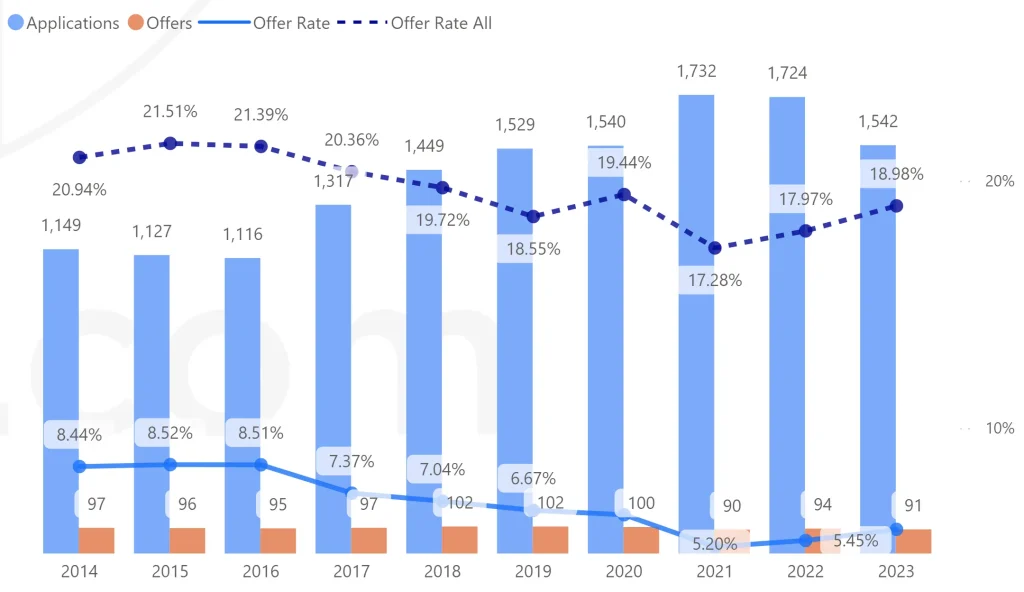
Economics and Management (E&M) Admissions Data at Oxford during 2014–2023 Application Cycles
(Plotted by UEIE based on official data)
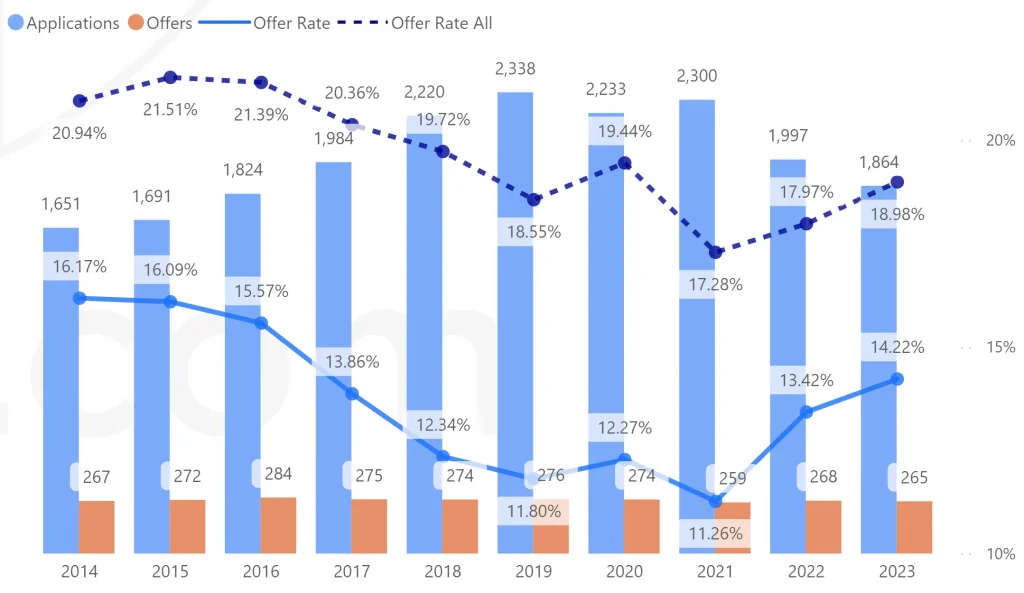
PPE (Philosophy, Politics and Economics) Admissions Data at Oxford during 2014–2023 Application Cycles
(Plotted by UEIE based on official data)
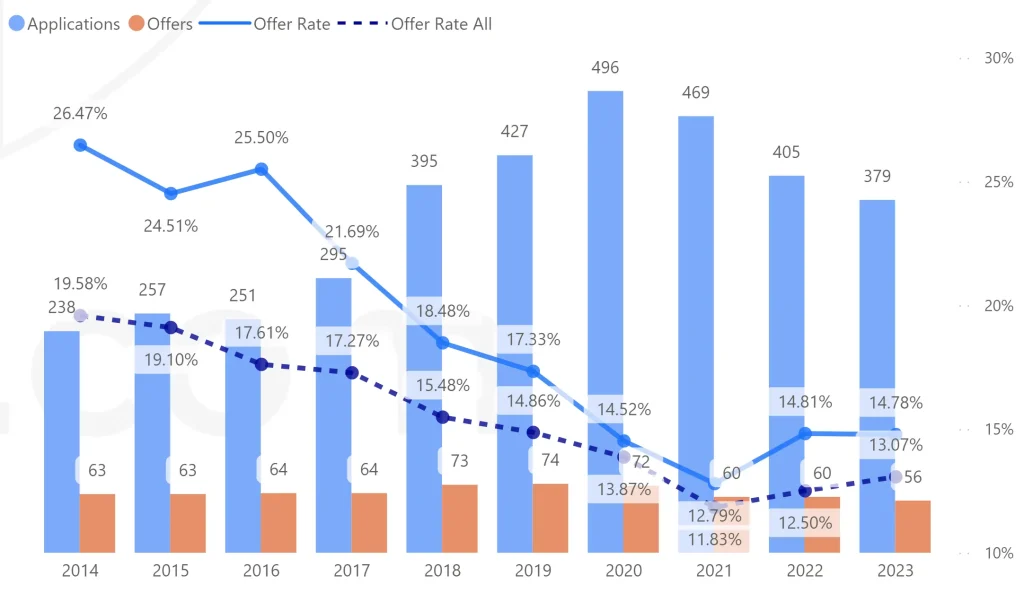
Experimental Psychology Admissions Data at Oxford during 2014–2023 Application Cycles
(Plotted by UEIE based on official data)
- Economics and Management (E&M)
This is one of the most fiercely contested tracks at Oxford. Over the past decade, the number of applicants climbed from 1,149 to 1,542, while the final number of offers issued has always been strictly capped under 100. Its offer rate has fluctuated downwards from an initial 8.44% to a mere 5.45% in 2023. - PPE (Philosophy, Politics and Economics)
As Oxford’s flagship programme, its applicant base is massive. Over ten years, the number of applicants surged from 2,800 to 3,406 (with a peak exceeding 4,000), while the final offer rate slid from 13.00% to 10.45%. - Experimental Psychology
The number of applicants nearly doubled over the decade, causing the offer rate to plummet by half from a high of 26.47% to 14.78%.
This objective data reveals a stark reality: for top students applying to the aforementioned programmes, perfect A-Level or IB marks are merely the basic entry ticket. When facing rejection rates as high as 90% or even 95%, universities must rely on highly differentiating standardised exams like TARA as an efficient filter to screen candidates.
2. Analysing Official TARA Data and the Admission "Safe Line"
TARA’s Critical Thinking and Problem Solving modules are scored separately. Candidates receive 1 mark for each correct answer, with no marks deducted for incorrect answers. The final scores are converted into a reported score between 1.0 and 9.0, precise to one decimal place.
According to explanations in the official UAT-UK report, the global median score for candidates is anchored at 4.5, while the threshold for the top 10% high score is set at 7.0. The global score distribution for the Critical Thinking and Problem Solving sections in the inaugural TARA in October 2025 is shown in the official report charts.
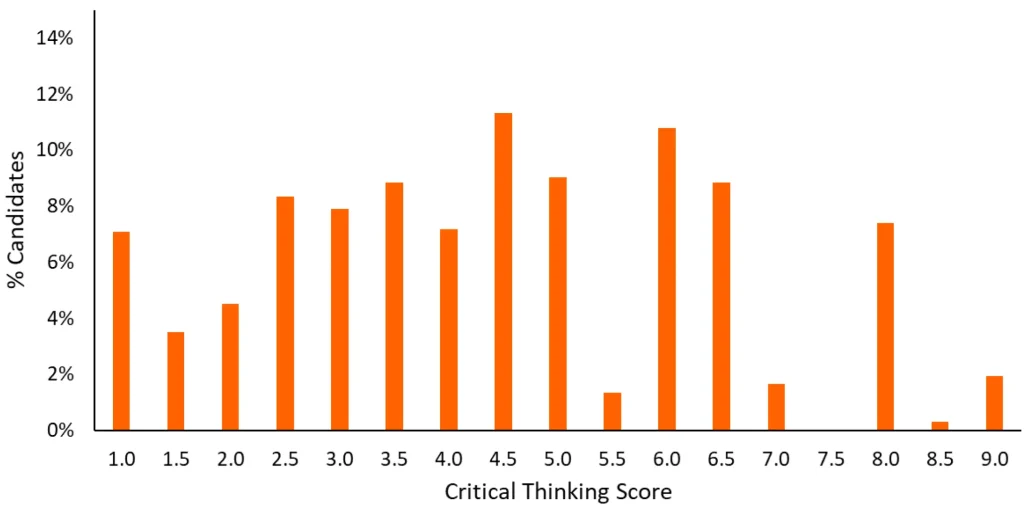
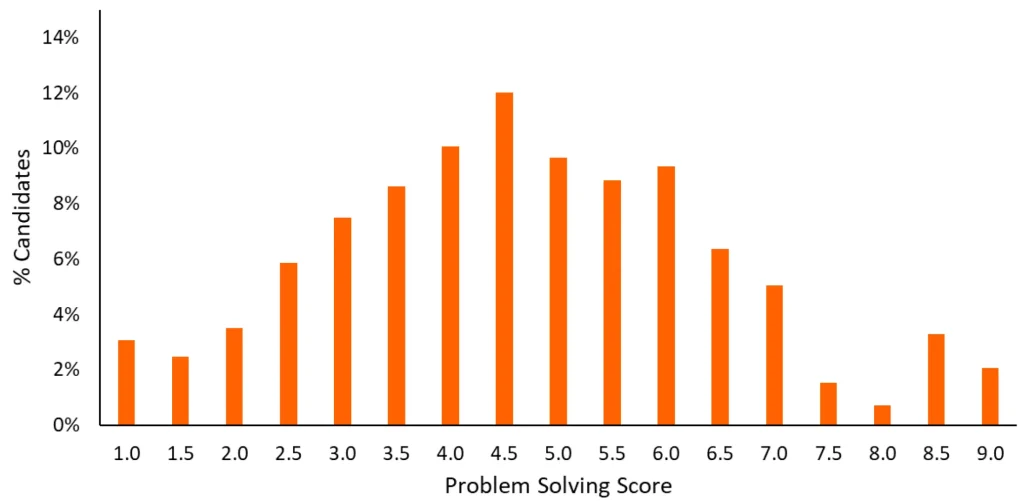
Global Score Distribution for the TARA — October 2025
When combined with the previously mentioned offer rates for Oxford E&M (approx. 5%) and PPE (approx. 10%), anyone wishing to secure an admission offer amidst such fierce competition must anchor their target for Critical Thinking and Problem Solving at 7.0 or even above 8.0. For science and engineering candidates applying to relevant programmes at UCL, the intensity of competition is relatively moderated, but it is still highly recommended to set a baseline target of 6.0 or above for TARA preparation.
Based on past experience and an analysis of official TARA data, I have created the following competitiveness ladder model for candidates’ reference:
Competitiveness Tier Model for
Economics, Computer Science, and Mechanical Engineering Programs
(Based on the personal insights of Mr. Xie Tao; tailored specifically for candidates from China and does not constitute an official guarantee of university admission.)
| TARA Report Score | Global Ranking | Tier | ||
|---|---|---|---|---|
| Economics | Computer Science | Mechanical Engineering | ||
| 8.5 | Top ~3% | Grandmaster | Grandmaster | Grandmaster |
| 8.0 | Top ~6% | Master | Master | |
| 7.5 | Top ~8% | Diamond | Diamond | Master |
| 7.0 | Top ~10% | Platinum | ||
| 6.5 | Top ~18% | Gold | Platinum | Diamond |
| 6.0 | Top ~28% | Platinum | ||
| 5.5 | Top ~32% | Silver | Gold | Gold |
| 5.0 | Top ~50% | Silver | Silver | |
Admission Predictions by Rank Tier
| Tier | Admission Prediction |
|---|---|
| Grandmaster | Extremely high probability of Oxford admission, allowing you to secure for admission based on academic results alone. |
| Master | Above average probability of Oxford admission, with distinct advantages applying to UCL. |
| Diamond | Relatively low probability of Oxford admission, but extremely high chances for securing offers from UCL. |
| Platinum | Strong probability of securing offers from UCL, and still stand a chance of Oxford admission, for those who are exceptionally lucky or deliver a truly outstanding performance in the interview. |
| Gold | Basic G5 competitiveness, most likely to get interview offer for Oxford admission. |
| Silver | Moderate competitiveness, at a relative disadvantage among applicants to top-tier universities. |
3. Diagnostic Exam and Target Anchoring
Why conduct an assessment?
Since TARA adopts a computer-based testing format, taking a diagnostic exam (mock test) before officially commencing your preparation is absolutely vital. This will help you to:
- Experience the real exam environment
Get a feel for the online platform’s interface, experience the extreme time pressure of completing 22 multiple-choice questions within 40 minutes for each module, and objectively expose any arithmetic weaknesses in a calculator-free environment. - Assess your current standing in each subject
Form a preliminary judgement of your critical thinking level, logical deduction capabilities, and problem-solving speed, identifying the actual gap between yourself and the test requirements.
How to choose assessment tools?
At present, official UAT-UK sources have only released sample questions and a small number of practice exercises, and the difficulty of the sample questions is significantly lower than the real exam, making it impossible to precisely evaluate your true level. To address this, our UEIE research and teaching team has developed a Free TARA Diagnostic Exam, complete with an online computer-based testing system that replicates the official interface with 99% fidelity.
This set of diagnostic exam is strictly aligned with the latest TARA syllabus. According to feedback from past students, the difficulty is slightly higher than the 2025 past papers, which helps us derive a reasonable reported score conversion curve based on global candidate data, thereby allowing you to pinpoint your exact global ranking. You may also use past BMAT/TSA papers for testing, but please note that they cannot simulate the countdown rules and interface switching of the computer-based test, and you will need to cross-reference syllabus differences yourself.
Click the link below to learn more details about this diagnostic exam and to answer it online.
Free TARA Diagnostic Exam
What is the self-assessment process?
- Strictly follow the independent 40-minute time limit for each module, completing the three modules—Critical Thinking, Problem Solving, and Critical Writing—consecutively.
- Complete the test on a computer, strictly prohibiting the use of calculators, using only pen and paper for rough workings.
- Cross-check against the answers or system grading to objectively evaluate your performance in each module (ideally converting it into a reported score between 1.0 and 9.0).
- Focus on analysing the reasons behind your errors: Is it unclear conceptual understanding? Arithmetic mistakes? Misalignments in reading comprehension? Inappropriate time allocation? Or a lack of test-taking techniques?
- Record the weak areas across various subjects to serve as the key focus areas for your subsequent TARA preparation.
II. Bridging the Gap: Core Competency Deconstruction of TARA's Three Modules Preparation
The TARA itself does not rely on a specific subject background. Its core purpose is to assess students’ logical flexibility and abstract thinking capabilities when confronting unfamiliar, high-difficulty academic scenarios. Before preparation, we need to study the officially published TARA syllabus and question guide deeply to align exam requirements precisely with our own competency gaps.
1. Critical Thinking: Counter-Intuitive Logical Deduction
In this module, the most common hidden barrier candidates fall into is mistakenly treating it as a “reading comprehension test for long and complex sentences” or an “everyday common-sense judgement”.
The official guide clearly states that the essence of this module is the evaluation of arguments. Within an argument, reasons are advanced to support a conclusion. If the conclusion follows tightly and logically from the reasons, the argument is valid. During the test, you must unconditionally assume that all reasons presented in the text are true, and then objectively examine whether the conclusion holds—it is by no means asking you to judge whether the matter is correct in the real world.
The official question type guide reveals that the Critical Thinking section focuses on testing the following 7 core academic skills:
- Identifying the Main Conclusion
Precisely isolating the core thesis supported collectively by other reasons from a complex textual narrative (conclusions can appear anywhere in the passage, not merely at the end). - Drawing a Conclusion
Based on the established factual reasons given in the text, carefully deducing a logical inference that must hold true, without overstepping the boundaries of the text. - Identifying an Assumption
Finding the underlying premise that is not explicitly stated in the text but is indispensable for the conclusion to stand. - Assessing the Impact of Additional Evidence
Analysing whether the original chain of argument is strengthened or weakened when a completely new external condition is introduced. - Detecting Reasoning Errors
Keenly spotting illogical causal impositions or reasoning gaps between reasons and conclusions. - Matching Arguments
Stripping away the specific textual content to abstract the underlying logical skeleton of the argument, and searching among the options for a parallel logical chain with an identical structure. - Applying Principles
Identifying the universal code of conduct or fundamental principle that the text relies on in a specific case, and correctly transferring and applying it to a completely different scenario.
For students within domestic international curricula, there is a clear cognitive gap here. High-achieving students are accustomed to searching for standard answers, making it easy for them to bring in personal everyday common sense and non-academic binary thinking when answering questions, thereby falling into the common-sense traps deliberately designed into incorrect options.
2. Problem Solving: Data Stripping and Tool-Free Arithmetic
The Problem Solving module only assumes that candidates possess an extremely basic foundation of lower-secondary school mathematics knowledge (For example: simple fractions, numerical values, basic concepts of percentages, the four arithmetic operations, averages, simple calculations of area, perimeter, and volume, as well as basic extraction of chart information).
The true difficulty of TARA Problem Solving lies in the fact that it evaluates novel problems with no off-the-peg solutions in real-world academic or professional contexts. The official guidelines divide these questions into three core assessment dimensions:
- Relevant Selection
Real-world problems are often accompanied by a massive amount of redundant interference. Candidates must quickly filter out unimportant, distracting, redundant data during high-pressure question analysis, selecting only the core indicators that are genuinely constructive to solving the problem. - Finding Procedures
Once the relevant data is clarified, since there are no off-the-shelf formulae to apply, candidates must design, deduce, and construct a clear algorithm and set of steps on the spot in their minds to efficiently generate a solution. - Identifying Similarity and Spatial Transformation
Assessing cross-media understanding and relationship matching for the same set of data across different presentation formats (such as bar charts, pie charts, tables), or the rotation and manipulation of two-dimensional and three-dimensional spatial shapes.
For AP and A-Level candidates who are accustomed to relying on graphing calculators for complex differentiation or brute-force arithmetic, the biggest pain point in this module is the decline in baseline arithmetic capability. In a TARA examination hall where calculators are banned throughout, when faced with complex redundant text and extreme countdowns, failing to swiftly perform precise data extraction and highly efficient mental arithmetic or estimation makes it exceedingly easy to fall into a time-starved dilemma at the final hurdle.
3. Critical Writing: Self-Disciplined Organisation and "Anti-Template" Speculation
The Critical Writing module presents three academic or social propositions, usually in the form of a short statement. Candidates are required to choose one of the questions to answer and complete the following three tiers of tasks:
- Precisely explain the deeper meaning implied by the statement.
- Construct a well-reasoned counter-argument targeted against the statement.
- Discuss in depth the extent to which you agree or disagree with the proposition.
The official guidelines set two red lines for this: the word limit is strictly capped within 750 words, and the use of any dictionaries or electronic spell checkers is prohibited throughout.
In the eyes of university admissions tutors, this is by no means an ordinary language proficiency test. Completing a piece of writing under 750 words within 40 minutes is designed to assess whether a student possesses a highly disciplined capacity for thought selection, rigorous organisational structuring, and concise, precise academic expression under high-pressure time constraints and extreme length limitations. Any template full of flowery rhetoric but lacking logical depth will lose its competitiveness in this module due to a lack of deep dialectical thinking. What you need to display is a mature scrutiny that steps outside binary oppositions, using targeted, contextualised, and rigorous arguments to prove to admissions tutors at top institutions like Oxford that you possess the potential for high-level academic dialogue.
III. Breaking the Deadlock: Enhancing Decision Efficiency and the Advanced Roadmap
Grasping the syllabus and score distributions is merely acquiring the ticket to this ranked tournament. In a real TARA, what decides the final victory is often not how deep your subject knowledge is, but whether you can make the most rational decisions and high-precision deductions under extreme time pressure. This requires us to shift our focus completely towards reshaping the muscle memory of our underlying core capabilities during the upcoming golden TARA preparation window.
1. Reshaping TARA Core Competencies and the Logic of Avoiding Pitfalls
The Critical Thinking and Problem Solving modules allow an average of less than 1.8 minutes per question. Therefore, you need to master the following three tiers of practical strategies during TARA preparation:
- Establish a “One-and-a-Half-Minute” Abandonment Philosophy
Fighting to the death over a single question is an absolute taboo in practical combat. TARA does not deduct marks for wrong answers, so preserving the total number of correctly answered questions is the core tenet for scoring high. You must cultivate strong, rapid decision-making powers: extract the core content quickly, and once an information extraction or logical analysis question stumps you for more than one and a half minutes, you must flag it immediately and skip it. - Reshape a Pure Path of Logical Deduction
In the Critical Thinking module, the behaviour most prone to losing marks is using everyday common sense to reverse-engineer options. You must completely discard subjective speculation and strictly adhere to the academic rule of “pure causal deduction based on given premises”. Only by becoming thoroughly familiar with the 7 core skills assessed officially (such as identifying intermediate conclusions and finding hidden assumptions) can you accurately recognize the logical flaws meticulously laid out within incorrect distractors. - Penetrate Information Redundancy and Wean Off Calculator Dependence
Although the Problem Solving module only involves basic arithmetic and charts, the questions often contain a large volume of redundant information designed to interfere. Under a total ban on calculators throughout, you not only need powerful estimation and mental arithmetic skills, but you must also train yourself to act like a radar, swiftly extracting core conditions from complex backgrounds and constructing a series of steps to solve the problem on the spot.
2. Core Factors Influencing the TARA Preparation Cycle
Because TARA is a non-subject-specific competency test, a candidate’s ideal preparation length often varies from person to person. Your TARA preparation cycle mainly depends on the following core factors:
- Target Scores and Applied Institutions
Aiming for Oxford University (targeting a score of 7.0 or even above 8.0) versus applying to UCL (targeting around 6.0) requires completely different polishing durations and training intensities. - Baseline Logic and Reading Foundation
Your current reading speed for long English texts, your sensitivity to abstract logical relationships, and your mental math speed in a calculator-free environment. - Complexity of Preparation Subjects
Are you working solely for TARA preparation, or do you need to simultaneously balance a multi-front campaign involving ESAT or TMUA? - Effective Weekly Study Time
How many hours can you consistently dedicate to focused, highly efficient, specialized training amidst heavy high school coursework?
3. Preparation Timeline Planning Categorised for Two Types of TARA Candidates
According to the examination arrangements, the TARA for the 2027 application cycle is split into October 2026 (1st Sitting) and January 2027 (2nd Sitting). Considering that many candidates applying for UCL Mechanical Engineering, Computer Science, etc., also face pressure from ESAT or TMUA, I generally recommend that such candidates take part in the second TARA sitting in January, rather than the first sitting in October which all Oxford applicants must attend. Therefore, I have provided two different TARA preparation timelines below.
Scenario 1: Candidates Aiming for Oxford University
Applicants to Oxford University must take the TARA in October, and are recommended to rigidly advance preparation according to the following June–October golden timeline:
Jun–Jul
Clear | √ Familiarise with Question Types; Deconstruct Underlying Logic
Specifically deconstructs the underlying logic of the 7 Critical Thinking question types and 3 Problem Solving question types officially disclosed. Avoid relying on subjective common sense; instead, deeply understand pure causal deduction rules, the identification of underlying assumptions, and precise extraction of redundant data. |
|---|---|
Jul–Aug
Increase Speed | √ Intensive Practice; Internalise Knowledge
Internalisation cannot be completed by merely being familiar with question types; it must be coupled with high-quality practice. Given the TARA’s characteristics, you must completely wean yourself off dependency on calculators, reinforcing mental arithmetic and estimation skills. Furthermore, to cope with the extreme decision-making pressure of computer-based testing, all practice must be completed under strict time constraints. |
Sep–Oct
Pursue Precision | √ Full Mock Exams; Polish Writing
In a highly simulated computer-based testing environment, familiarise yourself with the completely independent countdown pacing of the three modules, optimizing time management and abandonment strategies. Simultaneously, mandatory timed writing simulations must begin, training you to self-disciplinedly organise a dialectical essay of no more than 750 words with extremely rigorous “counter-arguments” within 40 minutes and under a dictionary-free environment. |
Scenario 2: Candidates Applying Jointly for UCL-Related Programmes
For candidates applying simultaneously to Oxbridge STEM courses and UCL Mechanical Engineering, Computer Science, etc., my advice is: treat sprinting for Oxbridge as your primary goal, confront ESAT or TMUA with full effort in October, and then commit all or part of your energy for the preparation of TARA in January of the following year.
Mid-Oct–Nov
Clear | √ Shift Mindset; Familiarise with Question Types
After concluding ESAT/TMUA, swiftly switch from a scientific mindset to a logical dialectical mindset. Systematically review the 7 Critical Thinking question types and 3 Problem Solving question types officially disclosed. |
|---|---|
Nov–Dec
Increase Speed | √ Intensive Practice; Internalise Knowledge
Combine with high-quality practice questions to adapt to the ultra-fast decision-making pace of 1.8 minutes per question. Break through the interference of “subjective common sense” in logical analysis as a priority, and reinforce information extraction capabilities. |
Dec–Jan
Pursue Precision | √ Full Mock Exams; Build Instinct
Rely on highly simulated computer-based testing systems to carry out full-paper sprints, honing stress-resistance capabilities under three independent 40-minute countdowns. Focus heavily on timed output training for the 750-word critical writing module. |
4. Common Pitfalls and Practical Mine-Clearing in TARA Preparation
Actively identifying and avoiding the following widespread misconceptions can make your TARA preparation yield twice the result with half the effort:
Pitfall 1: Starting Too Late, Underestimating the Cross-Disciplinary Workload
- Manifestation & Consequences
Many science and engineering candidates only discover they need to tackle unfamiliar TARA logic and writing close to the exam day, leading to a severe lack of practice in the later preparation stage and a total collapse of pacing under extreme time pressure. - Countermeasure
Fully recognise the long-term nature of TARA general reasoning capability training; launch a systematic, phased preparation plan as early as possible and execute it rigidly.
Pitfall 2: Disregarding Multiple-Choice Questions, Lacking Strategic Techniques Under High Pressure
- Manifestation & Consequences
Believing that multiple-choice questions can be passed simply by linguistic intuition or gut feeling, never timing oneself during ordinary practice, resulting in a solving speed far lower than the mandatory requirement of 1.8 minutes per question, and an inability to quickly eliminate distractors in the exam hall. - Countermeasure
Treat the multiple-choice exam techniques as core academic skills for targeted deliberate practice, cultivating an absolute sense of speed and accuracy.
Pitfall 3: Neglecting Online Characteristics, Practice Detached from Real Combat
- Manifestation & Consequences
Relying primarily on paper-based materials for TARA preparation, lacking sufficient operational practice on online platforms; unfamiliarity with reading, answering, flagging, and navigating in an online environment; failing to specifically train arithmetic speed and techniques in a calculator-free environment. This leads to clumsy operation, trailing speed, and frequent calculation errors in the exam hall. - Countermeasure
The mid-to-late stages of TARA preparation must shift focus toward online practice and simulation. Frequently use official practice tools and high-quality online mock exams (such as UEIE mock exams); treat calculator-free operations as a specialized skill for deliberate, continuous training.
Pitfall 4: Slighting the Writing Module, Blindly Worshiping Language Templates
- Manifestation & Consequences
Mistakenly believing that because writing does not count towards the reported score it is unimportant, or directly copying highly rigid standardized essay templates like IELTS or TOEFL, leading to a lack of depth in writing and prematurely exposing weaknesses in dialectical thinking. - Countermeasure
Strictly follow the official assessment standards of “explaining meaning, counter-arguing, and integrated discussion”, deliberately training your organisational ability to deliver high-quality academic output within the 750-word limit. Bear in mind that this original draft will land directly on the desks of Oxford and UCL admissions tutors.
IV. Farewell to Blind Grinding: Data-Driven TARA Preparation Resources and System Closed-Loop
Once you have clarified the categorized timelines and mine-clearing strategies, how to utilize high-quality resources to fill the vacuum period of “a brand-new computer-based test with no official past papers” is the final piece of the puzzle for executing TARA preparation. Faced with TARA, which features an extremely low tolerance for error and heavily tests on-the-spot reactions, blindly grinding questions will only achieve half the result with twice the effort. What you need is a scientific preparation solution for TARA that targets the pain points of computer-based testing directly.
1. Official Foundations and the Discernment of "High-Quality Alternatives"
You can acquire the most core baseline preparation materials from the official UAT-UK website, including the latest edition of the TARA syllabus, official sample questions and practice materials, question type guides, etc.
Since TARA is a standardized assessment implemented for the first time only in 2025, official sources have not published past exam papers. However, they have provided historical BMAT (2003–2023) past papers, alongside historical TSA (2007–2023) past papers. All of these can serve as high-quality alternative preparation resources for TARA practice.
2. The UEIE "Learn-Practise-Test" All-Around Matrix for TARA Preparation
To help candidates aiming for Oxford and UCL solve the dilemma of scarce preparation resources, our research and teaching team has poured its efforts into creating the UEIE TARA On-Demand Suite. It is rigorously revised every year based on the latest exam situations, perfectly covering the core closed loop of scientific preparation:
Bid farewell to fragmented learning and systematically organize core testing points. Deeply deconstruct “anti-routine” efficient problem-solving skills, breaking down accustomed subjective reading comprehension routines from the ground up.
Scientifically graded by topic modules and difficulty levels. Through a massive volume of high-quality, targeted, timed training, it helps you completely wean yourself off calculators, developing muscle memory for extreme mental arithmetic and rapid core information extraction.
This is the ultimate weapon for conquering TARA. We have dedicated immense effort to developing online mock exams that recreate the official computer-based testing environment with 99% fidelity. The system fully restores the high-pressure experience of three modules with completely independent countdowns, allowing you to secure a high-tier ranking in actual combat.
3. Advanced Learning and Cross-Border Joint Application Planning
Beyond the On-Demand Suite, UEIE also runs multiple cohorts of TARA preparation programmes year-round on a rolling basis. Particularly for candidates who need to prepare for TARA alongside ESAT/TMUA simultaneously, the difficulty of time allocation and mindset switching is immense. To address this, we have meticulously developed a systematic, thorough explanation and intensive closed-loop curriculum to ensure that under extremely high-intensity academic training, both the candidates’ scientific foundations and general academic reasoning capabilities reach the admission standards of top-tier elite universities.
Conclusion
TARA has never been a test that simply pits IQ or vocabulary against one another; it is an exceptionally objective touchstone. Using extreme time compression and counter-intuitive logical traps, it ruthlessly discriminates candidates’ academic reasoning capabilities and decision-making efficiency.
In the 2027 application cycle, where admission thresholds are climbing sharply, clarifying your own score positioning, mastering a targeted TARA golden preparation timeline, and relying on scientific, data-driven closed-loop training is your only shortcut to standing out. We hope this TARA preparation guide can help you reject ineffective internal competition, find your true coordinates, and become a solid milestone on your ascent to the peaks of Oxbridge and the G5.
Follow Us on Wechat