With the recent announcement that Oxford’s Mathematics and Computer Science programmes and Cambridge’s Mathematics department will fully adopt the TMUA as the basis for issuing interview invitations from 2026 onwards, the candidate pool is bound to expand significantly. A new round of intense hyper-competition has officially begun.
In the Comprehensive TMUA Guide, I previously provided an in-depth analysis of the exam’s requirements, format, and scoring mechanism. This preparation guide distils my years of hands-on teaching experience in Oxbridge and G5 admissions tests. Grounded in first principles, it aims to clear the fog and provide you with an objective, systematic, and highly efficient roadmap for advanced TMUA preparation.
I. Data Insights: TMUA Score Analysis and Target Setting
Before embarking on your TMUA preparation, we must use objective data to pinpoint your true standing in this highly competitive arena.
1. Analysing Admissions Data and the Real “Safe Line”
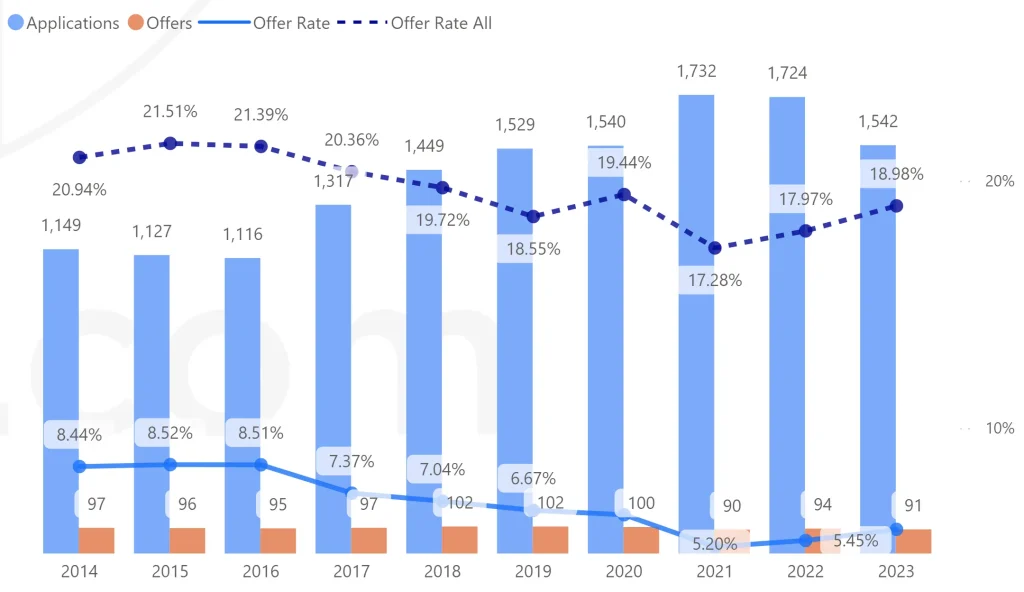
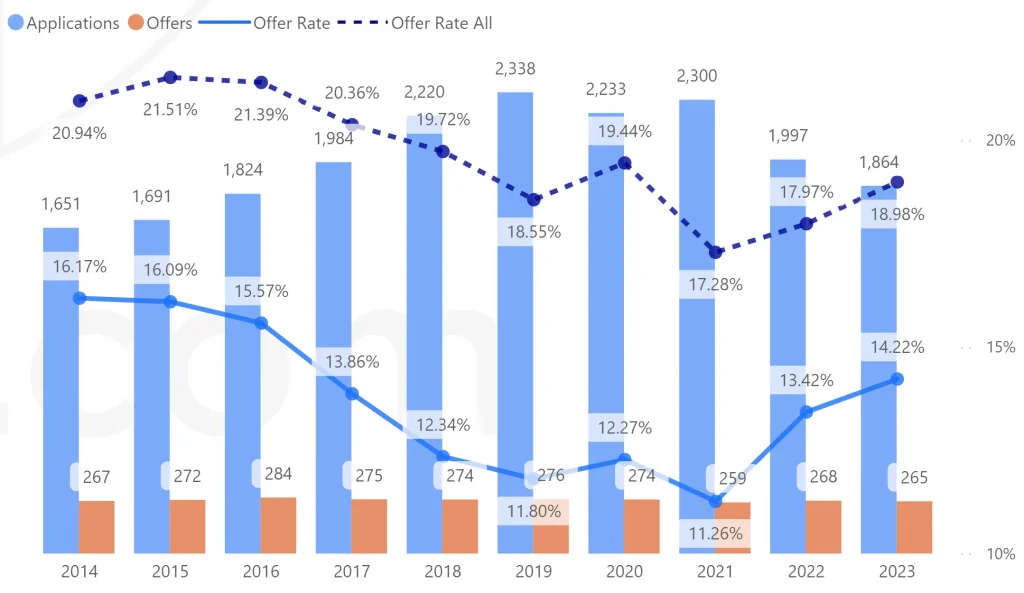
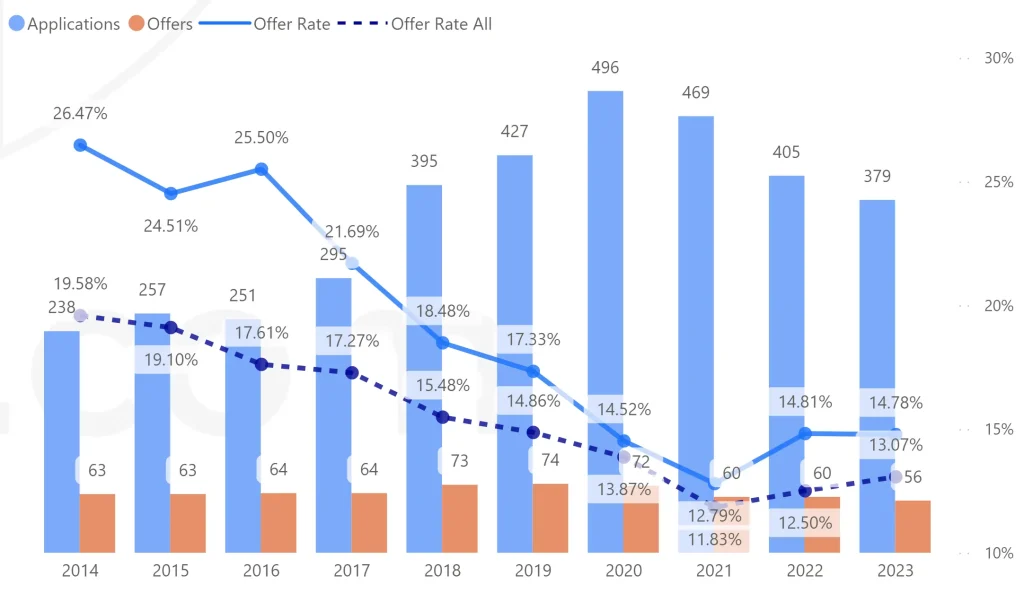
The charts below present admissions data over the past decade for Mathematics and Computer Science programmes at Oxbridge, alongside Economics at Cambridge.
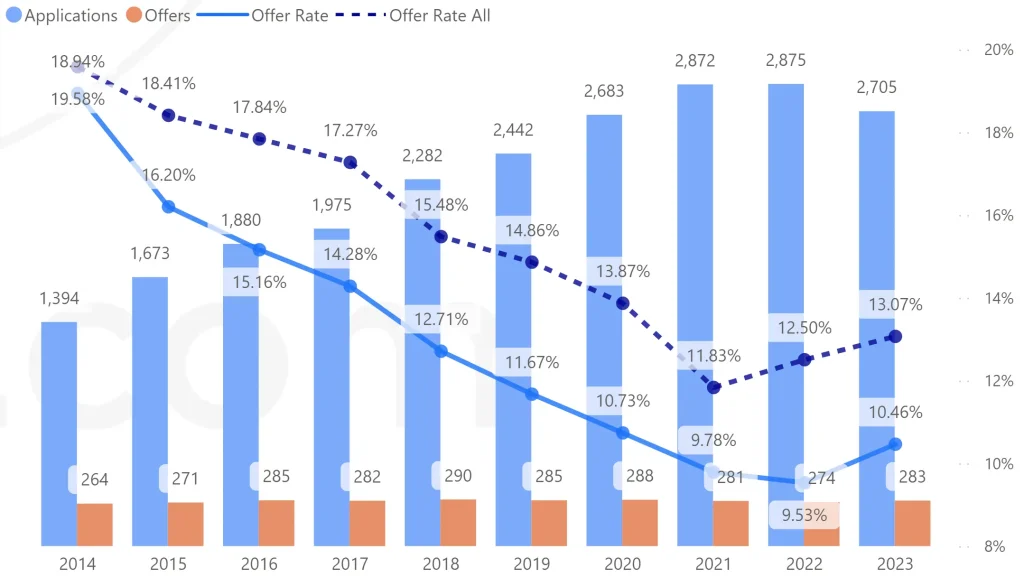
Mathematics-related Admissions Data at Oxford during 2014–2023 Application Cycles
(Plotted by UEIE based on official data)
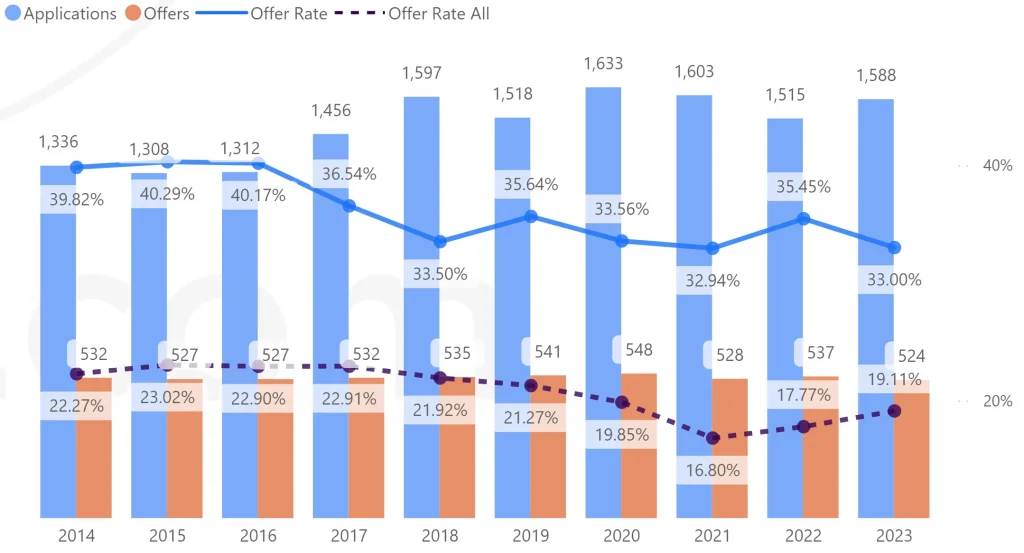
Mathematics-related Admissions Data at Cambridge during 2014–2023 Application Cycles
(Plotted by UEIE based on official data)
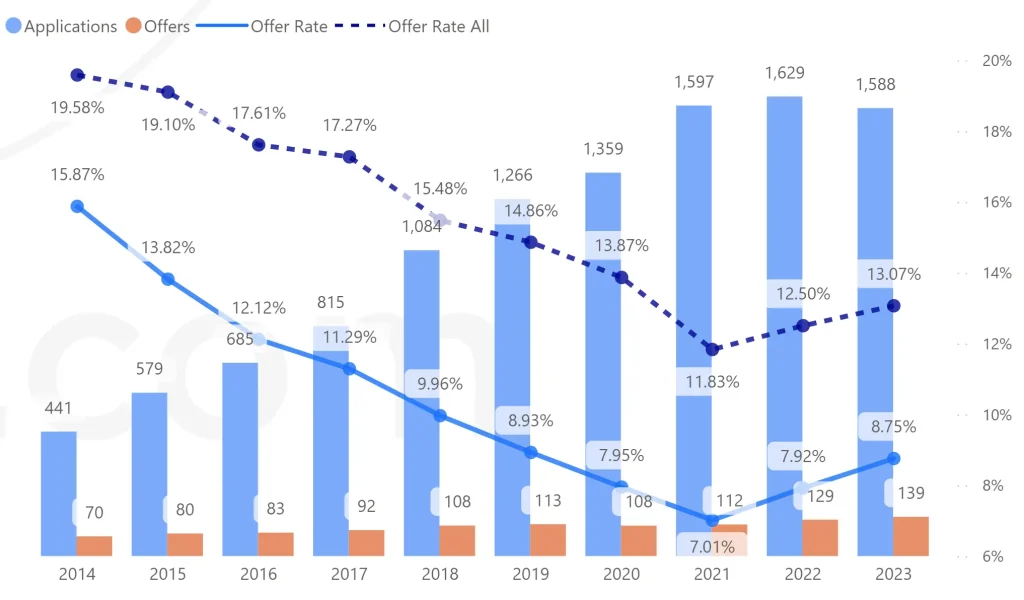
Computer Science Admissions Data at Oxford during 2014–2023 Application Cycles
(Plotted by UEIE based on official data)
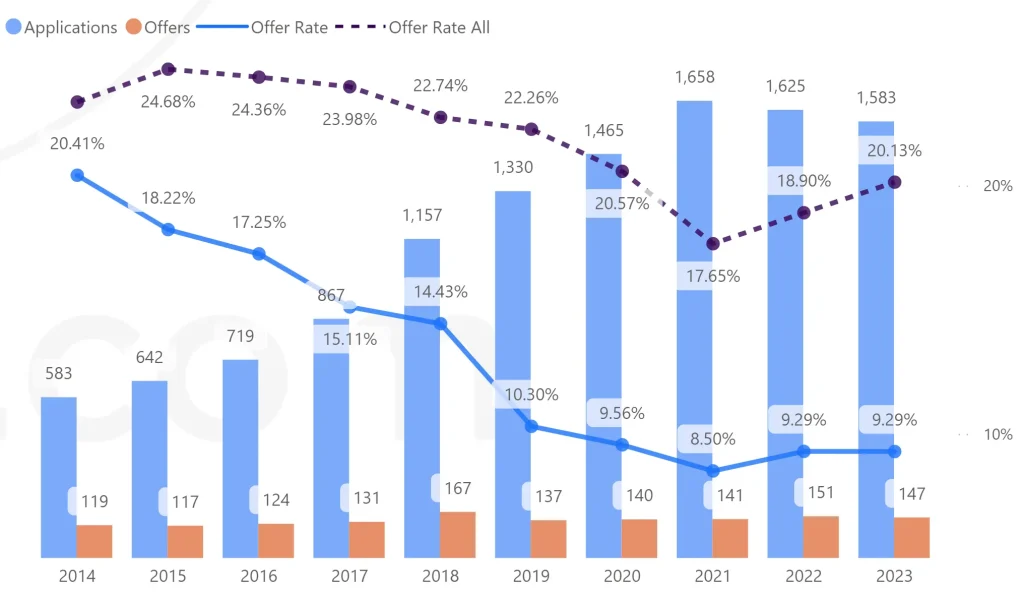
Computer Science Admissions Data at Cambridge during 2014–2023 Application Cycles
(Plotted by UEIE based on official data)
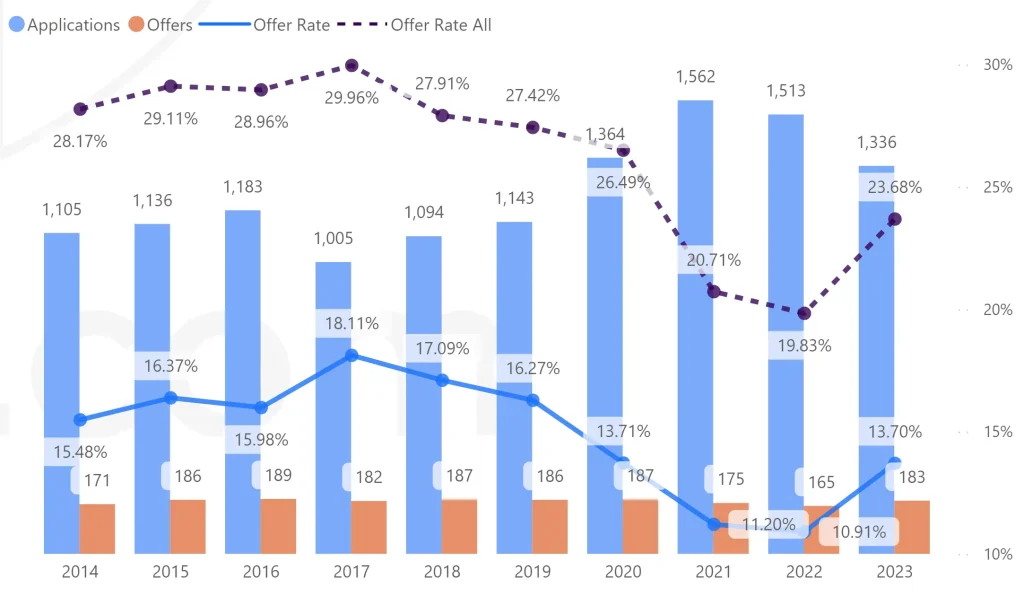
Economics Admissions Data at Cambridge during 2014–2023 Application Cycles
(Plotted by UEIE based on official data)
Synthesising data from previous years, the actual admission rate for Oxbridge mathematics programmes ranges between 10% and 17% (Cambridge’s Mathematics offer rate is high, but STEP ultimately filters out half of the offer holders). The offer rate for Computer Science stands at 8%–10%, while the offer rate for Cambridge Economics has hovered between 10% and 13% in recent years. This means that if you want to take the initiative in your Oxbridge application, your admissions test score must place you in the top 20% globally or regionally.
2. Extreme Regional Hyper-Competition: Shattering the Illusion of “Low Global Scores”
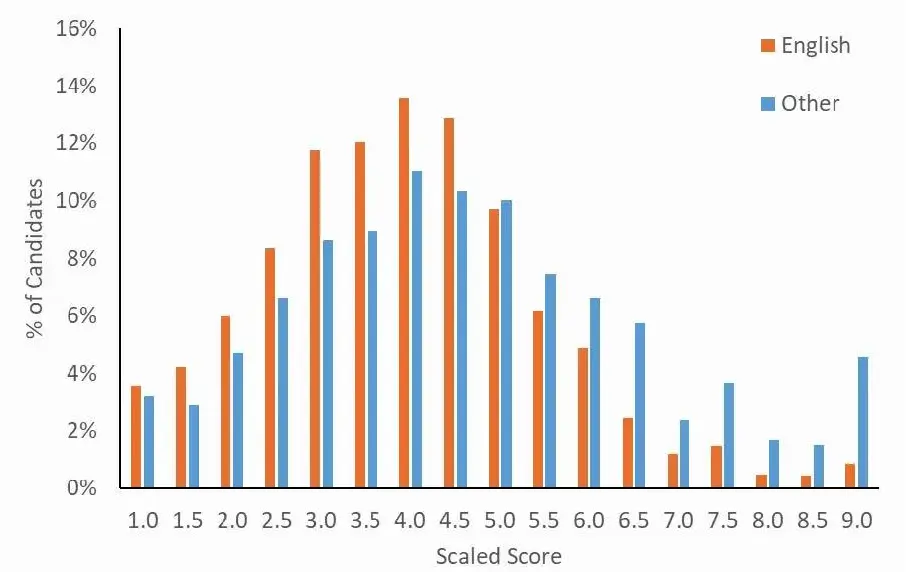
The TMUA features a maximum raw score of 40 marks (20 marks each for Paper 1 and Paper 2), which is converted into a final reported score ranging from 1.0 to 9.0.
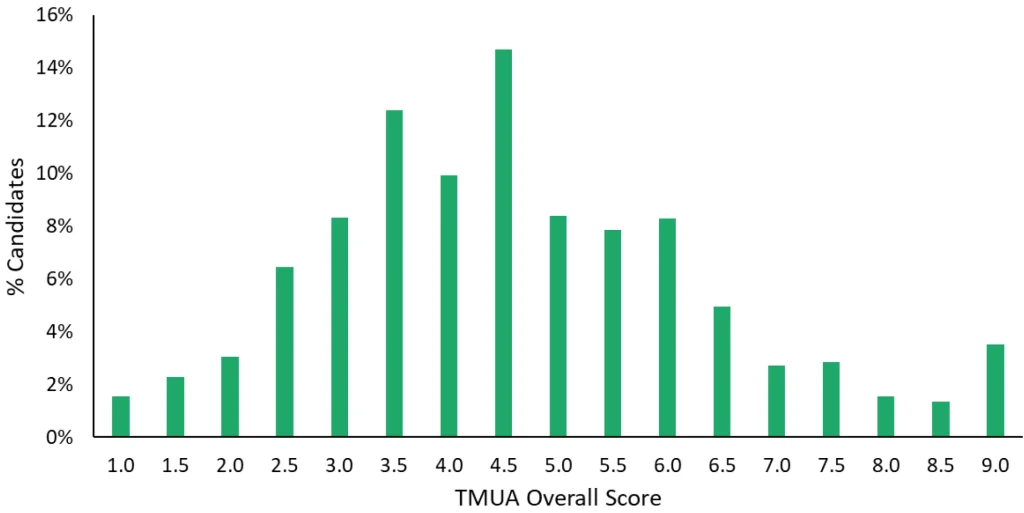
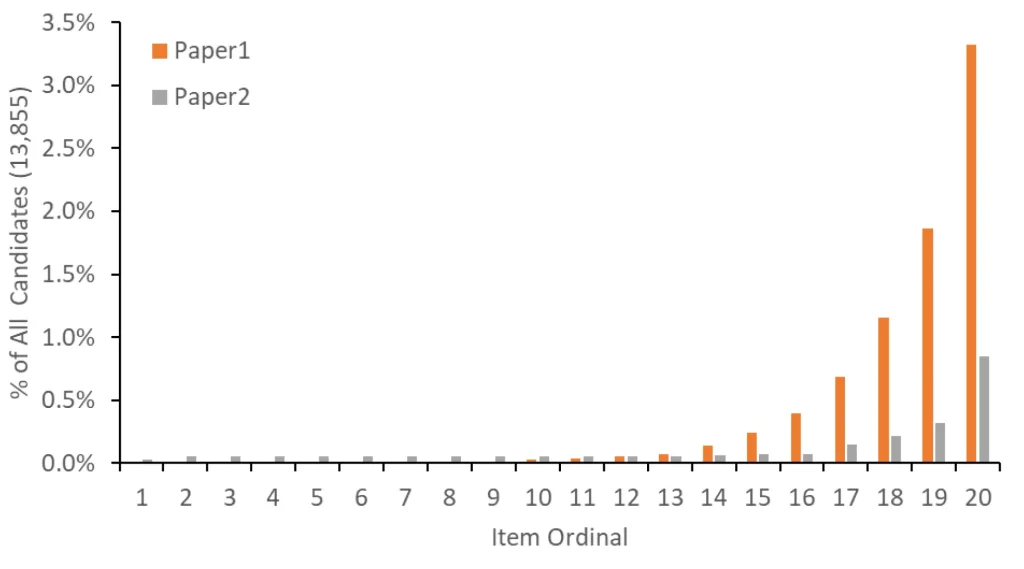
Global Score Distribution for the TMUA — October 2025
According to the global TMUA score distribution shown above, the top 10% globally corresponds to a score of 7.0, while the top 20% aligns roughly with 6.0. However, this is merely the global distribution. If you are a candidate from China, you should focus more on the regional score distribution and recognise the reality of intense local competition.
TMUA Core Score Distribution in Selected Regions (2024/25 Cycle)
| Country or Region | 50th Percentile | 75th Percentile | 90th Percentile |
|---|---|---|---|
| United Kingdom | 3.8 | 4.8 | 5.8 |
| China | 5.4 | 6.7 | 8.4 |
According to the official 2024/25 application cycle score distribution report published by UAT-UK, the 90th percentile (top 10%) for Chinese candidates is as high as 8.4! Meanwhile, the median score (5.4) is already closing in on the top 10% threshold for domestic UK candidates (5.8). For Chinese candidates to break into the top 20%, they generally need to achieve a TMUA score of around 7.0.
Based on these official data points, combined with my years of experience and observations of previously admitted students, we have developed a competitiveness ladder model for Mathematics, Computer Science, and Economics programmes based on reported TMUA scores.
Competitiveness Tier Model for
Mathematics, Computer Science, and Economics Programs
(Based on the personal insights of Mr. Xie Tao; tailored specifically for candidates from China and does not constitute an official guarantee of university admission.)
| TMUA Report Score | Global Ranking | Tier | ||
|---|---|---|---|---|
| Mathematics | Computer Science | Economics | ||
| 8.5 | Top ~4% | Grandmaster | Grandmaster | Grandmaster |
| 8.0 | Top ~6% | Master | Master | |
| 7.5 | Top ~8% | Diamond | Diamond | Master |
| 7.0 | Top ~10% | Platinum | ||
| 6.5 | Top ~17% | Gold | Platinum | Diamond |
| 6.0 | Top ~25% | Platinum | ||
| 5.5 | Top ~35% | Silver | Gold | Gold |
| 5.0 | Top ~50% | Silver | Silver | |
Admission Predictions by Rank Tier
| Tier | Admission Prediction |
|---|---|
| Grandmaster | Extremely high probability of Oxbridge admission, allowing you to secure for admission based on academic results alone. |
| Master | Above average probability of Oxbridge admission, with distinct advantages applying to other G5 universities. |
| Diamond | Relatively low probability of Oxbridge admission, but extremely high chances for securing offers from other G5 universities. |
| Platinum | Strong probability of securing interview offers from top-tier universities such as Imperial College and LSE, and still stand a chance of Oxbridge admission, for those who are exceptionally lucky or deliver a truly outstanding performance in the interview. |
| Gold | Basic G5 competitiveness, most likely to get interview offer for Oxbridge admission. |
| Silver | Moderate competitiveness, at a relative disadvantage among applicants to top-tier universities. |
3. Diagnostic Exam and Target Anchoring
Why is a diagnostic exam necessary?
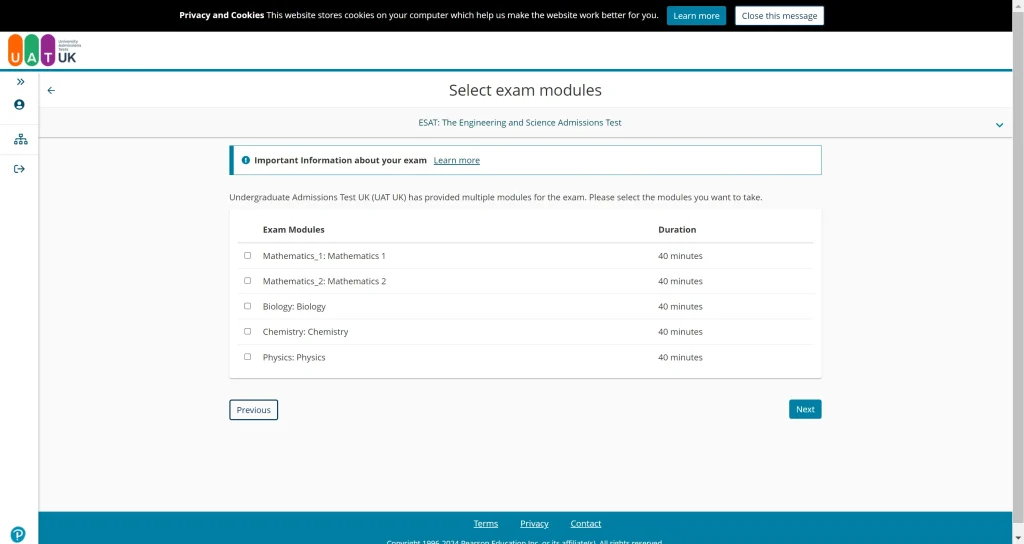
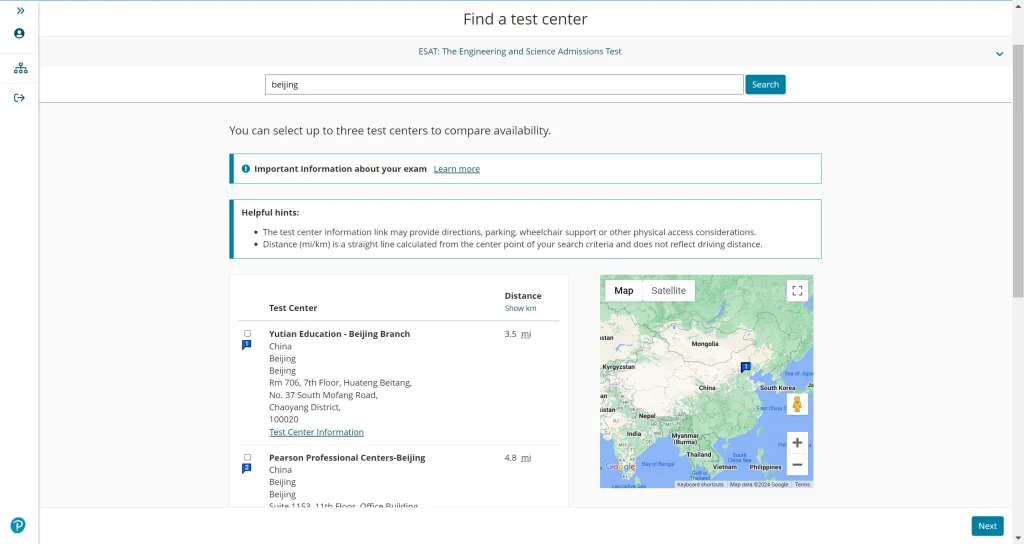
Since the TMUA is a computer-based test, sitting a diagnostic exam (mock test) before starting your official preparation is crucial. This helps you to:
- Experience the real exam environment
Familiarise yourself with the online testing platform’s interface and question presentation. Completing 20 multiple-choice questions within 75 minutes for Paper 1 and Paper 2 respectively creates intense time pressure, which may expose weaknesses in your mental arithmetic without a calculator. - Assess your current standing across topics
Evaluate your understanding of mathematics, logic, and proof, as well as your problem-solving speed and accuracy, identifying the primary gaps between your current level and the exam requirements.
How to select a diagnostic tool?
You can choose a past TMUA paper (2016–2023) for assessment. However, these past papers only test content knowledge and cannot fully simulate the TMUA’s online format, interface, and computer-based timing rules. You must also pay attention to how well they align with the current syllabus. Alternatively, you could use the official specimen and practice papers released by UAT-UK, but these tend to be easier than the exams from the last two years, making them less accurate for assessing your true capability. To address this, our UEIE research and teaching team has developed a Free TMUA Diagnostic Exam, paired with an online computer-based testing system that replicates the official interface with 99% accuracy.
This diagnostic exam is mapped against the latest TMUA syllabus and is designed to assess the core knowledge and skills required for the TMUA more effectively. According to feedback from past students, the difficulty of this paper closely matches that of the 2024 and 2025 past papers, maintaining an identical question style. Furthermore, based on data collected from global candidates sitting this diagnostic exam, we have derived an objective and reasonable conversion curve for reported scores, helping candidates better understand their standing within the global applicant pool.
Click the link below to learn more about this diagnostic exam and complete it online.
Free TMUA Diagnostic Exam
What is the self-assessment process?
- Strictly enforce independent timing of 75 minutes each for Paper 1 and Paper 2, completing them consecutively within a single 150-minute block.
- Complete the test on a computer. Calculators are strictly prohibited; use only pen and paper for rough workings.
- Check your answers against the solutions or system scoring to objectively evaluate your performance in each module (ideally converting it to a reported score between 1.0 and 9.0).
- Focus your analysis on the root causes of mistakes: Are they due to missing knowledge points? Unclear conceptual understanding? Calculation errors? Misinterpretations in reading? Poor time allocation? Or a lack of strategic techniques?
- Log your weak areas to serve as focal points for your subsequent TMUA preparation.
II. Bridging the Gaps: TMUA Syllabus Review and Weakness Checklist
To conquer the TMUA preparation, first it requires a clear understanding of the specific scope of knowledge required and knowing how to align these requirements with your current academic background (e.g., whether you have completed A-Level Mathematics or are studying within the AP/IB systems).
1. Key Changes to the Test Syllabus
- No changes to the syllabus content
The content of the latest syllabus remains unchanged from the previous year, indicating that the TMUA scope is highly stable. - 100% overlap between the TMUA and ESAT syllabi
The syllabus content for TMUA Paper 1 perfectly aligns with ESAT Mathematics 1 and Mathematics 2. This is excellent news for TMUA candidates as well working on the ESAT preparation and the select few who need to sit both tests.
2. Topics Covered
The TMUA framework is primarily based on the UK A-Level Mathematics syllabus, alongside elements of GCSE Mathematics. Consequently, a solid command of the corresponding A-Level and GCSE Mathematics content is a prerequisite for TMUA preparation.
Paper 1: Applications of Mathematics
- Section 1 mainly covers AS-Level Mathematics content: algebra and functions, sequences and series, coordinate geometry in the $(x, y)$ plane, trigonometry, exponentials and logarithms, differentiation, integration, and graphs of functions.
- Section 2 mainly covers GCSE Mathematics content: units, number, ratio and proportion, algebra, geometry, statistics, and probability.
Paper 2: Mathematical Reasoning
- In addition to covering all knowledge points from Paper 1, this paper introduces assessments on the logic of arguments, methods of proof, and identifying errors in mathematical proofs.
3. Is it necessary to study A-Level Further Mathematics in advance?
No. The TMUA syllabus content does not extend beyond AS-Level Mathematics and GCSE scope. However, from the perspective of deepening and broadening your mathematical thinking, as well as preparing for university interviews and future undergraduate studies, I highly recommend that students take A-Level Further Mathematics if time and energy permit. Although it is not directly tested, the thought processes and breadth of knowledge it instils are immensely beneficial for grasping challenging TMUA questions and future academic pursuits.
4. Is a background in mathematical competitions required?
It offers an advantage, but it is not essential. In recent years, the style and difficulty of certain TMUA questions have indeed shown a trend towards mathematical competitions, occasionally involving foundational knowledge and methods common in competitions (such as elementary number theory, basic combinatorics, and recursive thinking).
Consequently, students with a background in competitive training may hold an advantage when tackling certain difficult problems. Students without a competition background need not be overly anxious; the core of the TMUA remains the proficient application of syllabus knowledge. However, during the TMUA preparation, if you encounter questions of this nature, it is worth exploring and supplementing relevant foundational competition insights and problem-solving techniques to stretch and extend your capabilities.
5. Aligning Knowledge Across Different Curriculums
Students studying AP or IB curricula must pay close attention to differences in coverage and prepare systematically.
| Curriculum System | Alignment and Recommendations |
|---|---|
| A-Level System | Highest alignment with the syllabus. However, gaps may still exist in the breadth of pure mathematics and specific topics. Furthermore, regular school training typically lacks dedicated practice on themes found in Paper 2, such as “necessary and sufficient conditions”, “logic of proof by contradiction”, and “identifying flaws in proofs”. |
| AP System | AP Calculus AB or BC provides a strong foundation for most of the pure mathematics required in TMUA Paper 1 (especially calculus). However, the breadth of algebra and geometry is often insufficient. Furthermore, the TMUA demands a high level of proficiency in sketching graphs by hand. For AP students accustomed to relying on graphing calculators, encountering questions that require extreme precision in algebraic manipulation and manual sketching can easily lead to a breakdown. Therefore, AP students need to allocate time to adapt swiftly to a non-calculator exam environment. |
| IB System | Compared to the TMUA syllabus, IB Mathematics HL (including both AA and AI) may present gaps in the breadth of pure mathematics and statistics, as well as specific topics. Additionally, the intensity of foundational computation and algebraic skills training in the IB curriculum differs from TMUA requirements. Coupled with the heavy academic workload inherent to the IB programme, students in this system face a greater challenge when preparing for the TMUA. |
III. Breakout Strategies: Enhancing Decision Efficiency and the Advanced Roadmap
In the TMUA exam hall, the challenge lies not in the extreme depth of a single question, but in the ultimate demand for speed and accuracy under intense pressure.
1. Strategies for Enhancing Core TMUA Capabilities
To survive under the high intensity of having less than 1.5 minutes per question on average, you must achieve:
- Deeply understand core concepts and apply knowledge flexibly
You cannot stop at surface-level memorisation of formulas and definitions; instead, you must deeply understand the mathematical logic and applicability boundaries behind each topic. You must also be able to connect seemingly isolated knowledge points, applying them flexibly to novel scenarios set by the questions to quickly construct correct problem-solving models or approaches. This forms the foundation for quickly identifying the examined concept and eliminating distractor options. - Break the calculator dependency and rebuild mental arithmetic instincts
Calculators are strictly prohibited throughout the TMUA. Students who have grown accustomed to relying on tools in the A-Level or AP systems must deliberately train their mental and written calculation techniques during TMUA preparation. Fully transforming common formulas, algebraic manipulations, equation solving, and order-of-magnitude estimations into conditioned reflexes is the only way to avoid running out of mental computing power in the exam hall. - High-speed decision-making and the “philosophy of abandoning questions”
With an average of only 3.75 minutes per multiple-choice question, the timing might seem more generous than the ESAT. However, TMUA questions and options are exceptionally clever, littered with conceptual blind spots and distractor choices. You must develop an instinct for quickly identifying distractors, and decisively skip questions when stuck. Securing the total number of correct questions is the sole rule for achieving a high score.
2. Core Factors Affecting the TMUA Preparation Timeline
Your ideal TMUA preparation duration primarily depends on:
- Target Score Band
Are you aiming for a 6.5, a 7.0, or even higher? Higher targets generally demand longer refinement periods and higher-intensity training. - Baseline Proficiency
How solid is your current grasp of A-Level/GCSE knowledge? What is your calculation speed and accuracy? - Weekly Time Commitment
How many hours of highly efficient study time can you consistently guarantee each week?
3. TMUA Preparation Timeline Suggestions for Different Starting Points
Based on students’ backgrounds, here are my recommendations for TMUA preparation launch dates and cycles:
- Strong Baseline (e.g., STEP Grade 2 or above, or competition experience like AIME/BMO1)
The focus should be on adapting to the TMUA multiple-choice format, speed requirements, and Paper 2’s logical reasoning style. It is recommended to begin targeted training roughly 2–3 months before the exam (e.g., starting in July or August for the October exam). - Intermediate Baseline (e.g., A-Level system, no competition or STEP experience)
You need to simultaneously consolidate content proficiency, improve calculation speed and accuracy, and adapt to the TMUA assessment style. It is recommended to start systematic TMUA preparation no later than 4–6 months before the exam (e.g., launching in June or July for the October exam). You must progress through a complete cycle of “Knowledge Mastery $\rightarrow$ Strategy & Techniques $\rightarrow$ Mock Exams $\rightarrow$ Final Sprint”. You can refer to the “June to October TMUA Golden Preparation Timeline” table below. - AP / IB System Students (no competition or STEP experience)
In addition to the challenges faced by intermediate students, you will require extra time to bridge knowledge gaps, with a heavy emphasis on reinforcing calculation speed and precision—areas that may receive less training in your original curriculum. It is strongly advised to begin as early as possible, ensuring at least 4–6 months or longer for TMUA preparation (e.g., launching in early May or even earlier). Preparation must combine knowledge supplementation with TMUA-specific targeted training.
June to October TMUA Golden Preparation Timeline
Jun–Jul Clear | √ Familiarise with the Syllabus; Organise Knowledge
Systematically and comprehensively organise all knowledge points on the syllabus by category and topic. You must not only remember formulae but also understand their derivation, basic principles, and common question patterns, while beginning to accumulate problem-solving techniques. |
|---|---|
Jul–Aug Increase Speed | √ Intensive Practice; Internalise Knowledge
This is the watershed! Relying solely on lessons will not achieve internalisation. This must be coupled with high-quality practice, and the difficulty of the questions must be moderate: slogging through overly difficult problems wastes time and damages confidence, while simple questions fail to identify gaps. Furthermore, to cope with CBT pressure, all practice must be completed under timed conditions. |
Sep–Oct Pursue Precision | √ Full Mock Exams; Develop Instincts
In a highly simulated computer-based environment, become familiar with the countdown rhythm and optimise time management and question-skipping strategies. Through high-quality mock training, develop an instinctive response to various “trap” questions, ultimately improving accuracy under extreme time pressure. |
4. Common Pitfalls and Solutions for TMUA Preparation
In the process of tutoring students for the TMUA, I have observed several widespread misconceptions that severely hinder preparation efficiency and final performance. Actively identifying and avoiding them can help you achieve twice the result with half the effort.
Pitfall 1: Launching too late, lacking a clear plan
- Manifestation & Consequences
Underestimating the preparation time required to achieve the necessary speed and proficiency for the TMUA. Starting too late leaves insufficient time for later practice, making it difficult to perform stably under pressure. - Solution
Plan early and commit consistently! Refer to the timeline recommendations provided above, start as early as possible based on your individual situation, and stick to a regular schedule of high-quality training every week.
Pitfall 2: Ignoring the online format, practicing detached from reality
- Manifestation & Consequences
Relying predominantly on paper-based materials for TMUA preparation and lacking sufficient practice on online platforms. Failing to familiarise oneself with reading, answering, flagging, and navigating in an online environment; failing to specifically train calculation speed and techniques in a non-calculator setting. This leads to unfamiliarity with operations, an inability to keep up with the pace, and frequent calculation errors in the actual test. - Solution
Shift your focus entirely to online practice and simulations during the mid-to-late stages of TMUA preparation. Use official practice tools and high-quality online mock exams (such as UEIE mock tests) with high frequency; treat non-calculator arithmetic as a specialised skill to be trained deliberately and continuously.
Pitfall 3: Underestimating multiple-choice questions, lacking strategy and technique
- Manifestation & Consequences
Believing multiple-choice questions are simple and failing to focus on methods and techniques; lacking time-management awareness, with a problem-solving speed far slower than the required pace. Failing to analyse options, eliminate distractors, or make strategic guesses. - Solution
Treat multiple-choice exam techniques as an essential component of your learning. Complete a large volume of timed multiple-choice practice to build a sense of speed and accuracy. Repeatedly rehearse time allocation and answering strategies during mock exams.
Pitfall 4: Neglecting official resources, relying on outdated information
- Manifestation & Consequences
Failing to carefully study the latest official syllabus, leading to deviations in the scope of revision; failing to closely analyse the latest updates and official resources released by UAT-UK, hoarding vast amounts of materials without utilising them deeply. - Solution
Position the official syllabus and official practice resources at the core of your preparation; use past papers critically; select high-quality supplementary resources (such as UEIE self-study packs, Isaac Physics, etc.); regularly check the official website for the latest updates.
Pitfall 5: Emotional imbalance, carrying excessive stress
- Manifestation & Consequences
Experiencing extreme anxiety over the speed requirements; suffering an emotional breakdown when encountering difficult problems or consecutive incorrect answers, which compromises subsequent performance; harboring an excessive fear of losing marks instantly on multiple-choice errors. - Solution
Position yourself scientifically and respond calmly! Set reasonable milestone goals, and accept that failing to complete or making mistakes on some questions is entirely normal. Train your ability to quickly skip difficult questions and make strategic guesses. Cultivate resilience under pressure.
IV. Moving Beyond Blind Practice: Data-Driven Resources and Closed Loop for TMUA Preparation
After defining the timeline and avoiding pitfalls, leveraging high-quality resources to fill the vacuum left by the scarcity of new official questions represents the final step in executing your TMUA preparation. When facing the TMUA—which carries an exceptionally low margin for error and rigorously tests real-time reflexes—blindly grinding through questions will yield half the result for twice the effort. What you need is a scientific TMUA preparation scheme that directly addresses the pain points of computer-based testing while genuinely elevating your mathematical aptitude.
1. Official Cornerstone Resources
You can access the most vital foundational TMUA preparation materials on the official UAT-UK website:
- The latest version of the TMUA syllabus
- Official specimen papers and practice materials
- Examination guides and FAQs
- TMUA Paper 2 notes on logic and proof
- TMUA past papers (2016–2023)
Special Reminder: While past papers are excellent tools for verifying knowledge mastery, they cannot simulate a genuine computer-based testing environment or the psychological pressure of a countdown timer. During the mid-to-late stages of revision, you must combine your study with highly realistic online practice, and avoid seeking a false sense of security in paper-based legacy questions.
2. UEIE’s Exclusive “Learn-Practise-Test” All-In-One Matrix
To help candidates aiming for Oxbridge and the G5 achieve top scores, our research and teaching team has meticulously crafted the UEIE TMUA On-Demand Suite. This material is rigorously revised annually based on the latest TMUA test trends, perfectly covering the core closed loop of scientific preparation:
Systematically review core examinable topics and deeply deconstruct efficient, “anti-routine” problem-solving techniques.
An all-English question bank, scientifically categorised by topic modules and difficulty levels. Through a massive volume of targeted, high-quality timed practice, it helps you completely break your dependency on calculators.
Developed with immense effort, these exams replicate the official computer-based testing environment with 99% accuracy. They recreate the genuine exam interface and high-pressure countdown experience, ensuring you firmly secure a top-tier standing through real-world practice.
3. Advanced Studies and Systematic Planning
Beyond the on-demand suite, UEIE runs systematic, rolling TMUA preparation programmes year-round. For students required to sit the TMUA, we have mapped out a structured teaching and reinforcement loop. This is particularly true for high-achieving candidates aiming for the top 10%, who often require more rigorous TMUA preparation planning and instructional hours as a guarantee. Through high-density academic pressure and periodic milestone assessments, we ensure that candidates leave absolutely no blind spots in either their breadth of knowledge or precision in problem-solving.
TMUA Preparation Programme (October 2026 Sitting)
Conclusion
In an application season marked by intense hyper-competition, the TMUA has never been a test that purely measures the extreme difficulty of beyond-syllabus knowledge. What you can least afford to waste is time spent blindly trialling and making errors. Pinpointing your score target, mastering the golden TMUA preparation timeline, and employing scientific training methods constitute your only shortcut to standing out.
It is my hope that this TMUA preparation guide will help you reject ineffective hyper-competition, locate your true coordinates, and serve as a reliable beacon on your journey to scaling the heights of Oxbridge and the G5.