




Oxford Cambridge Computer Science Admissions Guide

UEIE Founder
Senior Oxbridge preparation mentor and Olympiad gold medal coach with nearly 20 years of international curriculum teaching experience. 55 students coached have received Oxbridge offers, with hundreds more gaining admission to G5 and Ivy League universities.
UEIE Founder
Oxford Cambridge Computer Science Admissions Guide

Introduction
During the planning and application process for Computer Science at Oxbridge and G5 universities, many students and parents often fall into a cognitive misconception: they believe that mastering a few programming languages and completing a couple of hardcore research projects will secure them an admissions ticket to Oxford and Cambridge. However, what Oxbridge looks for has never been “skilled coders”, but rather computer scientists possessing top-tier abstract logic and mathematical talent. In the eyes of university professors, writing code is merely a tool skill that can be learnt at any time, whereas the underlying computational thinking and mathematical abstraction capabilities form the core threshold that cannot be fast-tracked.
When highly homogenised perfect scores no longer offer a sense of security, how exactly do top prestigious universities filter out 90% of applicants through a set of mechanisms? Today, combining the latest official core data, I will take you directly through the real admissions funnel and screening metrics of Oxford and Cambridge Computer Science.
I. Visible and Invisible Thresholds: Straight A*s and Competition Resumes Are Not Absolute Guarantees
In the current applications for Computer Science at Oxford, Cambridge and G5 universities, if you solely focus on the minimum admissions requirements listed on the official university websites, you will most likely develop an illusion of “I fully meet the criteria”.
1. The Visible Threshold: Inflated Paper Grades and Homogenised Resumes
Browsing the official websites, the admissions requirements for Computer Science and related programmes at Oxford, Cambridge, Imperial College London, and UCL are typically A*A*A, with an explicit stipulation that Mathematics must be an A*. For top-tier academic overachievers, this threshold poses no pressure at all, and candidates capable of submitting transcripts with 4A* or even 5A* are everywhere.
Furthermore, many students spend a significant amount of time outside school learning Python and C++, or participating in various computer olympiads (such as USACO), attempting to craft an extremely hardcore resume. However, when straight A*s and programming project experiences have already become standard configurations in the application pool, they serve merely as a basic admission ticket and cannot be an absolute guarantee for you to stand out.
2. The First Invisible Barrier: A Top-Tier Mathematics Department Disguised as Computer Science
The biggest strategic misjudgement for many applicants is equating Computer Science to Software Engineering.
Under the academic framework of Oxbridge and the G5, the essence of Computer Science is highly abstract discrete mathematics, algorithm analysis, and logical calculus. Therefore, the first invisible barrier is an extreme preference for Further Mathematics.
Oxford and Cambridge directly bind Further Mathematics within their Computer Science admissions requirements; whereas on the official websites of Imperial College London and UCL, although the wording for Further Mathematics is mostly “Highly Recommended” or “Preferred”, in actual admissions, almost all accepted students possess an A* in Further Mathematics. In the eyes of admissions officers, even if you can independently develop complex programmes, if you lack a solid foundation in pure mathematics, you lack the academic bedrock required to conduct underlying research in this discipline.
3. The Second Invisible Barrier: The Absolute Metrics of Admissions Tests (TMUA and TARA)
When examinations like A-Levels and APs fail to differentiate candidates effectively, universities inevitably require a unified and extremely precise new metric. Under the latest UAT-UK test framework, this metric has formed a complete monopoly over top prestigious universities:
- TMUA
Currently, it serves not only as a mandatory admissions threshold for Cambridge Computer Science, Oxford Computer Science, and their joint schools, but even the Computer Science as well as Mathematics and Computer Science programmes at Imperial College London have fully adopted it as a core requirement. - TARA
As a new standardised test evaluating academic reasoning and non-subject-specific abilities, it has also become the screening standard for Computer Science-related programmes at UCL.
Whether it is TMUA or TARA, they do not test any programming syntax or algorithms, but purely and with high intensity evaluate the candidates’ thinking and logic—namely, the ability to extract core information, establish mathematical models, identify logical traps, and perform rapid deductions within an extremely limited timeframe.
These tests thus constitute the most central second invisible barrier in the application: if the score fails to reach the safety line drawn internally by the university, no matter how perfect the high school grades are or how rich the project experience is, one will be ruthlessly eliminated in the first round of screening.
II. The Hell-Level Funnel: The Cruel Filtering Behind an Admissions Rate Plunging Below 8% at Oxford & Cambridge Computer Science
Having seen clearly the interwoven visible and invisible admission thresholds, let us examine how these standards operate in actual recruitment.
To give you a visual representation of the true competitive intensity across various Computer Science-related disciplines, I have constructed the following dynamic chart, “Comparison of Oxford & Cambridge Computer Science Admissions Funnels,” based on the officially disclosed data from the latest (2023/24) application cycle.
You can try selecting different Computer Science-related programmes from the drop-down list (for instance, choosing Oxford Computer Science for one funnel and Cambridge Computer Science for the other), and by toggling the gender dimension (All / Women / Men), personally experience the astonishing elimination ratios of the admissions funnels:
From the intuitive comparison of the aforementioned data, we can unpack the extremely rigorous three-layer screening logic of Oxford and Cambridge Computer Science admissions:
1. The Macro Market: A "Needle-Eye" Style, Extremely Low Offer Rate
The Computer Science track of Oxford and Cambridge is unlike other specialities; the admissions test stage alone eliminates over two-thirds of the candidates, and the fortunate individuals who ultimately receive an offer account for less than 10%.
- Oxford Computer Science
871 top academic overachievers submitted applications, and ultimately only 65 offers were issued, with the overall offer rate dropping as low as 7.5%. - Cambridge Computer Science
Among 1,583 applicants, 147 offers were ultimately handed out, yielding an overall offer rate of a mere 9.3%.
This implies that whether it is Oxford or Cambridge, a conservative and stringent admissions strategy is adopted for Computer Science applicants right from the beginning. In this track, there is virtually no room for error, and over 90% of candidates are destined to become mere runners-up in this fierce contention.
2. Pre-emptive Strangling: The Highly Efficient Filtering Net Prior to Interviews
The data from the University of Oxford clearly demonstrates the astonishing lethality of the pre-emptive stages to us.
Taking male applicants for Oxford Computer Science as an example, out of 676 applications, only 140 individuals received interview invitations (Shortlisted). This means that up to 79% of straight-A* overachievers were ruthlessly eliminated in the first round of screening not even got to see the professors.
The situation for the Mathematics and Computer Science programme is equally brutal: 480 males applied, and only 163 obtained interview invitations. This pre-interview elimination rate of nearly 70% once again validates the previous point: when perfect A* paper grades become standard, independent metrics such as the TMUA (previously the MAT examination) have become the universities’ most efficient and foundational filtering nets.
3. Data Perspective: Gender Advantage Completely Vanishes
Because Computer Science is traditionally a discipline heavily dominated by males, some parents of female applicants pin their hopes on the universities’ gender diversity policies, believing there is a significant admissions dividend for females applying for Computer Science. This set of charts provides an exceptionally objective answer from reality.
- In terms of conversion rates, the admission probability for female students is indeed slightly higher. Taking Oxford Computer Science as an example, the admissions rate for females is approximately 9.7% (19/195), slightly higher than the 6.8% (46/676) for males, while the offer rate for females in Cambridge Computer Science is 12.0% (33/276), also marginally higher than the 8.7% for males.
- However, looking at the absolute baseline numbers, the competition remains hell-level. Globally, Oxford issued a mere 19 offers to females for pure Computer Science in a single year, while Cambridge Computer Science only distributed 33 admissions.
This indicates that while universities might be willing to encourage more outstanding female students to enter the computing field in their macro planning, the hardcore baseline based on written test scores will absolutely not budge during the actual review process. Expecting to gain an advantage through gender identity is nothing short of a pipe dream.
III. Pre-emptive Screening: The Underlying Logic of TMUA
Having clearly seen the Oxford and Cambridge admissions funnel for Computer Science plunging below 10%, many students and parents will inevitably ask: since almost all students who submit applications hold double A*s in Mathematics and Further Mathematics, and their programming experiences are largely similar, what metric exactly do Oxford and Cambridge use to weed out 90% of people?
The answer lies hidden in the macro market of the past decade where competition has continuously intensified, as well as in the scores of the TMUA (before 2026, Oxford adopted the MAT), which has fully taken over the admissions screening for Oxford and Cambridge Computer Science.
1. The Cliff-Like Drop of the Ten-Year Macro Market and the Forced Ultimate Metric
If you think single-digit offer rates are merely an annual anomaly, you might as well look at the official macro trend charts from the past decade (2014-2023) aggregated by UEIE.
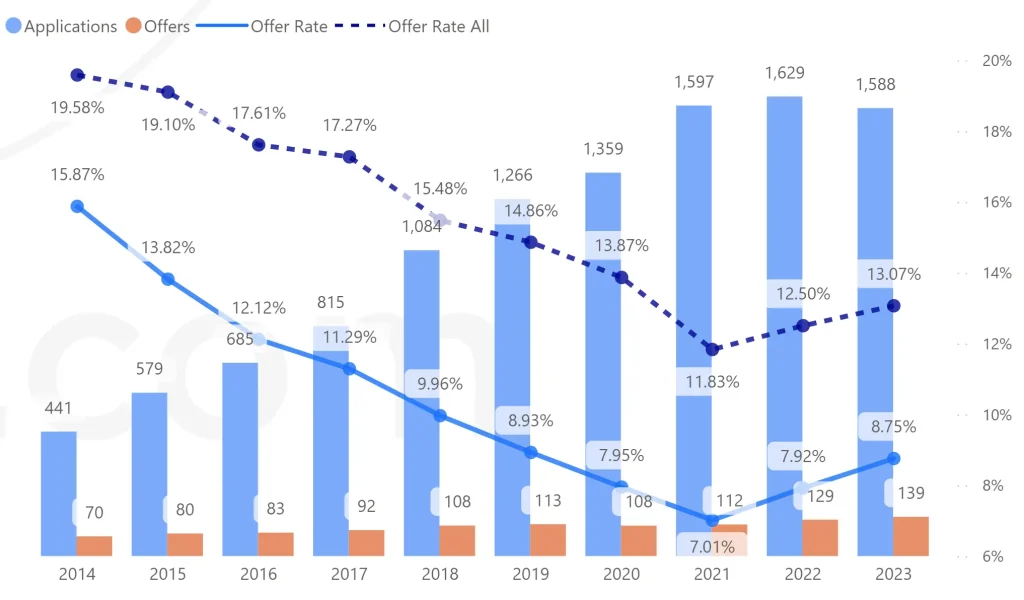
Computer Science Admissions Data at Oxford during 2014–2023 Application Cycles
(Plotted by UEIE based on official data)
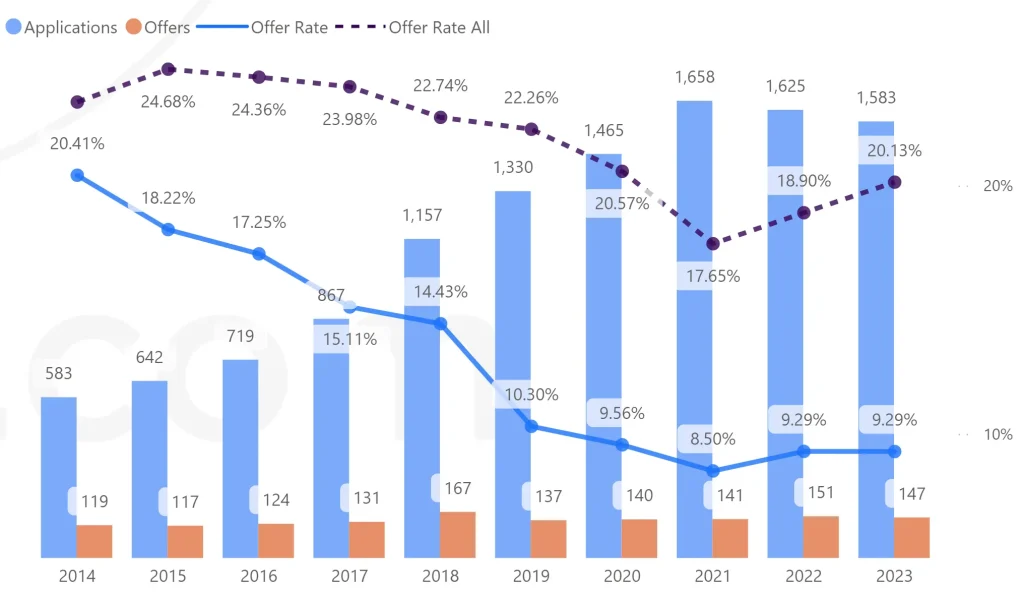
Computer Science Admissions Data at Cambridge during 2014–2023 Application Cycles
(Plotted by UEIE based on official data)
This substantial decade of data clearly reveals a suffocating trend:
- Oxford Computer Science
Applications surged from 441 individuals in 2014 to 1,588 individuals in 2023. The number of applicants multiplied nearly fourfold, causing the offer rate to plummet from an initial 15.87% all the way down to 8.75%. - Cambridge Computer Science
The exact same script played out at Cambridge, where application numbers soared from 583 individuals in 2014 to 1,583 individuals. The offer rate was halved from a relatively high position of 20.41% down to 9.29%.
When A-Levels completely lose their ability to differentiate, and faced with a massive annual influx of straight-A* applicants, universities are forced to pin their hopes on the TMUA as the ultimate metric to perform extreme stretching within the full-mark range.
TMUA Score Distribution in Selected Regions (2024/25 Cycle)
| Country or Region | Number of Candidates | Average Score | 25th Percentile | 50th Percentile | 75th Percentile | 90th Percentile |
|---|---|---|---|---|---|---|
| United Kingdom | 7715 | 3.86 | 2.8 | 3.8 | 4.8 | 5.8 |
| China | 2554 | 5.42 | 4.1 | 5.4 | 6.7 | 8.4 |
| India | 779 | 3.63 | 2.4 | 3.5 | 4.7 | 5.7 |
| Singapore | 316 | 4.78 | 3.6 | 4.7 | 5.8 | 6.9 |
| Hong Kong, China | 296 | 5.06 | 3.8 | 5.0 | 6.3 | 7.6 |
| Malaysia | 231 | 3.80 | 2.7 | 3.8 | 4.7 | 5.7 |
* Source: UAT-UK Official Report
- The Extreme Hyper-Competition of Chinese Academic Overachievers
More brutally, the average score of Chinese candidates is as high as 5.42 points, far exceeding the 3.86 points of British domestic candidates. This means that along this track, if you merely reach the global average level, you simply cannot stand out from your peers. - Dimensional Reduction Strike on Applicants
Official data demonstrates that the 90th percentile (i.e., top 10%) for Chinese candidates is as high as 8.4 points. Because Computer Science gathers a cohort of brains with the strongest mathematical abilities, this hyper-competition will be further amplified within the computer application pool. Many parents assume that scoring a 7.0 or 7.5 is already outstanding, but among candidates applying for Oxbridge Computer Science, this score will most likely not even touch the threshold for an interview.
2. Computational Thinking Tests Under Extreme Pressure
Unlike traditional high school mathematics examinations, the TMUA does not test any programming syntax at all, but instead evaluates the most central essence of Computer Science: algorithm optimisation and computational thinking. It requires you not only to “be able to solve for the answer”, but more demanding still, “to find the optimal solution under extreme high pressure”.
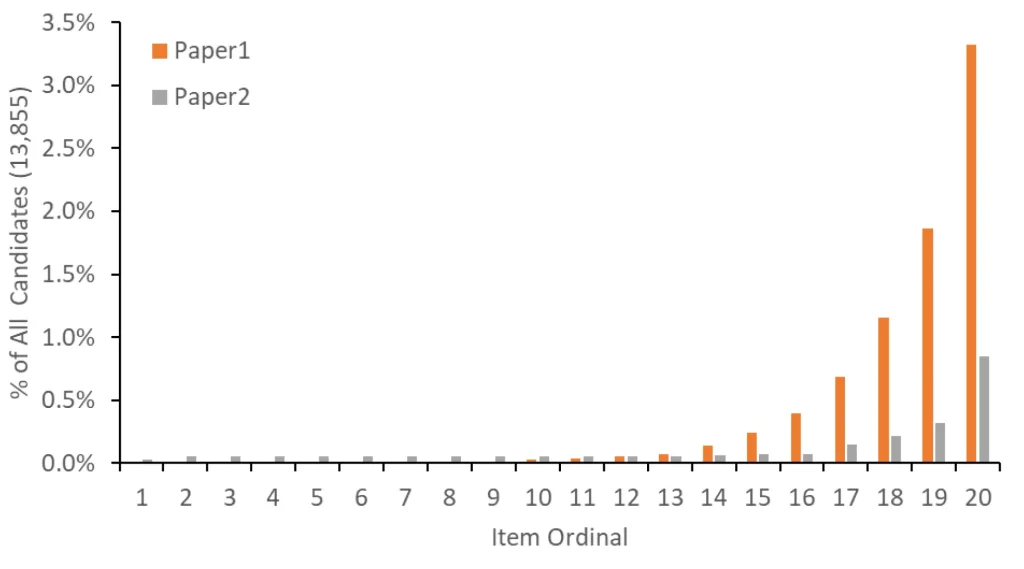
Percent of Unreached Items by Item Ordinal on TMUA Paper 1 and Paper 2 (2024/25 Application Cycle)
(Screenshot from the Official UAT-UK Report)
Official data indicates that up to 23% (3,227) of candidates spent no more than 10 seconds on at least one question. This shows that nearly a quarter of candidates completely collapsed as the countdown neared its end, forced to guess blindly to submit their papers.
The essence of Computer Science is to seek the most efficient algorithms. If you still employ high school “generic methods” to solve problems in the TMUA test hall, you will inevitably exhaust your time. What the TMUA aims to identify are precisely those top-tier contestants who can rapidly spot logical traps, eliminate redundant information, and find the shortest path to a solution.
3. Stripping Away the Language Shell, Hitting the Core of Abstract Logic Directly
After failing the admissions test stage, many international students habitually blame the outcome on “too many long and complex English sentences in the questions, so reading speed could not keep up”. However, official data ruthlessly shatters this self-consolation.
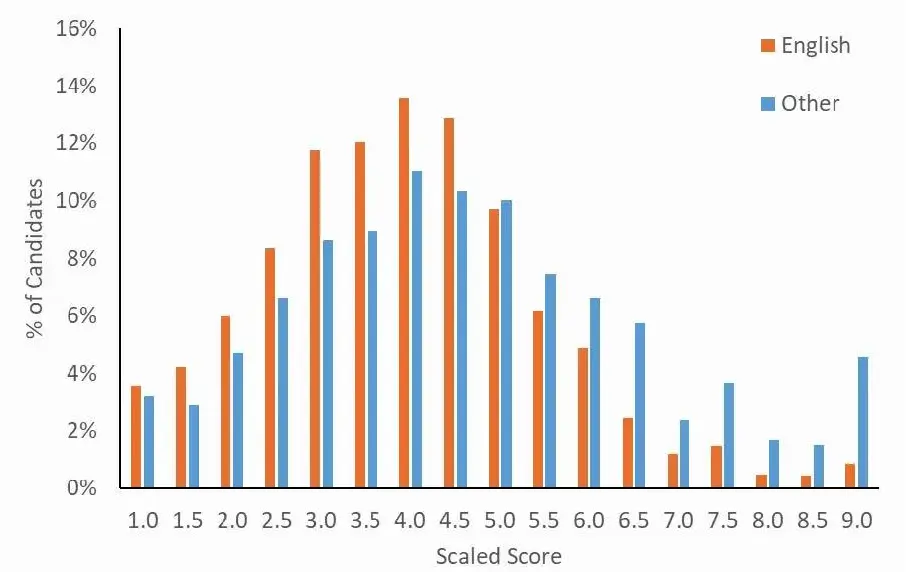
Comparison of Score Distributions by First Language: English vs. Other
(Screenshot from Official UAT-UK TMUA Techical Report, published in September 2025)
- Counter-Intuitive Data
According to the official report, candidates whose native language is not English (average score of 4.61) performed significantly better than native English-speaking domestic candidates (average score of 3.94). - Underlying Logic
The officials explicitly point out that the language load of this type of standardised examination is extremely low. This means that in this battle, there is absolutely no excuse of “language disadvantage” to be found. It strips away all superficial packaging, directly measuring the true acuity deep within the candidates’ brains for discrete mathematics and logical frameworks. This happens to be precisely the trait that a top computer scientist must possess when facing low-level machine languages and complex systems.
IV. The Ultimate Touchstone: What Kind of Brain Is Oxbridge Computer Science Actually Looking For?
Having crossed the admissions test “execution line” that drops below 10%, during the interview stage, the assessment standards of Oxford and Cambridge Computer Science departments are remarkably consistent. Leafing through the official statements and interview guidance of both universities, we can clearly extract the core qualities that a top computer scientist must possess, which are exactly what the interviews focus on evaluating:
1. Official Perspective: Not Looking at Code Proficiency, but Rather Computational Flexibility
Many students assume that interviews will examine complex programming syntax or project experiences, but Oxford and Cambridge officials explicitly state that the core of the interview is not to test the high school knowledge you have already mastered or pre-memorised materials. On the contrary, what professors truly care about is the candidate’s mathematical intuition and intellectual flexibility.
Oxford University explicitly requires candidates to be able to “engage with unfamiliar problems in real time” under extreme pressure. They do not care how many out-of-syllabus algorithm problems you have practiced in advance, but rather see whether you have a set of underlying computational thinking in your mind that can be continuously guided and extended when pushed into unknown territories outside the high school syllabus, and whether you are willing to embrace entirely new ways of looking at problems.
2. The Essence of the Interview: A Session of Algorithmic Deduction and System Debugging Under High Pressure
To examine this flexibility for admissions, Oxford and Cambridge Computer Science interviews are by no means simple question-and-answer sessions of knowledge. In Oxford interviews, Computer Science belongs to the subjects with the highest technical requirements (Tier 3), where you need to conduct high-intensity mathematical deductions and logical architectures in real time with professors on a shared virtual whiteboard.
The professor will intentionally toss out a computational model or logical game you have never seen before. Cambridge officials make no secret of pointing out: “we do not expect you to get it 100% right; in fact, you are almost guaranteed to need to work with us to get through”.
This is precisely the ultimate touchstone of the interview: do you possess teachability and a debugging mindset? When your train of thought hits a dead end and the professor offers a hint, can you rapidly comprehend the guidance, sensitively troubleshoot edge cases within your thinking, steady your mindset, and continue down the unknown logical chain? This ability to resonate on the same frequency as top scholars in uncharted waters is the core of passing.
3. The Warmth Behind Cold Data: Machines Look at Results, Professors Look at the Process
Although the selection process of Computer Science at Oxford and Cambridge is extremely brutal during the front-end admissions tests, once it reaches the interview stage, it is by no means a conventional screening mechanism that solely values accuracy. This also embodies the most central value of Oxbridge admissions: holistic assessment. The TMUA can only see which option you ultimately selected, but during the interview, professors can genuinely observe your mental representation. As an Oxford tutor noted, compared to those candidates who chase speed and provide answers that “appear correct but are actually riddled with loopholes”, they prefer students who dare to think aloud, rigorously troubleshoot boundary conditions, and do not hesitate to overturn everything and start afresh when they discover logical errors.
In the academic interviews of Computer Science at Oxford and Cambridge, as long as you can display a strong inner drive and top-tier potential for algorithmic deduction, even if you make a calculation error in a specific step, this door to prestigious universities with an admissions rate plunging below 10% is still willing to open for you.
Conclusion: Abandon Ineffective Hyper-Competition, Position Strategies Precisely
Having seen clearly the aforementioned funnel mechanisms and selection rules, we will understand a most foundational reality: Computer Science admissions at Oxford and Cambridge are never a battle that can be won by stacking programming projects and frantic last-minute question drilling.
Since admissions test scores represent the first life-and-death checkpoint for securing a place, and the underlying computational thinking and real-time debugging capabilities tested during interviews are by no means built in a day, in this application season where competitive intensity has hit a historic high, what you can least afford to waste is using these precious few months to blindly make trial and error. All strategies must be established upon an objective recognition of one’s true competence.
Regarding how to internalise the capability of crossing thresholds into an instinct under the brand-new standardised test system, and how to scientifically plan the revision rhythm for the coming months, it is strongly recommended to read this practical guide in parallel:

Oxbridge Admissions Tests Reform: Is Your Preparation Timeline on Track?
In this article, you can obtain highly simulated computer-based diagnostic exams exclusively developed by the UEIE teaching and research team. Use an exceptionally objective data diagnosis to pinpoint your current true combat capability and launch the first step of scientific preparation.
Follow Us on Wechat