




Cambridge Economics Admissions Guide

UEIE Founder
Senior Oxbridge preparation mentor and Olympiad gold medal coach with nearly 20 years of international curriculum teaching experience. 55 students coached have received Oxbridge offers, with hundreds more gaining admission to G5 and Ivy League universities.
UEIE Founder
Cambridge Economics Admissions Guide
Introduction
In the competitive race for admissions to top-tier prestigious universities, Cambridge Economics is undoubtedly one of the most highly sought-after pathways. However, among the numerous students and parents I have encountered, I find that they generally fall into a cognitive misconception: believing that as long as they achieve an A* in A-Level Economics, regularly read The Economist, and participate in a few highly prestigious business competitions to win top-tier awards, they will secure a guaranteed admissions to the University of Cambridge.
In fact, within Cambridge’s academic framework, the Economics course is essentially a core science discipline disguised as a social science——one that is highly mathematised and heavily model-driven. In the eyes of professors, without top-tier mathematical deduction capabilities as a foundation, no matter how much humanities literacy and commercial experience one has, it is merely a castle in the air.
Therefore, while a vast number of applicants are still piling up their profiles using a humanities and business mindset, through what kind of mechanism does Cambridge precisely screen its candidates? Today, combining the latest official admissions data for the Cambridge Economics course with a ten-year macro overview, I will guide you to recognise the true yardstick behind this selection process.
I. Explicit and Implicit Thresholds: A-Level Economics Grades and Business Competition Experience Are Not Absolute Guarantees
1. Explicit Thresholds: The Counter-Intuitive "Non-Essential" and Homogenised Profiles
Browsing the official website of the Faculty of Economics at the University of Cambridge, the typical admissions standard is A*A*A, which explicitly specifies that Mathematics must be an A*. There lies a highly subversive logic hidden here: Cambridge does not officially mandate that applicants must study A-Level Economics——this setting directly lowers the admissions weighting of a traditional economics profile.
In the eyes of Cambridge admissions officers, materials such as top awards in business competitions (e.g., NEC, IEO) or high-scoring essays (e.g., John Locke) can only prove that you possess basic common sense and enthusiasm for economics, but they are not prerequisites. Coupled with the fact that these types of profiles tend to be homogenised, they cannot serve as an absolute guarantee to make you stand out. While everyone focuses their energy on piling up profiles with a humanities and business mindset, the real screening actually takes place in the dark.
2. Implicit Barrier I: An Extremely Hardcore Pure Mathematics Foundation
The greatest strategic miscalculation made by many applicants who were not accepted in the admissions is underestimating the science attributes of the Cambridge Economics course.
The curriculum of the Cambridge Economics course is flooded with high-intensity calculus, linear algebra, and complex statistical models. Consequently, the first implicit barrier to Cambridge Economics admissions is an extreme craving for Further Mathematics. Although the wording on the official website of Cambridge Economics is relatively mild (such as “highly recommended”), in actual admissions, the vast majority of candidates who receive offers possess an A* grade in Further Mathematics. From the professors’ perspective, if your pure mathematics foundation is not solid enough, you simply will not survive post-enrolment in an academic system packed with mathematical derivations.
3. Implicit Barrier II: The Economics "Minor Peak" Behind the TMUA Data Distribution
When standard academic results lose their differentiation power, Cambridge unleashes its second barrier—the TMUA. This is the arena where the UK’s top academic talents in mathematics, computer science, and economics compete on the same stage.
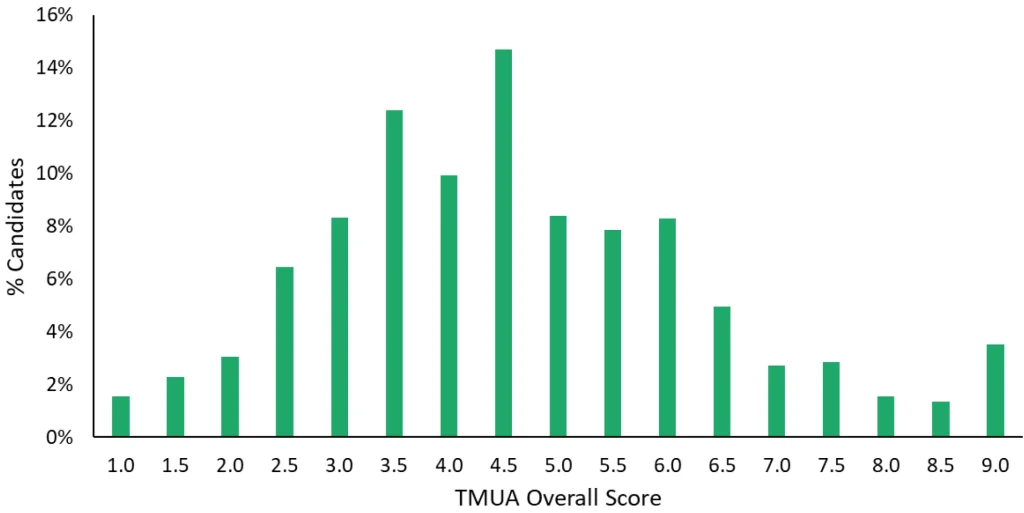
TMUA Global Score Distribution – October 2025
(Screenshot from Official UAT-UK Report)
Observing the official October 2025 TMUA global score distribution chart above carefully, we can clearly decipher the real competitive landscape and watershed moments:
- The 4.5-point Common Hub
The scores of the main crowd are densely clustered between 3.5 and 5.5 points, forming an absolute primary peak at 4.5 points. - The Extreme Tail-End at 9.0 points
At the far-right end of the chart, an anomalous tail-up appears at the 9.0 perfect score band. This interval is basically occupied by science geniuses applying for Mathematics and Computer Science. - The 7.5-point Economics Minor Peak
Most noteworthy is that within the downward trend sliding to the right from 6.0 points, there is a slight rebound at 7.5 points, carving out a local minor peak. This is precisely formed by the aggregation of the very top candidates in the economics application pool.
This chart provides a most chilling warning to students pursuing Cambridge Economics admissions: hitting the 4.5 average line is meaningless; even if you score 5.5, you are merely submerged in the shadow of the common primary peak. For economics top students, you must break into the minor peak area of 6.0 or even 7.0 and above in one go. Only here can you prove to admissions officers that you possess the mathematical intuition to stand shoulder-to-shoulder with elite science students.
II. The Cambridge Economics Admissions Funnel: The Brutal Filtration Behind a Decade of Acceptance Rates Consistently Below 15%
Having recognised the “science-driven dimensionality reduction strike” that the economics students must face, let us examine how these criteria operate in actual admissions at Cambridge.
If you think that the high elimination rate is an accidental phenomenon peculiar to certain years, you might as well look at the macro overview trend chart compiled by UEIE based on official data from the past decade (2014–2023):
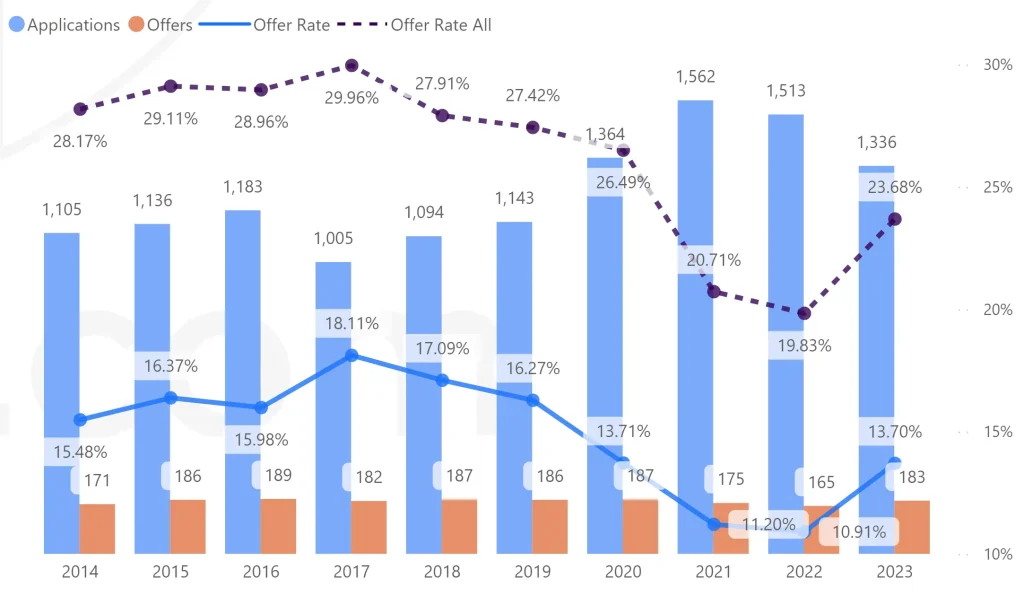
Economics Admissions Data at Cambridge during 2014–2023 Application Cycles
(Plotted by UEIE based on official data)
This decade of admissions data clearly reveals a pattern: the number of applicants for Cambridge Economics remains perennially high (reaching 1,336 in 2023). However, in the face of such a massive application base, the offer rate is strictly suppressed by the university, fluctuating at a low level between 10% and 15% (only 13.7% in 2023).
To help you perceive the brutality of this screening more intuitively, I have constructed the following “Cambridge Economics Admissions Funnel” dynamic chart based on the latest underlying official data from the 2023/24 application cycle. You can try switching the gender dimensions (All / Women / Men) to experience first-hand the cliff-like elimination ratios across different groups:
From the direct comparison between the macro overview and funnel data, we can extract two highly objective admissions logics for Cambridge Economics:
1. An Extremely Steep Initial Screening Cliff
Out of 1,336 applications for Cambridge Economics, only 183 ultimately received an offer. This means that a staggering 86.3% of top academic talents fell by the wayside in this round. For applicants on the traditional business track, if they pile up a large amount of homogenised business competition experience on their CVs but fail to demonstrate a mathematical intuition of 6.0 points or above in the TMUA, they will not even see a professor’s face and will drop directly into this 86% elimination denominator.
2. Unveiling the Myth of Gender Advantage: An Absolutely Fair Science Yardstick
As economics is a traditionally highly popular subject, many parents of female students pin their hopes on the university’s “gender balance” policy, believing that competition might be slightly milder for female applicants to Cambridge Economics; however, the admissions funnel provides an extremely cold and objective answer:
- Male Data
838 applied, 115 received offers, offer rate of 13.7%. - Female Data
498 applied, 68 received offers, offer rate of 13.6%.
In the Faculty of Economics at Cambridge, the offer rates for male and female students are astonishingly perfectly equal (with a gap precise to 0.1%). This implies that the admissions criteria of Cambridge Economics are absolutely rational and data-driven. There is no gender-based “identity shortcut” to take here; regardless of gender, the sole metric is your capacity for abstract logical deduction demonstrated under high pressure.
III. Interdisciplinary Showdown: The Substantive Challenge of the TMUA for Economics Applicants
After clearly recognising the admissions funnel perennially maintained around 13% low rate, we must confront a more core question: given that students who reach the Cambridge Economics interview round are universally excellent, how exactly does the TMUA, as the absolute benchmark in this screening mechanism, precisely stream economics applicants?
Combining the data from the official TMUA report released by UAT-UK, we can summarise the true assessment dimensions of the TMUA for economics applicants into the following three layers of logic:
1. The Implicit Pressure of Competing on a Crossover Stage
The first challenge economics applicants face on the TMUA track lies in the altered composition of rivals competing on the same stage. The TMUA is not a test designed exclusively for economics; its primary audience consists of candidates with the strongest mathematical abilities applying for pure Mathematics and Computer Science.
TMUA Score Distribution in Selected Regions (2024/25 Cycle)
| Country or Region | Number of Candidates | Average Score | 25th Percentile | 50th Percentile | 75th Percentile | 90th Percentile |
|---|---|---|---|---|---|---|
| United Kingdom | 7715 | 3.86 | 2.8 | 3.8 | 4.8 | 5.8 |
| China | 2554 | 5.42 | 4.1 | 5.4 | 6.7 | 8.4 |
| India | 779 | 3.63 | 2.4 | 3.5 | 4.7 | 5.7 |
| Singapore | 316 | 4.78 | 3.6 | 4.7 | 5.8 | 6.9 |
| Hong Kong, China | 296 | 5.06 | 3.8 | 5.0 | 6.3 | 7.6 |
| Malaysia | 231 | 3.80 | 2.7 | 3.8 | 4.7 | 5.7 |
* Source: UAT-UK Official Report
Official data shows that among nearly 14,000 candidates globally, the average score is only 4.20 points; meanwhile, the average score for Chinese candidates is pulled up directly to 5.42 points, with their 90th percentile (top 10%) reaching as high as 8.4 points.
This means that when economics applicants attempt to push into the 7.5-point economics minor peak mentioned in the first section, the competitive pool they face contains not only other economics top students but also a large number of top-tier contestants from mathematics and computer science directions. Applicants with traditional humanities and business mindsets will endure immense pressure in this high-intensity mathematical showdown.
2. Mathematical Conditioned Reflexes Under Extreme Time Pressure
Paper 1 and Paper 2 of the TMUA each consist of 20 multiple-choice questions, to be completed within 75 minutes respectively. This high-intensity question distribution essentially tests candidates’ mathematical conditioned reflexes and extreme time management capabilities.
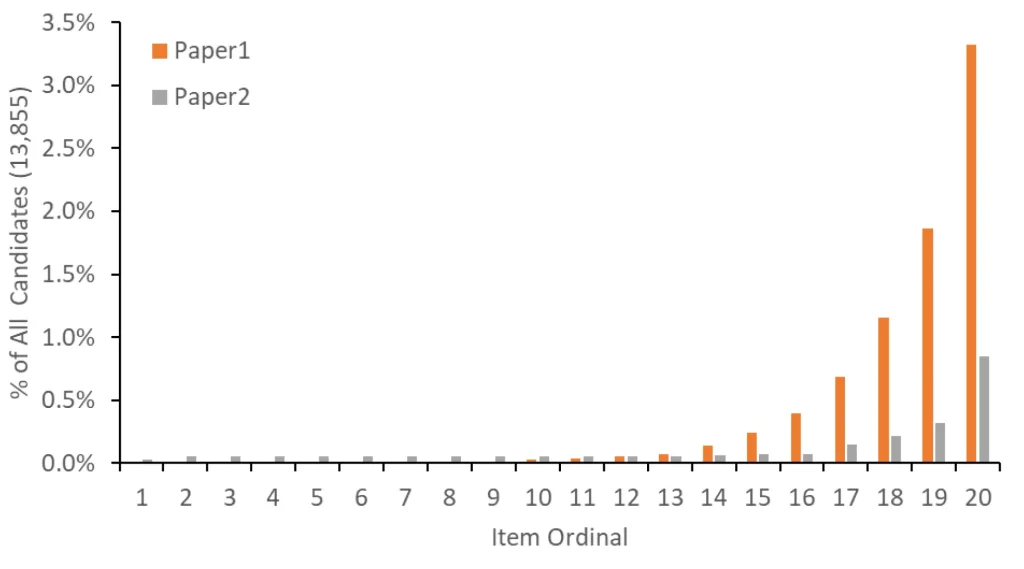
Percent of Unreached Items by Item Ordinal on TMUA Paper 1 and Paper 2 (2024/25 Application Cycle)
(Screenshot from the Official UAT-UK Report)
- The Real State of Time Consumption
The official report points out that the standard test time is 150 minutes, and among candidates who did not apply for special arrangements for extra time, the median time to complete the test is as high as 02:29:37. This indicates that the vast majority of candidates fight until the very last second under extreme pressure. - Data Support for the Breaking Point
More warningly, up to 23% (3,227) of candidates spent no more than 10 seconds on at least one question. The official body explicitly notes that this is highly likely because candidates completely froze under intense countdown pressure or when facing incomprehensible questions, ultimately being forced to blindly guess and submit their papers. For economics applicants accustomed to long essays and ample thinking time, if they have not developed muscle-memory-like mathematical deduction intuition under a high-pressure environment, it is extremely easy for their rhythm to collapse in front of the countdown.
3. The Complete Stripping of the Linguistic Shell
Many international students tend to attribute public test failures to “too many long and complex English sentences in the questions, unable to keep up with the reading speed”. However, the TMUA official technical data shatters this psychological suggestion.
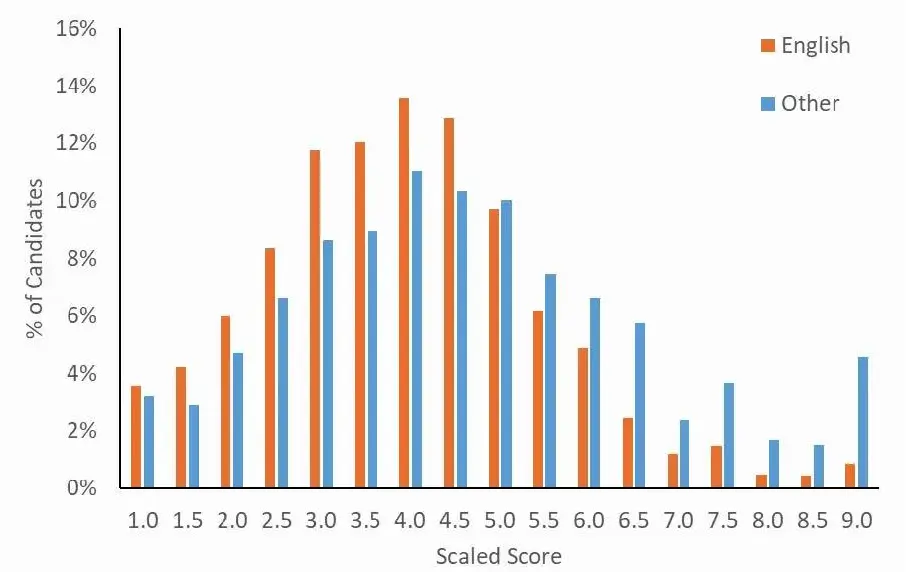
Comparison of Score Distributions by First Language: English vs. Other
(Screenshot from Official UAT-UK TMUA Techical Report, published in September 2025)
- Counter-Intuitive Data
The report shows that candidates whose first language is not English (average score 4.61) significantly outperformed native English-speaking domestic candidates (average score 3.94) in overall performance. - Underlying Logic
The official technical team explicitly states that the TMUA is a pure mathematics test with an extremely low language load. It strips away all linguistic narrative shells biased toward humanities and social sciences, directly measuring candidates’ logical proof capabilities and mathematical structuring abilities, which possess the strongest science attributes. This means that in this duel, there are no linguistic shelters to hide behind. Failing to stand firm in the 7.5-point minor peak area essentially reflects a shortcoming in the sharpness of the underlying mathematical logic.
Summary
The TMUA uses an extremely low macro average score, suffocating problem-solving time limits, and pure logical depth to constitute an efficient filter. It weeds out those applicants who merely pile up profiles using a humanities and business mindset, sending only those minds that can still deduce alongside top-tier science students under extreme high pressure into the final Cambridge Economics interview stage, which determines the final admissions.
IV. The Truth About Academic Interviews: What Kind of Brain Is Cambridge Economics Admissions Actually Looking For?
Having successfully withstood the crossover squeezing from top-tier science students in the TMUA, candidates finally stand before the professors of the Cambridge Economics Faculty to face their ultimate test before admissions.
Not a few students frantically memorise editorials from The Economist before the interview or prepare lengthy discourses to analyse current global inflation and monetary policy. However, this often encounters the most brutal instant exposure. Combining Cambridge University’s official interview guide with the logic of past exam questions, we can clearly see that what professors are truly looking for is by no means a “current affairs commentator”, but a young scholar possessing immense “cognitive flexibility”.
1. Shattering Illusions: Replacing Lengthy Discourses with Mathematical Modelling
The academic interview that determines final admissions for Cambridge Economics is, in essence, a mathematical deduction disguised as economics. Professors rarely ask open-ended questions like “how do you view a certain economic policy”, which easily succumb to rote memorisation.
Instead, they usually throw out a highly abstract micro-behaviour or social phenomenon, requiring you to construct a mathematical model on the spot. For instance, using a Game Theory matrix to deduce the pricing strategies of two firms, or using calculus to solve for utility maximisation under specific taxation conditions. What professors want to see is not how many business cases you have memorised, but whether you can precisely strip down and abstract complex human social behaviour into rigorous mathematical logic.
2. Core Assessment Yardstick: Teachability Under High Pressure
A Cambridge interview is actually a Supervision (Cambridge’s unique one-to-one or one-to-two tutorial) conducted ahead of time. In this high-pressure dialogue, the professor will deliberately keep modifying the underlying assumptions, for example: “What if we now introduce an incomplete information condition?” Your thinking will inevitably freeze; this is not only normal but is even deliberately engineered by the professor.
The ultimate yardstick determining final admissions to Cambridge Economics is your teachability. When you hit a deadlock, the professor will offer a hint. Can you swiftly comprehend this unfamiliar new variable, discard your previous inherent thinking, and re-derive the formula on the whiteboard? This ability to rapidly absorb new ideas in uncharted waters and resonate on the same frequency as top-tier scholars is precisely the core qualification Cambridge values most.
3. Economic Intuition: The Rapid Translation Capability Between Mathematics and Reality
If interviews for mathematics courses test the absolute limits of logic, economics interviews demand an additional layer: explaining the real-world significance of the data.
When you arrive at a result through complex differentiation, the interview is not over. The professor will immediately follow up: “What does this negative derivative, or this Nash equilibrium point, mean in real-life consumer behaviour?” A top-tier economic mind can not only push extreme deductions within pure scientific logic but can also translate mathematical language back into real-world economic intuition within a single second. This is the sole and true place where humanities and business literacy should come into play within this hardcore discipline.
Conclusion: Give Up Ineffective Internal Competition, Return to First Principles
In this article, we have peeled back the mild facade of Cambridge’s official website’s “no mandatory requirement for grades in economics”, and used the admissions funnel data dropping below 15%, the “economics minor peak” at 7.5 points in the TMUA, and the extremely hardcore academic interview logic to reconstruct the truest admissions selection thresholds of the Cambridge Economics course.
Having seen through this mechanism, we will understand a most foundational, brutal reality: to be successful in the admissions of Cambridge Economics, this is never a battle that can be won by throwing money at business competitions and piling up profile-enhancement projects.
When TMUA scores become the first life-and-death hurdle, and when a pure mathematics foundation and logical deduction become the passport to the interview, what you can least afford to waste is using these precious months to blindly prepare those humanities and business profiles that offer zero differentiation.
All strategies must be built upon an objective understanding of first principles. Instead of seeking a sense of security in homogenised business competition essays, it is better to immediately pivot to the battlefield that truly decides victory or defeat.
Regarding how to internalise threshold-crossing mathematical abilities into instinct under the brand-new UAT-UK test system, and how to scientifically plan the revision rhythm for the coming months, it is highly recommended to cross-read this practical guide:

Oxbridge Admissions Tests Reform: Is Your Preparation Timeline on Track?
Here, you can obtain high-simulation computer-based diagnostic exams exclusively developed by the teaching and research team at UEIE. Use a highly objective data diagnosis to pinpoint your current true combat power and kick-start the first step of scientific progression.
Follow Us on Wechat

- Categories Admissions Tests
- Tags Apply to Cambridge University, Economics Course, TMUA