




Oxford Cambridge Engineering Admissions Guide

UEIE Founder
Senior Oxbridge preparation mentor and Olympiad gold medal coach with nearly 20 years of international curriculum teaching experience. 55 students coached have received Oxbridge offers, with hundreds more gaining admission to G5 and Ivy League universities.
UEIE Founder
Oxford Cambridge Engineering Admissions Guide
Introduction
In engineering science applications for Oxbridge and the G5, a large number of top-tier academic overachievers holding straight A*s in both Mathematics and Physics confidently submit their applications every year, equipped with dazzling practical profiles filled with robotics, engineering innovation projects, and awards. They generally believe that extensive hands-on experience and creative passion serve as the stepping stone to Oxbridge. However, this completely deviates from the underlying selection logic of engineering admissions at Oxford and Cambridge. In the eyes of professors at prestigious universities, engineering is never an advanced “handicraft class”, but rather a hard-core science built upon abstract mathematics and physics.
So, through what kind of mechanism do elite universities precisely filter out these “hands-on experts”? Below, combining the latest official Oxford and Cambridge admissions data as well as the official UAT-UK report, I will take you directly to the true yardstick behind this top-tier engineering competition.
I. Homogenised A* Grades and Engineering Project Profiles are No Absolute Guarantee
If one merely stares at the admissions requirements on the official websites of universities like Oxford, Cambridge and Imperial College, many engineering applicants will develop the illusion that “not only do I meet the criteria, but my background is also highly enriched.”
1. The Overt Threshold: Inflated Academic Grades and Homogenised Practical Profiles
The standard entry threshold for engineering admissions at Oxford, Cambridge and Imperial College is typically A*A*A (explicitly requiring an A* in both Mathematics and Physics). For top academic high-fliers, submitting straight A* grades has long been a standard prerequisite for entry. To set themselves apart, countless students invest massive amounts of time and money into extracurricular practices, attempting to build a hard-core CV: such as VEX/FRC robotics competition awards, drone design, or even Formula racing projects.
However, when these immensely time-consuming experiences have already become standard configurations in the application pool, they merely prove your passion for engineering and can by no means serve as an absolute guarantee to make you stand out. What professors truly value is whether the candidate possesses top-tier mathematical and physical analytical derivation capabilities.
2. Hidden Barrier I: An Extremely Hard-core Further Mathematics Foundation
Under the Oxbridge academic system, the core task of engineering is to use higher mathematical tools to model physical systems. Therefore, the first hidden barrier is the intense craving for Further Mathematics. Although the wording on some university websites is “Highly Recommended”, in actual admissions, candidates who secure an offer are almost entirely decorated with an A* in Further Mathematics. Without undergoing high-intensity training in calculus, complex numbers, and mechanics modules during the high school stage, it is simply impossible to survive the mechanics and electromagnetism derivations that are saturated with complex formulae upon enrolment.
3. Hidden Barrier II: The ESAT Module Combination Congested by 72% of Applicants
When standardised academic grades and extracurricular projects lose their differentiation power, Oxbridge unleashes the second barrier—the ESAT. Applicants for engineering courses (excluding Chemical Engineering and Design Engineering at Imperial College, and Electronic and Electrical Engineering and Mechanical Engineering at UCL) are compulsorily required to select three modules in the ESAT: Mathematics 1 + Mathematics 2 + Physics. Among nearly 12,000 applicants globally, up to 72% (8,564 people) chose this specific module combination. This means that engineering applicants must compete on the same stage with top science students from across the UK and the globe who are applying for Physics and Natural Sciences.
Closely observe these three score distribution charts recently released officially:

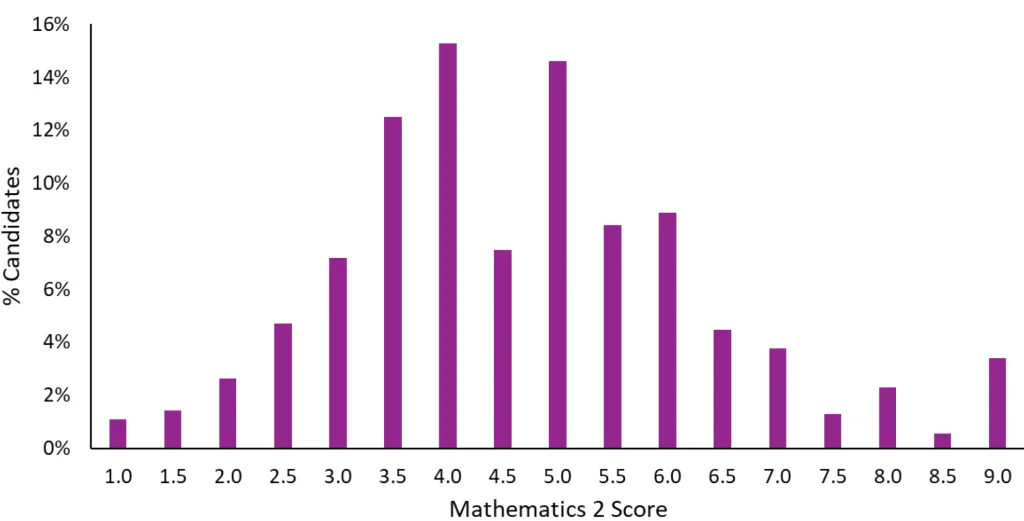
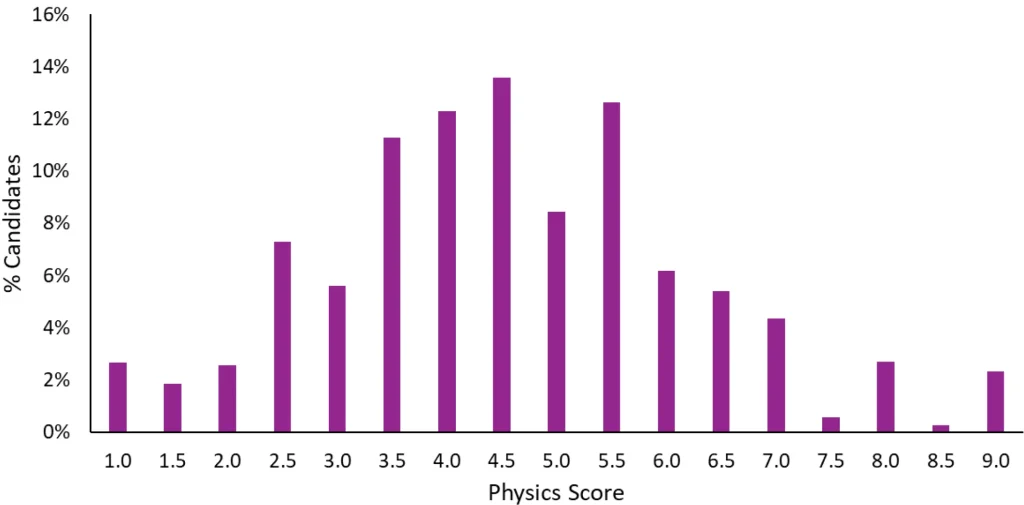
Global Score Distribution for ESAT Maths 1, Maths 2, and Physics — October 2025
(Screenshot from the Official UAT-UK Report)
It is not difficult to see that their distributions exhibit the following characteristics:
- The 4.0–5.0 Cannon Fodder Layer
Whether it is Mathematics 1, Mathematics 2, or Physics, nearly one-third of the candidates’ scores are piled up between 4.0 and 5.0 marks, forming a massive main peak. - The Rapidly Declining Right-hand Long Tail
Starting from 6.0 marks, the bar chart experiences a cliff-like drop. Many applicants assume that scoring 6.5 or 7.0 makes them outstanding, however, in the fiercely competitive arena of engineering—where elites clash—this score merely represents a tentative crawl out of the quagmire of mediocrity. - The Extreme Upturn at 9.0 Marks
At the far-right end of the charts (especially in Mathematics 1 and Mathematics 2), a highly conspicuous slight rebound (upturn) appears in the perfect 9.0 score bracket, showing that the mathematical strength of top-tier academic wizards cannot be underestimated.
II. The Oxford & Cambridge Engineering Admissions Funnel and 62% Elimination Rate
Next, let us examine how this screening mechanism operates in actual admissions. The following two charts show the engineering admissions trends for Oxford and Cambridge compiled by UEIE based on official data from the past decade (2014–2023):
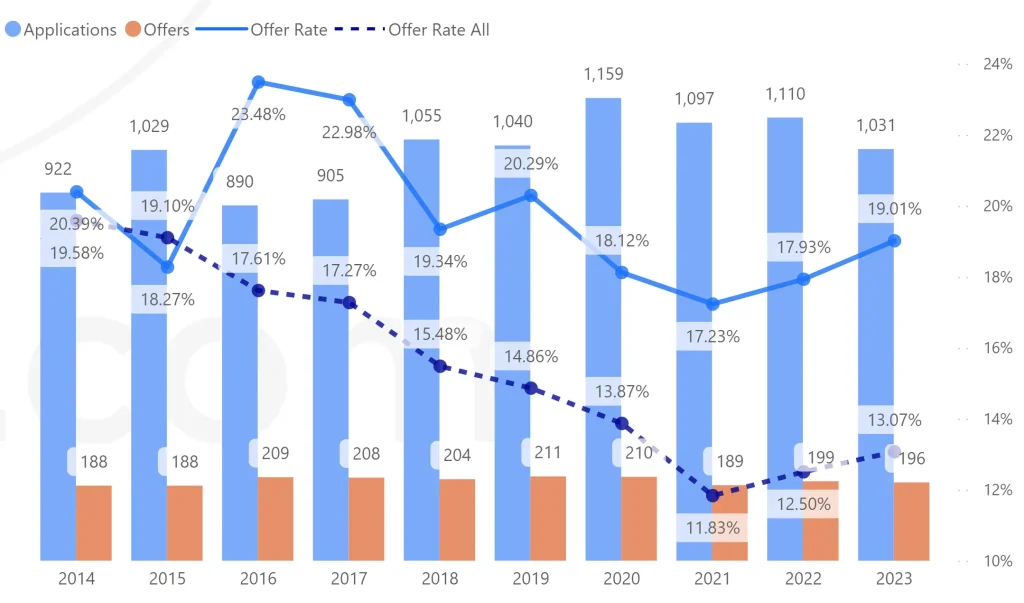
Engineering Science Admissions Data at Oxford during 2014–2023 Application Cycles
(Plotted by UEIE based on official data)
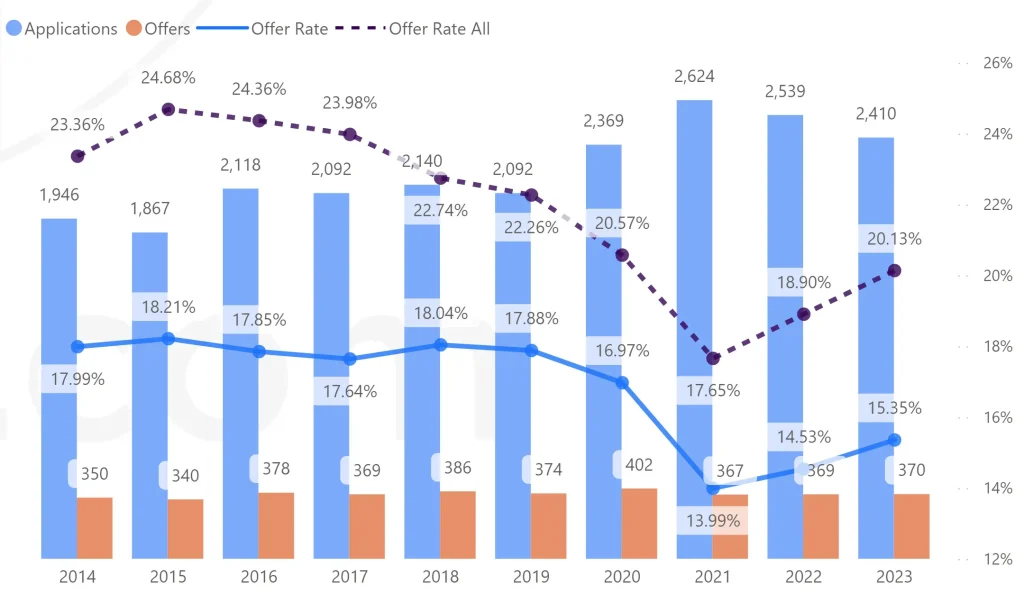
Engineering Admissions Data at Cambridge during 2014–2023 Application Cycles
(Plotted by UEIE based on official data)
These two charts clearly reveal the surging popularity and tightening admissions thresholds of Oxford and Cambridge engineering courses:
| Cambridge Engineering | The number of applicants rose steadily from 1,946 in 2014 to 2,410 in 2023. Diluted by this massive base, the offer rate fluctuated downwards from an initial 17.99%, being compressed firmly to a low of 15.35% by 2023. |
|---|---|
| Oxford Engineering Science | Over the past decade, Oxford Engineering received a total of 10,238 applications, yet the overall shortlisting rate stood at a mere 43.23%. This implies that over the past ten years, more than half of the applicants failed to even knock open the gates to the interviews. |
To give you a more intuitive sense of this brutal layer-by-layer filtering mechanism, I have constructed the interactive chart below, “Comparison of Oxford & Cambridge Engineering Admissions Funnels”, based on the latest data of 2023/24 application season. You can try selecting engineering at Oxford and Cambridge on the left and right sides, and toggle the gender dimensions (All/Women/Men) to experience first-hand the cliff-edge elimination demonstrated by the admissions funnels:
From the ten-year admissions trends and the latest funnel charts, we can extract two objective logic paths in the application process of Oxford and Cambridge engineering courses:
1. Extremely Steep Pre-emptive Slaughter
Oxford University’s four-stage admissions funnel reveals to us the incredibly shocking pre-emptive elimination rate of its admissions test (known as the PAT prior to 2026).
Taking the latest data for male applicants in Oxford Engineering Science as an example, out of 2,428 applicants who held almost straight A*s, ultimately only 924 individuals received interview invitations (Shortlisted). This means that a whopping 61.9% of top-tier academic aces were directly “slaughtered” in the first round of screening, without even gaining a chance to showcase their engineering projects and practical skills to the professors.
This thoroughly validates our conclusion in Section I: when academic grades are thoroughly inflated, admissions tests become the universities’ most efficient filter.
2. Unveiling the Absolute Reality of the Gender Perspective
Due to the traditional gender imbalance in engineering courses, many parents pin their hopes on the universities’ “gender diversity” policies, believing that female applicants will enjoy a massive “grade-lowering dividend”. This impression does indeed find some support in the data, but it is by no means set in stone.
- Final Offer Conversion
Looking at the ultimate conversion rates, the probability for female applicants’ admissions is indeed slightly higher (for instance, the offer rate for female Oxford Engineering applicants is 19.1%, which is overall higher than the 17.9% for males; the offer rate for female Cambridge applicants is 18.5%, higher than the 14.5% for males). - Overall Interview Shortlisting
Although Cambridge Engineering theoretically does not release official gender-disaggregated data for the preliminary screening round, based on my observations over the years, female applicants often receive a certain degree of leniency regarding the written test score threshold for interview invitations compared to males. However, female applicants applying for Oxford Engineering have not enjoyed much of an advantage—they similarly face a steep, cliff-edge elimination rate of up to 62.6%.
This implies that when applying for Oxford Engineering, regardless of gender, it is absolutely impossible for the hurdle of the admissions tests to experience any substantive loosening based on sex. As for Cambridge Engineering applications, even if female candidates gain a certain head start in entering the interview round, they will still, with a high probability, be filtered out during the excruciatingly brutal academic interview phase if they lack the matching rock-solid capability.
III. The Ultimate Challenge Behind the ESAT Data Distribution
As the unified admissions tests completely taking over engineering admissions for both Oxford and Cambridge, the ESAT is by no means a conventional academic proficiency test. Complemented by the latest data published by UAT-UK, we can deconstruct the following three layers of selection logic:
1. Extremely Low Global Average Scores and the Cliff-Edge Hyper-competition among Chinese Academic Aces
Comparison of ESAT Module Scores: Chinese vs. UK Candidates (2024/25 Application Cycle)
| Module | Country or Region | Number of Candidates | Average Score | 25th Percentile | 50th Percentile | 75th Percentile | 90th Percentile |
|---|---|---|---|---|---|---|---|
| Maths 1 | UK | 6031 | 3.93 | 3.1 | 3.9 | 4.8 | 5.6 |
| China | 2568 | 5.91 | 4.7 | 5.8 | 7.1 | 8.5 | |
| Maths 2 | UK | 4929 | 4.07 | 3.1 | 4.1 | 5.0 | 5.7 |
| China | 2197 | 5.68 | 4.5 | 5.6 | 6.8 | 8.2 | |
| Physics | UK | 4657 | 4.15 | 3.2 | 4.1 | 5.0 | 6.0 |
| China | 1961 | 5.58 | 4.5 | 5.6 | 6.8 | 8.0 |
* Source: UAT-UK Official Report
The data distribution in the table above not only shatters the illusion that “straight-A* students can breeze through effortlessly”, but also reveals the brutal ecology of the arena in which Chinese candidates find themselves:
- Chinese candidates exhibit overwhelming dominance across all modules.
- In Mathematics 1, the average score for British candidates is a mere 3.93, whereas the average score for Chinese candidates is as high as 5.91.
- The 90th percentile (i.e., top 10%) data for Chinese candidates is even more staggering: reaching 8.5 marks in Mathematics 1, 8.2 marks in Mathematics 2, and 8.0 marks in Physics.
This implies that the engineering programmes at Oxford and Cambridge aggregate a cluster of minds with the strongest mathematical and physical capabilities; consequently, for Chinese students aspiring to gain admissions in this track, global average level holds absolutely zero reference value. If you only score 6.0 or 6.5 marks, you will not only fail to stand out among your peers, but will instead be directly drowned out by the long tail of scores forced upwards by elite Chinese applicants. In the engineering arena, the “safety line” for Chinese candidates starts at 8.0 marks.
2. 52% "Blind Guess" Collapse Rate: "Speed Slaughter" Under Extreme Time Pressure
One of the core objectives of the engineering discipline is to find the optimal solution within given constraints of resources and time. The ESAT format pushes this examination of “efficient algorithms” to the absolute extreme: 40 minutes per module to handle 27 multiple-choice questions, averaging less than one and a half minutes per question!
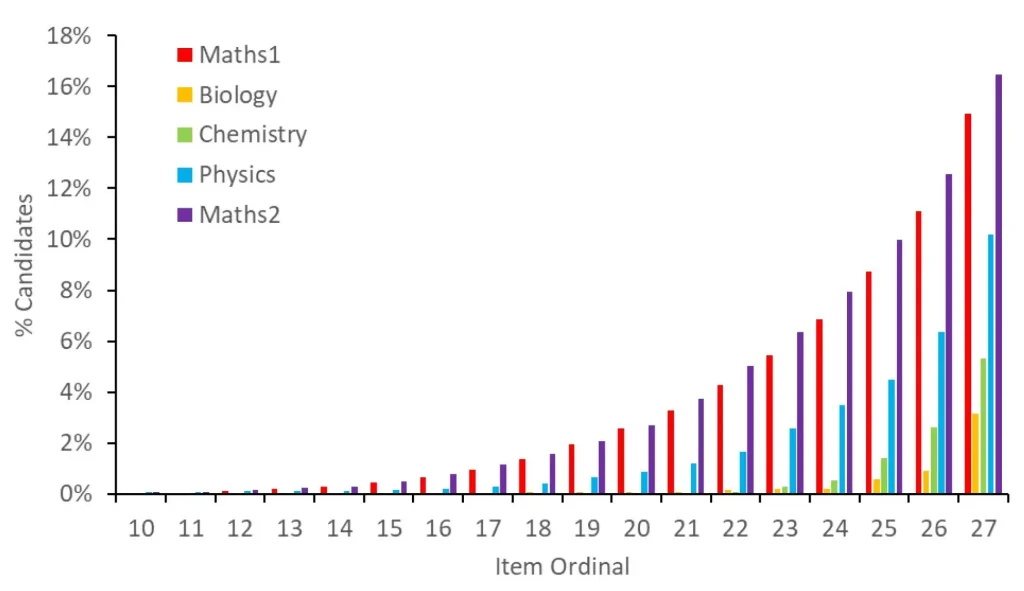
Percentage of Candidates Failing to Reach Questions by Item Ordinal Across ESAT Modules
(2024/25 Application Season)
- Hell-mode Mathematics 2
The official technical report released in September 2025 explicitly points out that this module was overly difficult for the majority of candidates. Data shows that up to 52% of candidates experienced a complete breakdown in this module, classified as “running out of time or being forced to blind-guess and submit within 5 seconds (Unreached/Low Time)”. - Suffocating Time Depletion for All
Not only in Mathematics 2, but even in the compulsory Mathematics 1, 46% of candidates fell into blind guessing before the countdown ended; this proportion was also as high as 31% in the Physics module.
This means that if you continue to employ the high school habit of brute-force calculation or step-by-step compliance in the exam hall, you will inevitably face time depletion and a comprehensive rhythm collapse when confronted with such a dense volume of questions. What the ESAT aims to identify is precisely those top-tier contenders who, under extreme high pressure, can still uncover efficient algorithms and instantaneously grasp the physical essence of a problem.
3. Complete Stripping of the Language Shell: No Excuses Allowed
Following admissions tests setbacks, many domestic international students habitually blame the outcome on the excuse that “the questions contained too many long and complex English sentences to finish reading within 40 minutes.” However, the underlying technical data provided officially brutally shatters this self-consolation.
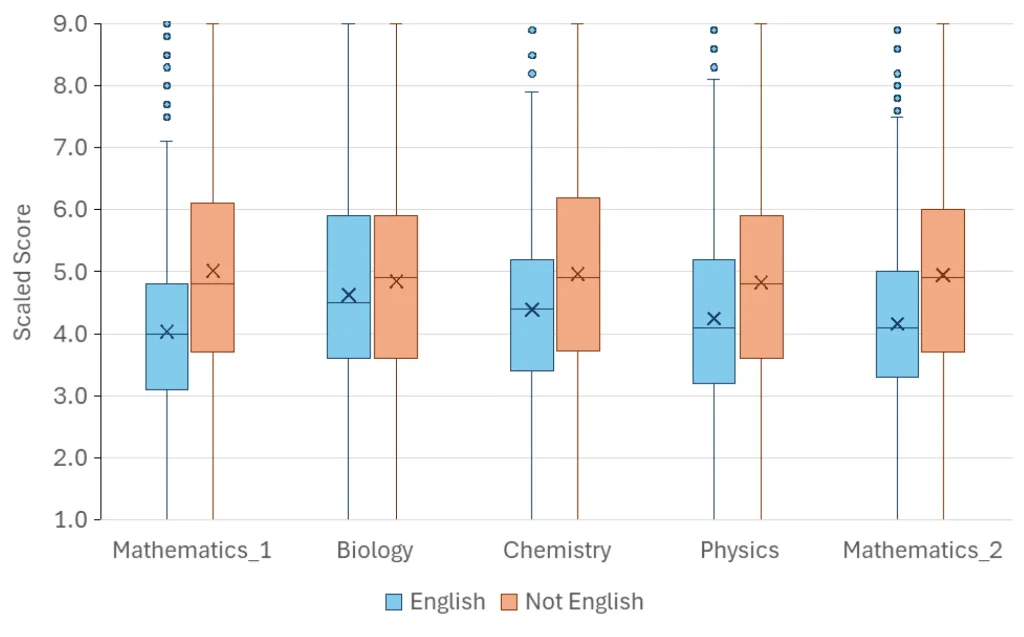
Comparison of Score Distribution by First Language: English vs Others
(Screenshot from the Official UAT-UK ESAT Report Released in September 2025)
- Counter-intuitive Data
The report demonstrates that candidates whose first language is not English (with an average score of 5.01 in Mathematics 1) significantly and comprehensively outperform native English-speaking local candidates (who averaged 4.03 in Mathematics 1) in global performance. - Underlying Academic Logic
The ESAT belongs to a typical “low language load” test category.
This implies that in this hard-core science showdown, there are absolutely no excuses regarding language disadvantage to be found. Failing to break into the absolute high-score bracket above 8.0 marks fundamentally indicates that one’s mathematical and physical foundations are not solid enough, and that shortfalls exist within one’s computational thinking.
Summary
In essence, the ESAT serves as a highly efficient filter. It screens out those “engineering enthusiasts” who rely solely on profile packaging and lack a hard-core mathematical and physical foundation, sending only those “engineering scientists”—who can still step up to perform analytical derivations alongside top science wizards under extreme compression—into the final interviews.
IV. The Truth About Academic Interviews: What Kind of Brains Are Oxford and Cambridge Engineering Admissions Actually Looking For?
Having crossed the hurdle of the admissions test, the successful applicants finally get to sit before professors from the Oxford and Cambridge engineering departments. So, what kind of candidates are the professors actually seeking?
The official interview guidelines from the Oxbridge engineering departments and public feedback from senior tutors indicate that the sole objective of the interview is to assess your “fluency in physics and maths” under extreme high pressure, alongside your ability to “apply existing knowledge methodically to new situations”.
The core of the above lies in the following three layers of selection logic:
1. Live Modelling: Instantaneously Mathematising Physical Concepts
The Oxbridge engineering department interviews will absolutely never test any pre-memorised engineering common sense; on the contrary, the interview will directly present mathematical or physical problems.
The most frequent interview format adopted by professors is to casually toss you a highly representative physical or mechanical entity. For instance, a classic real question provided officially by Oxford University: “Consider the engineering design of a vertical faced gravity dam wall.” Or, “A uniform beam is supported at two points; how does its bending moment vary along its length?”
Professors do not expect you to recite any ready-made, polished final answers from memory. What they value is whether, during the live interactive dialogue, you can acutely and cohesively “translate” intricate, real-world physical issues—such as gravity, water seepage, and overturning moments—into pure mathematical formulae composed of calculus and second-order differential equations.
2. Extreme Pressure Resistance: The Ultimate Test of Teachability and Reasoning Agility
The underlying essence of an Oxbridge interview is, in fact, a miniature Tutorial/Supervision (the small-group tutorial system unique to Oxbridge). This is an academic screening specifically designed to verify whether you can “thrive in the learning environment” under such immense academic intensity.
During the interview, once you present an initial model, the professor will inevitably intervene and redirect you. They will continuously introduce brand-new variables completely transcending the high school syllabus onto the whiteboard (such as non-linear deformation of materials, non-negligible soil failure, etc.). Under such extreme pressure cooker conditions, even the finest candidates are bound to get stuck.
Oxbridge admissions officers explicitly emphasise that they are by no means averse to seeing candidates hit a deadlock; on the contrary, this is precisely where the test begins. When your derivation halts and the professor timely drops a minor hint, can your rapidity in thinking and reasoning keep pace with the academic’s cognitive bandwidth? Can you swiftly assimilate new concepts, comprehend the guidance, and immediately execute calculations to debug on the whiteboard? This capacity for real-time error correction under high uncertainty is the sole yardstick for passing.
3. Discarding the Exam Machine: The Granularity of Thinking Aloud
In the interview selection process, the most fatal strategic blunder is not miscalculating a formula, but sinking into a “dreadful silence” upon hitting a cognitive bottleneck.
Just as emphasised repeatedly in Oxford University’s official interview guidance handbook: professors most despise the sort of “exam machine” that calculates frantically in silence and eventually just flings out a seemingly correct result; they are looking for students who dare to Think Aloud and fully lay out their line of thought.
Is the underlying logical chain of your reasoning complete? What kind of breakthrough strategies do you possess when facing unfamiliar scenarios? Do you possess rigorous self-skepticism and intuitive reactions when you discover you have botched your stress analysis? Within the holistic assessment framework of Oxford and Cambridge, if you display the mathematical and physical flexibility on the academic whiteboard that only top-tier engineering scientists possess, even if you ultimately commit a minor clerical slip in specific numerical calculations, the gates to these prestigious elite institutions—with an admissions rate hovering at a mere 15%—will still swing wide open for you.
Conclusion: Abandon Ineffective Hyper-competition, Return to First Principles of Mathematics and Physics
In this article, we have peeled back the official website’s pleasantry of “welcoming extensive practical experience”, restoring the truest selection thresholds of Oxford and Cambridge engineering departments: from Oxford’s staggering 62% pre-emptive admissions test elimination rate, to the high 52% blind-guessing collapse baseline in the ESAT Mathematics 2 module, all the way to the extreme assessment of live mathematical modelling such as gravity dam design during academic interviews.
Having seen through this brutal set of rules, we can deduce a foundational strategic positioning: pursuing for engineering admissions at Oxford and Cambridge is never a physical battle that can be won by “pouring money into piling up robotics projects” or “assembling a drone at the eleventh hour”.
Since admissions test scores represent the first life-or-death pass for position-grabbing, and the “applied mathematical modelling” and “extreme real-time error-correction capability” evaluated during interviews are by no means skills built overnight, what you can least afford to waste in this application season—where competitive intensity has shattered historical records—is squandering these precious few months, or even a year or two, blindly trial-and-erroring through those “homogenised profiles” completely devoid of differentiation.
All strategies must be established upon an objective awareness of one’s own true science capabilities. Rather than searching for a false sense of security amidst blind project piling, it is better to first figure out the cards held in your own hand.
Regarding how to internalise the threshold-crossing mathematical and physical intuition into problem-solving instincts under the brand-new unified examination framework, as well as how to scientifically plan your revision rhythm over the coming months, it is highly recommended to cross-read this practical guide:

Oxbridge Admissions Tests Reform: Is Your Preparation Timeline on Track?
In this article, you can acquire highly simulated computer-based diagnostic exams exclusively developed by the UEIE teaching and research team. Utilise a highly objective data diagnosis to pinpoint your current true combat power, unlocking the first step towards a scientific upgrade.
Follow Us on Wechat